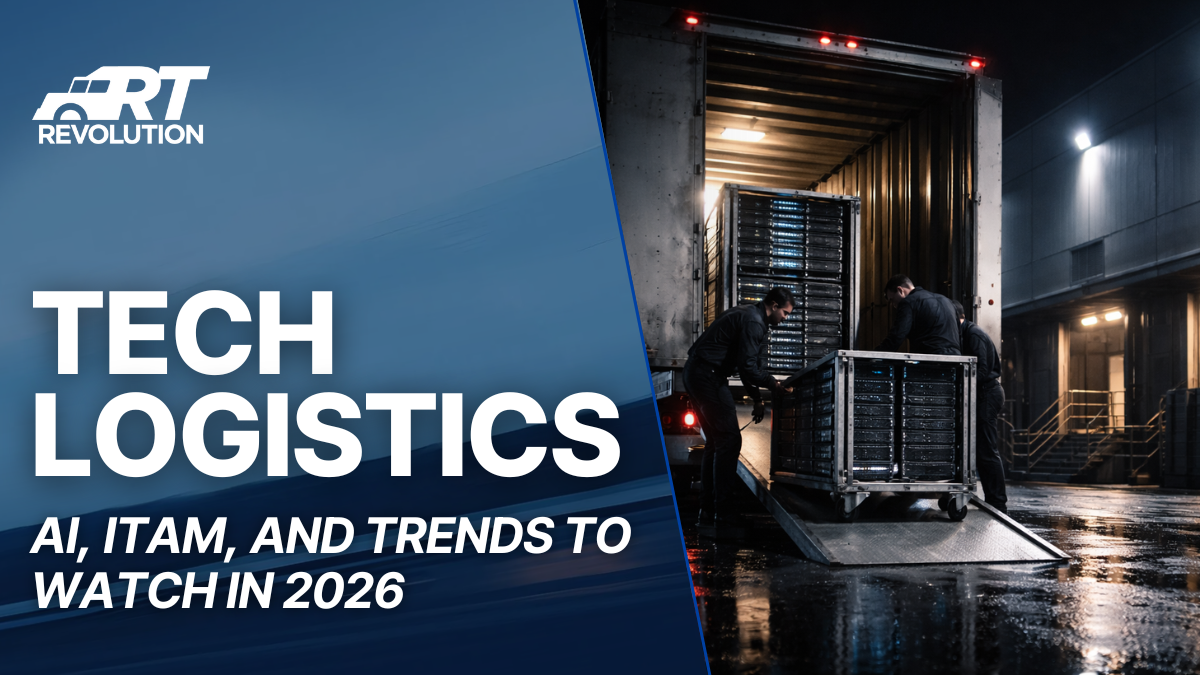
Introduction: Why Tech Logistics Actually Matters in 2026
By 2026, logistics is no longer about moving boxes from point A to point B. It’s about tech logistics: the orchestration of systems, controls, and accountability required to move high-value, data-bearing IT assets safely through their entire lifecycle
This shift is not theoretical. It is being driven by three structural realities that logistics leaders can’t ignore. Hardware refresh cycles have compressed dramatically, with laptops, servers, and edge devices now turning over every 18–36 months instead of every five to seven years. At the same time, regulatory scrutiny around data security, ESG reporting, and chain-of-custody documentation has intensified. Layered on top of that is a simple operational truth: IT assets now move across more locations, more vendors, and more hands than ever before.
For leaders tracking logistics trends in 2026, the core question has changed. It is no longer “How do we ship faster?”
It is “How do we prevent loss, exposure, and downtime, at scale?”
That question is what elevates tech logistics, anchored in IT asset management (ITAM) and IT asset disposition (ITAD), from a back-office function to a board-level concern.
Macro Tech Logistics Trends to Watch in 2026
Digitization and Automation in Logistics: Eliminating Blind Spots
Automation in logistics is often misunderstood. It is not primarily about robots, autonomous vehicles, or futuristic warehouses. In practice, automation in 2026is about removing blind spots from complex asset movements.
Historically, many logistics programs relied on manual bills of lading, spreadsheet-based tracking, and after-the-fact exception reporting. These approaches break down when assets are high-value, data-bearing, and time-sensitive. The problem isn’t speed, it’s visibility.
Modern digitized logistics systems replace assumptions with verification. Serialized scans at every handoff establish an unbroken record of custody. Real-time location verification confirms not just that an asset is moving, but that it is moving where it is supposed to move. Exception alerts are triggered by deviation from plan, not by missed delivery windows.
A delayed server shipment is often recoverable. A server that quietly deviates from its approved route is a risk event. The difference between the two is visibility, and that visibility is what automation actually delivers.
When planning, execution, compliance, and billing all draw from the same live data, efficiency compounds instead of fragmenting.

Building Resilient Supply Chains: Designing for Failure
Supply chain disruptions are no longer edge cases. Weather volatility, labor constraints, border slowdowns, and component shortages are now routine operating conditions.
In this environment, resilience is not about reacting faster after something breaks. It is about detecting instability early enough to intervene.
Resilient supply chains in 2026 are intentionally designed with redundancy and decision authority built in. Carrier diversification prevents single-point failures. Pre-approved alternate routes eliminate the need for ad-hoc approvals under pressure. Most importantly, exception ownership is clearly defined.
Organizations that perform well under stress do not treat exceptions as shared problems. They assign ownership immediately, with clear authority to act inside a defined decision window. That governance model—not just technology—is what prevents small disruptions from cascading into major incidents.
Sustainability and Green Logistics: From Reporting to Operations
Sustainability has moved out of annual reports and into daily operational constraints. Carbon disclosure requirements and customer expectations now force organizations to measure impact continuously, not retrospectively.
In tech logistics, this shows up in practical ways. Lane-level emissions modeling replaces generic averages. IT refresh programs are designed to include redeployment and reuse instead of default replacement. ITAD shifts from being a disposal expense to a value-recovery function with measurable outcomes.
Green logistics in 2026 is not about signaling values. It is about operating efficiently under environmental and regulatory constraints. Waste costs money. Unnecessary replacement costs even more.

IT Asset Management (ITAM) Trends for 2026
Predictive Analytics in ITAM: Preventing Downtime Before It Happens
IT asset management has evolved from inventory tracking into operational forecasting. Organizations with mature ITAM programs no longer wait for assets to fail before acting.
By analyzing asset age, usage intensity, warranty coverage, and historical failure patterns, teams can plan refresh cycles during controlled windows instead of reacting during outages. This reduces downtime, eliminates emergency shipping, and stabilizes operating costs.
AI in ITAM plays a specific role here. It does not replace human judgment. It narrows the decision space by surfacing the few actions that matter most, based on thousands of prior asset histories. The result is better timing, not just better data.
Hybrid and Cloud-Based ITAM Solutions: One System of Record
With assets spread across data centers, branch offices, and remote employees, fragmented tracking has become a material liability.
Cloud-based ITAM platforms provide a unified system of record that spans environments. That visibility supports purchasing discipline, simplifies audits, and improves financial forecasting. More importantly, it ensures that logistics execution and IT governance are working from the same underlying truth.
When asset data is consistent, logistics decisions become faster and safer.
Compliance and Data Security in ITAM: Built In, Not Bolted On
Most compliance failures do not stem from malicious intent. They stem from missing documentation and broken handoffs.
In 2026, compliance-ready ITAM systems treat documentation as a byproduct of normal operations. Custody transfers are logged automatically. Actions are tied to serial numbers, not just product categories. ESG and regulatory reporting is generated from live data rather than manual reconciliation.
When auditors ask questions, answers already exist, because compliance was designed into the workflow, not layered on afterward.

IT Asset Disposition (ITAD) Trends for 2026
Secure IT Asset Disposal: Chain of Custody as Risk Control
End-of-life assets represent maximum risk at minimum visibility. Devices leaving service still contain sensitive data, yet they often move through the least controlled parts of the supply chain.
Best-in-class ITAD programs treat chain of custody as a security control, not a logistics detail. Assets are serialized, tracked from pickup to destruction, routed through verified facilities, and documented with certificates of destruction tied directly to each device.
Without this level of rigor, organizations are relying on assumptions, and assumptions do not hold up under regulatory or reputational scrutiny.
Remote ITAD Logistics: Control Without Centralization
Remote work permanently altered asset flows. Devices no longer funnel neatly back to a central office at end of life.
Remote ITAD programs—mail-back, local collection, or distributed pickup—can work, but only if control standards remain consistent. Chain-of-custody requirements cannot degrade simply because assets are dispersed. Data handling procedures must be identical, and accountability must remain centralized.
Convenience without control does not eliminate risk; it delays its consequences.
Sustainability in ITAD 2026: Recovering Value and Proving Impact
Sustainable ITAD programs focus on hierarchy, not disposal. Assets are refurbished and redeployed where feasible. Recycling is reserved for what truly cannot be reused.
This approach reduces environmental impact while recovering residual value. When tracked properly, ITAD becomes a measurable ESG contributor rather than a sunk cost.

Technology Shaping the Future of Logistics
AI in Logistics 2026: Exception Management as an Operating Discipline
AI only becomes meaningful in logistics when it compresses the time between signal, decision, and action. In 2026, the most valuable AI applications are not focused on automation for its own sake, but on managing exceptions before they turn into outages, security incidents, or contractual breaches.
In practice, this means AI systems are continuously comparing live shipment data against an expected operating model: approved routes, custody timelines, handoff locations, and asset-specific risk profiles. When something deviates—an unexpected dwell, an unscheduled route change, a missed scan—AI does not simply flag the issue after the fact. It surfaces the deviation in real time, ranks its risk based on asset type and exposure, and recommends a constrained set of corrective actions.
For example, a delayed shipment of generic hardware may require no intervention. A delayed or misrouted shipment containing serialized servers tied to a data-center deployment window is a materially different event. AI helps logistics teams distinguish between noise and risk, so human operators can act decisively inside a shrinking decision window.
This is why the goal is not full automation. Logistics still requires judgment. AI’s value lies in containment, preventing small deviations from cascading into downtime, data exposure, or compliance failures.
Cloud and IoT: Making Logistics Verifiable, Not Just Visible
Cloud platforms and IoT sensors have fundamentally changed what “visibility” means in logistics. In earlier systems, visibility often meant periodic status updates or estimated delivery times. In 2026, visibility is about verification.
IoT devices provide continuous data on location, movement, and condition, while cloud platforms aggregate that data into a shared operational view accessible to logistics, IT, security, and compliance teams simultaneously. This matters because most logistics failures are not caused by missing information, but by disconnected information. When different teams are working from different versions of reality, delays compound and accountability blurs.
With a unified cloud-based control layer, handoffs are no longer assumed, they are confirmed. Routes are no longer implied, they are verified. When exceptions occur, they are visible to all stakeholders at the same time, eliminating lag between detection and response.
The result is not just smoother execution, but fewer internal escalations, cleaner audits, and higher trust between logistics providers and enterprise customers.
Reverse Logistics and Control Towers: Managing the Full Asset Lifecycle
Reverse logistics has moved from a secondary concern to a strategic capability, particularly in environments dominated by IT refresh cycles and distributed workforces. In 2026, the return, redeployment, and disposition of assets carries the same operational and security weight as outbound deployment.
Modern logistics control towers now present forward and reverse flows together, allowing organizations to manage the entire asset lifecycle as a single system rather than a series of disconnected events. This unified view enables tighter coordination between deployment schedules, refresh planning, redeployment opportunities, and ITAD execution.
For example, assets returning from a regional office closure can be evaluated in real time for redeployment versus disposition, based on age, condition, and upcoming demand elsewhere in the network. Without a control tower view, those decisions are delayed, assets sit idle, and unnecessary replacements are ordered.
When reverse logistics is integrated into the same operational model as outbound movement, organizations reduce waste, recover value, and maintain control over data-bearing assets even as they exit service.
This lifecycle-level visibility is what turns logistics from a cost center into a strategic operating function.

Revolution’s Approach to Tech Logistics and ITAM/ITAD
Compliance-First Secure Data Disposal Logistics
Revolution Trucking designs ITAD programs around accountability rather than volume. Serialized scans at every handoff and GPS-verified routes ensure that security and compliance are not assumed, they are proven. By integrating ITAM data directly into logistics execution, Revolution helps clients plan refresh cycles proactively, reduce emergency shipments, and align deployment with decommissioning. The result is a closed-loop lifecycle, from rollout to retirement, managed under one operational framework. Whether executing a national server rollout or coordinating a distributed laptop recovery, Revolution acts as an orchestration partner. Carriers, systems, compliance requirements, and reporting are aligned under a single operating model designed for scale, security, and sustainability.
Preparing Your Supply Chain for 2026 and Beyond
Organizations preparing for the future treat asset data quality as an operational KPI, assign explicit ownership for exceptions, and design reverse logistics into every rollout and refresh plan from the start.
Conclusion: From Buzzwords to Operational Advantage
The future of logistics is not louder technology. It is better control.
By aligning IT asset management and IT asset disposition with real operational ownership, organizations reduce risk, improve sustainability, and gain predictability in an increasingly complex environment.
At Revolution, tech logistics isn’t a trend. It’s the operating model, and it’s built for what comes next.
other blog posts

%2520(3).webp)


%2520(1).webp)