The Real Cost of a Freight Failure in Manufacturing
A $340 freight invoice can trigger $10,000+ in real costs when a shipment fails. Learn how to calculate the hidden freight costs manufacturers absorb from delays, damage, expedites, and production schedule disruptions.

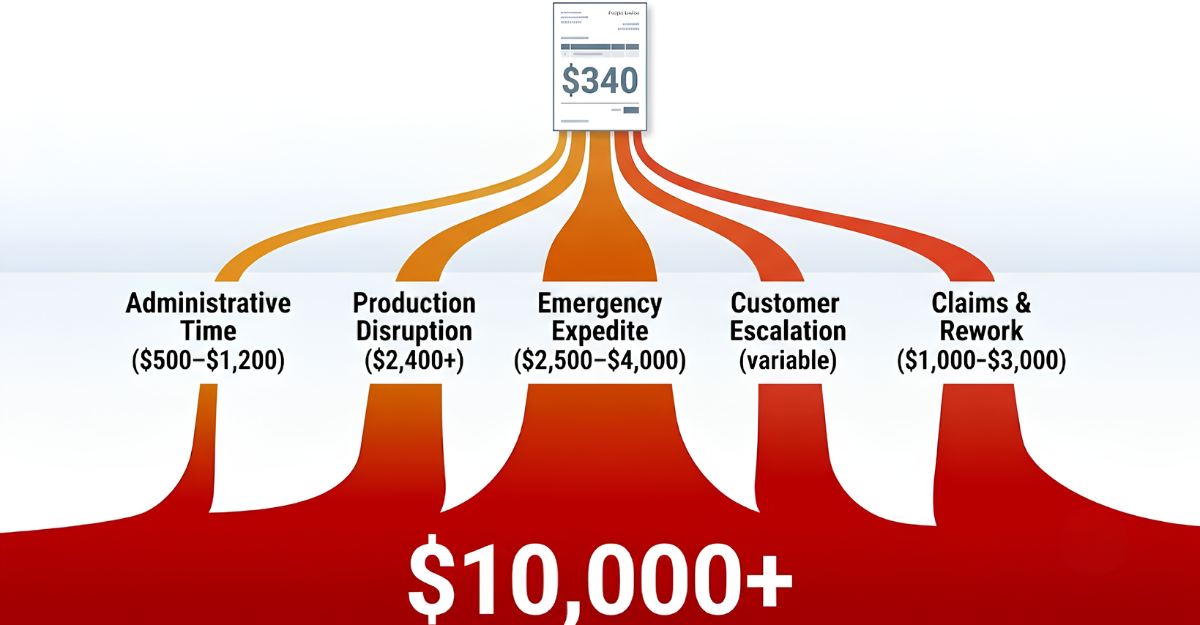
A precision component ships standard LTL. The rate is reasonable. Pickup happens on time. Everything looks routine on the tracking screen — until the shipment misses its dock appointment. Delivery slips two days. Those two days hold an inspection window. The inspection window pushes an assembly start three weeks. The freight invoice reads $340. The actual cost to the manufacturer exceeds $10,000.
This is not an unusual scenario. It is an unremarkable Tuesday for a distressing number of machine shops, tooling manufacturers, and precision component producers across the Midwest and beyond. The shipment "failed" in the narrowest sense — it arrived late — but the cost of that failure radiated outward through production scheduling, customer communication, expedited recovery, and administrative overhead in ways that never appeared on the freight bill.
Most manufacturers manage production costs with exceptional rigor. Cycle times are measured in seconds. Material yields are tracked to fractions of a percent. Tooling wear is monitored and predicted. But freight — the function that connects raw materials to the production floor and finished goods to the customer — is frequently managed as a commodity purchase where the lowest bid wins. The reason is straightforward: the cost of a freight failure is invisible until it happens, and when it happens, the expense is absorbed across departments rather than attributed to the shipment that caused it.
This article makes those costs visible before the next shipment moves.
What Shows Up on the Invoice (and What Does Not)
The Visible Cost: Freight Price
The price of a shipment is the number that appears on a rate confirmation or freight invoice. It includes the line-haul rate, fuel surcharge, any accessorial charges (liftgate, inside delivery, appointment scheduling), declared value coverage, and packaging materials. This is the number procurement teams compare when selecting carriers, and it is the number that drives most freight decisions in manufacturing environments.
The visible cost is real, and managing it matters. Manufacturers operating on 8 to 15 percent margins cannot afford to overspend on transportation. But the visible cost creates an illusion: because it is the only number attached to the shipment, it appears to be the total cost. It is not. It is frequently the smallest portion of what a failed shipment actually costs.
The Invisible Cost: Freight Failure
The invisible cost only materializes when something goes wrong — and in freight operations handling precision manufactured goods, the failure rate is higher than most shipping coordinators realize. Industry data indicates that standard LTL shipments experience damage ratios between 1 and 2 percent, and on-time delivery performance for many LTL carriers hovers between 85 and 92 percent. For a manufacturer shipping 200 LTL loads per year, that translates to somewhere between 16 and 30 shipments that arrive late, damaged, or both.
Each of those failures generates costs across five categories that rarely appear in any freight accounting.
The Five Hidden Cost Categories
1. Administrative Time: Chasing What Should Have Been Automatic
When a shipment deviates from plan, someone inside the manufacturing organization begins spending time on it. A shipping coordinator checks the tracking portal. The portal shows the shipment is "in transit" with no updated ETA — because most LTL carriers update status only at terminal scan points, not in real time. The coordinator calls the carrier's customer service line, waits on hold, gets transferred, and eventually learns that the shipment missed a cross-dock connection and will arrive a day late.
That information must now travel inside the organization. The coordinator notifies the production planner. The production planner notifies the customer-facing project manager. The project manager evaluates whether the delay affects a downstream commitment and begins drafting communication to the customer. If the shipment involves inbound material, the production scheduler must determine whether the delay requires rearranging the floor schedule to keep other jobs running.
The direct labor cost of this administrative chain is typically 4 to 8 hours of skilled professional time across multiple people. At fully burdened rates for the planning, logistics, and customer-facing roles involved, the administrative cost of a single freight disruption routinely reaches $500 to $1,200 — for a shipment that may have been booked at $340 because the rate was $60 less than the next-best option.
2. Production Schedule Disruption: The Multiplier
For manufacturers operating any form of lean production, just-in-time delivery, or cell-based manufacturing, a late inbound shipment does not simply delay one operation. It cascades.
If raw material arrives two days late to a CNC machining operation that was scheduled to feed a downstream assembly cell, the assembly cell goes idle. If that assembly cell was the constraint operation for a customer order, the customer order slips. If the customer order had a fixed delivery date tied to an installation window or a production launch, the slip triggers penalties, rescheduling costs, or relationship damage that dwarfs the value of the machined part itself.
The cost of production disruption is difficult to generalize because it depends on the manufacturer's throughput value, the criticality of the part, and the flexibility remaining in the schedule. But it is not difficult to calculate for a specific operation. A shop running $150 per hour in throughput value that loses 16 hours of production time due to a freight-induced material delay has absorbed $2,400 in lost throughput — an amount that exceeds the freight invoice by a factor of seven.
For mission-critical logistics — delivery of components tied to fixed-schedule events like production launches, construction milestones, or government inspections — the disruption cost is not linear. It is exponential. A one-day delay might cost nothing if the schedule has float. The same one-day delay, consumed after the float is gone, can halt an entire project.

3. Emergency Expedite: Paying for the Same Outcome Twice
The most common recovery mechanism when a freight failure threatens a production commitment is expedited shipping. The manufacturer, having already paid for a standard shipment that failed, now pays a second time — at a premium rate — to achieve the outcome the original shipment was supposed to deliver.
Emergency expedite rates for time-critical manufacturing freight typically run 5 to 10 times the cost of planned transportation. A replacement shipment that would have cost $400 via standard LTL might cost $2,500 to $4,000 via dedicated expedite, depending on distance, timing, and equipment requirements.
The financial waste is obvious. What is less obvious — and what the webinar series supporting this article explores in detail — is that chronic expedite spending is frequently a symptom of upstream coordination failures rather than a genuine freight problem. Manufacturers spending heavily on expedited freight every month should examine whether the root cause is unreliable inbound supplier pickups, poor carrier communication, or freight mode decisions that do not match the shipment's actual risk profile. The solution is often better inbound coordination, not faster outbound trucks.
4. Customer Escalation: The Relationship Tax
When a freight failure causes a delivery commitment to slip, the manufacturer's customer does not distinguish between a production failure and a logistics failure. From the customer's perspective, the manufacturer committed to a date and missed it. The cause is irrelevant to the consequence.
Customer escalation costs include the time spent communicating the delay, the credibility erosion that makes the next conversation harder, the risk of expedited pricing concessions to preserve the relationship, and — in the worst case — the loss of future orders. These costs are the hardest to quantify and the easiest to underestimate.
For manufacturers selling into automotive, aerospace, or OEM supply chains where vendor scorecarding is standard, a single late delivery can trigger a supplier performance review that affects future bid eligibility. The freight invoice was $340. The impact on a $500,000 annual account is incalculable.

5. Claims, Re-Inspection, and Rework: The Damage Cascade
Freight damage to precision manufactured parts creates a cost chain that extends far beyond the replacement value of the part itself.
First, there is the claims process. Filing a freight claim against an LTL carrier requires documentation — photos of the damage, the original bill of lading, the delivery receipt with exceptions noted, proof of the part's value, and evidence that the packaging met carrier liability requirements. Most LTL carriers limit liability based on weight, not value. A $5,000 precision component weighing 80 pounds may be covered for as little as $80 under standard released-value terms. The claims process itself — documentation, submission, follow-up, dispute — consumes 6 to 12 hours of administrative time and can take 30 to 120 days to resolve.
Second, damaged freight that was destined for a customer must be replaced. If the part is a standard catalog item, replacement may be straightforward. If it is a custom-machined, coated, or calibrated component, replacement means re-entering the production queue, consuming machine time and material that was allocated to other orders, and potentially displacing other customers' jobs in the schedule.
Third, replacement parts require their own shipping — often expedited, to recover lost time — adding a second freight cost on top of the original failed shipment.
The total cost of a damaged precision shipment — claims administration, production rework, expedited replacement shipping, and customer relationship management — routinely reaches 3 to 5 times the value of the part itself. A $2,000 damaged component generates $6,000 to $10,000 in total realized cost.

Why the Failure Cost Stays Invisible
The reason most manufacturers do not track freight failure costs is structural, not negligent. The costs are absorbed across departments — logistics handles the claims paperwork, production absorbs the schedule disruption, sales manages the customer escalation, finance processes the expedite invoice — and no single person or system aggregates them against the original shipment that caused the cascade.
This distribution of costs creates a condition where the freight function appears to be performing well on its own metrics (low per-shipment cost, reasonable carrier rates) while the organization is absorbing significant untracked losses from failures that cheaper service levels make more likely.
The manufacturers that break this pattern are the ones that begin attributing failure costs backward to the shipment that caused them. When a $340 LTL shipment generates $8,000 in downstream costs, the true cost of that shipment is $8,340 — not $340. And the $400 alternative that would have prevented the failure was not $60 more expensive. It was $7,940 less expensive.
How to Calculate Your Freight Failure Cost
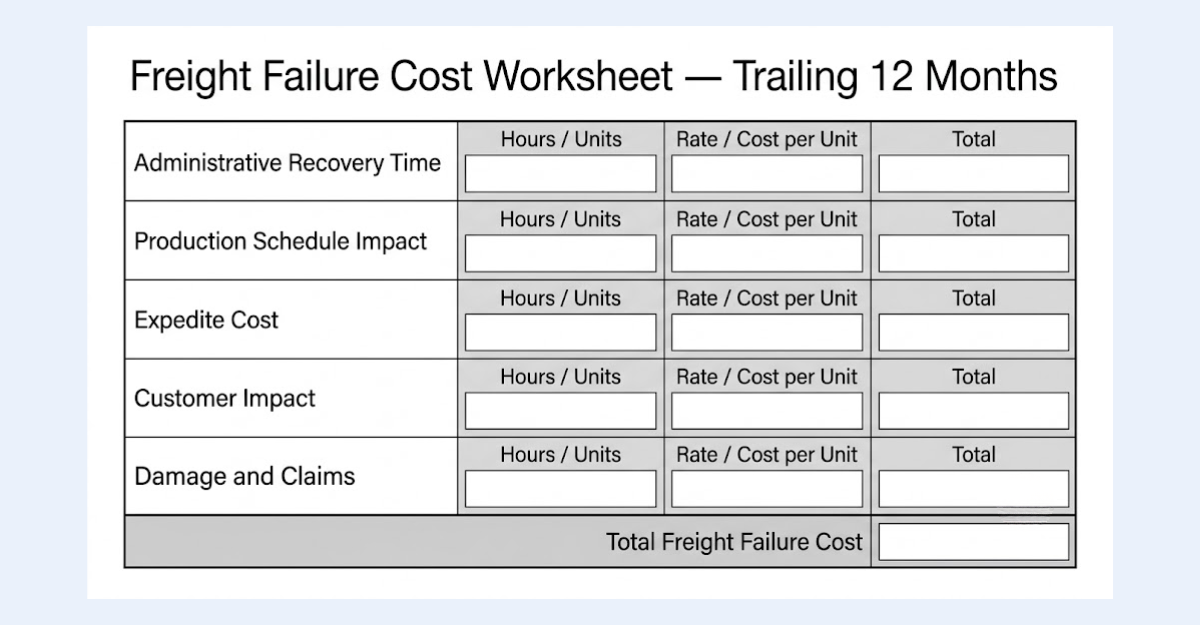
The following framework provides a starting point for manufacturers who want to quantify what freight failures actually cost their operation. For each failure event in the trailing 12 months, capture:
- Administrative recovery time. Hours spent by all personnel involved in tracking, communicating, and resolving the disruption. Multiply by fully burdened hourly rates. Include shipping coordinators, production planners, project managers, and customer-facing staff.
- Production schedule impact. Hours of lost throughput on affected machines or cells. Multiply by the shop's throughput rate (revenue per machine-hour or per cell-hour). Include both the directly affected operation and any downstream operations that were idled or rescheduled.
- Expedite cost. The full cost of any emergency replacement shipping, minus what the original shipment would have cost if it had succeeded. This is the net overpayment for recovery.
- Customer impact. Any chargebacks, penalties, pricing concessions, or documented relationship actions (supplier scorecard downgrades, required corrective action responses) that resulted from the failure.
- Damage and claims. Replacement part production cost, claims administration time, and the gap between actual part value and carrier liability coverage.
Sum these five categories for each failure event, then aggregate across the trailing 12 months. The resulting figure is the manufacturer's annual freight failure cost — the number that should be compared against the cost difference between the current freight program and a logistics approach designed to prevent the failures that generate it.
For most precision manufacturers running this exercise for the first time, the annual freight failure cost exceeds the annual freight spend difference between the cheapest available carrier and a service-matched provider by a substantial margin. The "savings" from selecting the lowest-rate carrier are not savings at all. They are a down payment on future failures whose costs are distributed too widely to be visible in any single budget line.

When Cheap Freight Is Actually Correct
Intellectual honesty requires acknowledging that not every shipment justifies premium service. A manufacturer shipping palletized MRO supplies — replaceable, well-packaged, not time-sensitive — to a warehouse with flexible receiving has a different risk profile than one shipping a one-of-one aerospace component to a customer with a 48-hour installation window.
For the MRO shipment, standard LTL at the best available rate is the correct decision. The failure cost is low because the consequences of delay or damage are manageable: the parts are replaceable, the schedule is flexible, and the customer impact is minimal. Overspending on premium freight for this shipment is waste.
The discipline is not "always pay more." The discipline is matching the freight decision to the failure cost — paying for control where failure is expensive and accepting commodity service where failure is absorbable. The risk scorecard approach we use with manufacturers provides a repeatable way to make this distinction shipment by shipment, rather than applying a blanket service level across freight with vastly different risk profiles.
From Freight Invoice to Freight Strategy
The shift from managing freight on invoice cost to managing freight on failure cost is not a technology change or a vendor change. It is a perspective change that requires three things:
Attribution. When a freight failure occurs, trace the downstream costs back to the shipment and record the total realized cost alongside the freight invoice. Do this for six months and the data will speak clearly enough to change decisions.
Risk matching. Not every shipment carries the same failure cost. Parts that are irreplaceable, time-bound, or customer-facing deserve service levels that reflect their downstream exposure. Parts that are routine, replaceable, and schedule-flexible can move on commodity service without meaningful risk. The distinction between the two is the foundation of freight strategy in manufacturing.
Accountability. The freight function in most manufacturing operations reports into procurement or finance, where it is measured on spend. Moving freight decisions to a framework that accounts for failure cost requires either changing the metrics the freight function is measured on or involving operations and production leadership in carrier selection and mode decisions.
Manufacturers who make this shift — from freight-as-commodity-purchase to freight-as-production-input — consistently find that their total logistics cost decreases even when their per-shipment freight spend increases. The math is straightforward: preventing a $10,000 failure by spending $60 more on the original shipment is the most profitable investment in logistics a manufacturer can make.
Frequently Asked Questions
What are the hidden freight costs in manufacturing? Hidden freight costs include administrative time chasing shipment updates, production schedule disruptions from late inbound material, emergency expedite charges to recover from failures, customer escalation costs when delivery commitments slip, and claims administration plus rework costs when freight arrives damaged. These costs are distributed across departments and rarely attributed to the shipment that caused them, making freight appear less expensive than it actually is.
How much does a freight failure actually cost a manufacturer? The total cost depends on the part's value, replaceability, and downstream schedule dependencies. For precision manufacturers, a single freight failure on a critical shipment routinely generates $5,000 to $15,000 in total realized costs — from a shipment with a $300 to $500 freight invoice. Annual freight failure costs for mid-size manufacturers typically exceed the rate savings that drove the carrier selection decision that caused the failures.
How can manufacturers reduce freight failure costs? Start by tracking failure costs backward to the originating shipment for six months. Use a risk-based approach to freight decisions that matches service level to failure cost rather than applying the cheapest available rate to every shipment. Invest in freight exception management that catches disruptions early enough to intervene, and ensure carrier selection accounts for communication capability and on-time performance — not just rate.
Is LTL shipping too risky for precision manufactured parts? Not categorically. LTL is the correct mode for many manufacturing shipments — particularly routine, well-packaged, replaceable freight with flexible delivery windows. The risk increases when LTL is used for irreplaceable, time-sensitive, or high-value components where the failure cost far exceeds the freight savings. A mode selection framework helps manufacturers distinguish between shipments where LTL is appropriate and shipments where the risk profile requires a different approach.
Why do manufacturers keep choosing the cheapest carrier? Because freight failure costs are structurally invisible. The costs are absorbed across logistics, production, sales, and finance departments, and no single system or person aggregates them against the shipment that caused the cascade. When the freight function is measured solely on per-shipment cost, the cheapest carrier always appears to be the best choice — until the organization calculates what the failures actually cost.
other blog posts
%2520(1).webp)
.webp)
%2520(2).webp)
%2520(4).webp)