After hours freight problems are some of the most disruptive and expensive challenges in modern transportation operations. Late night freight problems don’t just create delays—they expose weaknesses in ownership, escalation, and decision authority that rarely surface during normal business hours.
When shipments move overnight, the margin for error shrinks. Site contacts go offline. Approval chains slow down. Recovery options disappear. What might be a manageable delay at 2:00 PM can quickly turn into a full after-hours freight failure at 2:13 AM.
For shippers, carriers, and logistics teams managing time critical freight after hours, understanding why these failures happen—and how to respond in the moment—is essential to maintaining service reliability, protecting delivery dates, and controlling cost.
This article breaks down what actually goes wrong after midnight, how to recognize high-risk situations early, and how to apply a proven freight escalation process that improves outcome certainty when it matters most.
Why After-Hours Delivery Time Delays Are Different
After hours shipment delays behave differently than daytime disruptions because the operating environment fundamentally changes once offices close. During the night, fewer people are available to respond, fewer decisions can be made quickly, and fewer recovery options exist.
In standard business hours, a late pickup or missed delivery time typically triggers a series of rapid adjustments. Dispatchers can reach site managers. Shippers can authorize changes. Carriers can reroute drivers or adjust schedules. After hours, that flexibility largely disappears.
Late night load delays are more likely to escalate because:
- Decision authority is unclear or unavailable, creating operational blind spots
- Escalation windows are shorter, reducing recovery window options
- Single-thread ownership is missing, leading to drift instead of containment
- Live intervention is delayed, even when shipments are being tracked
As a result, after hours trucking issues often create delays that ripple across the supply chain, impacting downstream pickups, next day deliveries, aircraft connections, and customer expectations.
This is why overnight freight management requires a different mindset than daytime shipping. Tracking shipments alone is not enough. What matters is real-time ownership, decisive action, and control under pressure.
The Most Common Causes of Late-Night Freight Problems
Across hundreds of trucking after hours exceptions and post-mortem reviews, the same failure points appear again and again. While symptoms vary—missed delivery time, additional fees, unhappy customers—the underlying causes are remarkably consistent.
Delivery Service Delays and Hours-of-Service Constraints
Driver-related issues are one of the most frequent causes of freight issues after midnight. Traffic congestion, late departures, unexpected wait times at pickup, and hours-of-service limitations can quickly push a shipment outside its planned transit times.
When drivers are close to their limits, even small disruptions can create delays that affect delivery schedules, priority shipments, and guaranteed service commitments.
Missed or Incorrect Appointments
Appointment integrity is critical for overnight shipping problems. For example, incorrect delivery dates, unclear dock instructions, or mismatched expectations between facilities and carriers frequently lead to site refusals or extended wait times.
These issues are especially costly when a shipment arrives on time but cannot be unloaded due to access restrictions or unavailable staff.
Site Refusal or No Unload Access Till Next Day
Many after hours freight problems occur when a truck arrives but cannot access the destination. Closed gates, limited security, restricted zip codes, or lack of overnight personnel can all prevent unloading—even when the shipment was otherwise delivered on schedule.
This creates additional costs, forces rescheduling, and may require extra lead time to recover.
Equipment or Mechanical Issues
Mechanical failures don’t respect business hours. Equipment issues, trailer problems, or aircraft availability constraints can instantly change transit plans and delivery service expectations.
When these failures occur overnight, escalation must be fast to avoid cascading delays.
Weather and Environmental Factors
Weather remains a major contributor to late night freight problems, particularly during peak season and holidays. Severe weather can reduce capacity, increase transit times, and strain carrier resources, especially for air and next day shipments.
Paperwork and Information Gaps
Incomplete documentation, incorrect addresses, missing packing details, or unclear delivery instructions frequently create after hours logistics problems. These issues often originate upstream but only surface once a shipment is already in transit.
By the time someone notices, recovery options may already be limited.
This is where the failure actually happens.
It is rarely a single mistake. It is the absence of exception control, decision authority, and a defined escalation process when something breaks at night.
The First 15 Minutes: The After-Hours Freight Escalation Process
When a shipment breaks after hours, the first 15 minutes determine whether the issue is contained or allowed to drift into a full operational failure. In overnight freight management, this window is where outcome certainty is either created or lost.
Across trucking emergency escalation reviews, one pattern consistently emerges: teams that act decisively in the first 15 minutes preserve recovery options. Teams that hesitate lose them.
This is why experienced operators rely on a first-15-minute rule—not as a slogan, but as a governing discipline designed to protect the recovery window.
Step 1: Confirm the Facts Immediately
Before decisions can be made, the situation must be clearly understood. That requires confirmation—not assumptions.
Within minutes of identifying an after hours freight failure, the owner must confirm:
- Driver status and exact location, including distance remaining and current transit conditions
- Available hours, team viability, or aircraft cutoff constraints if air service is involved
- Site access details, including unload availability, security, and contact status
Without confirmation, teams risk acting on incomplete information, which frequently creates delays instead of resolving them.
Step 2: Make a Forced Decision
Once the facts are clear, a decision must be made quickly. The worst outcome at night is indecision.
Typical forced decisions include:
- Hold the shipment vs reroute
- Attempt early arrival vs reschedule delivery date
- Escalate to the site vs absorb the delay
This is where decision authority matters. If approval is unclear or delayed, the escalation window closes and recovery options disappear.

Step 3: Notify One Owner, Not Everyone
After hours trucking operations break down when too many people are notified and no one owns the next move.
Effective trucking exception handling requires:
- One internal owner
- One external contact
- One active communication thread
This single-thread ownership model prevents confusion, limits back-and-forth, and enables live intervention instead of email paralysis.
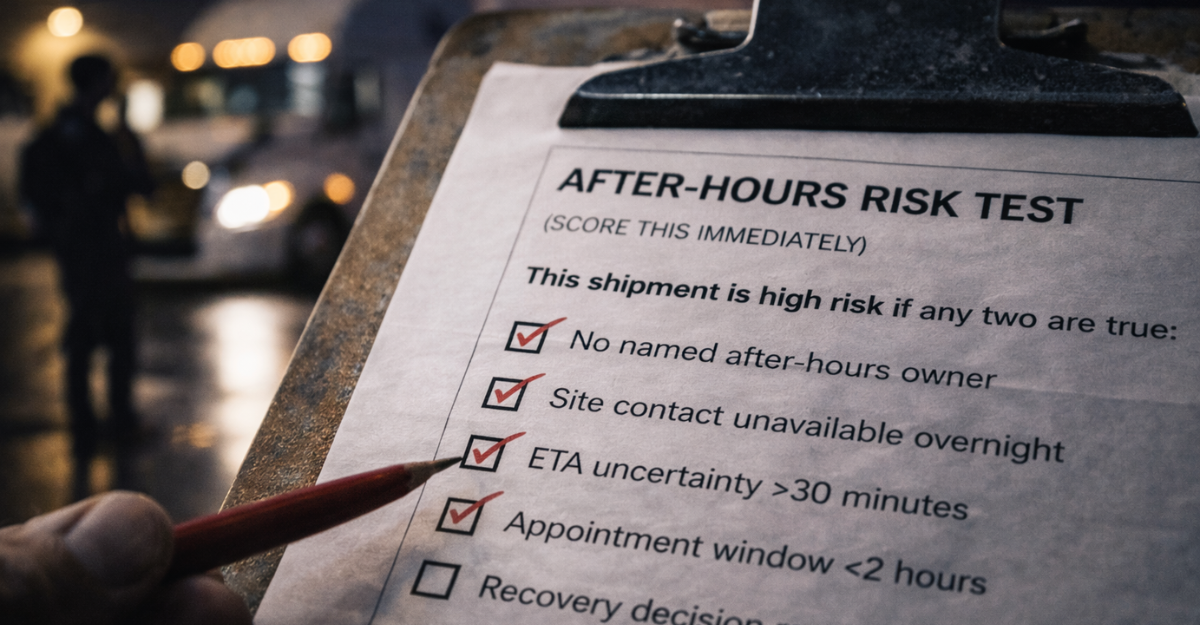
After-Hours Risk Test (Score This Before You Panic)
Not every late-night issue requires the same response. Some loads can absorb a delay. Others become high-risk immediately.
This risk test helps teams classify the situation quickly and determine whether escalation is required.
Score the Shipment
A shipment should be treated as a high-risk load if any two of the following are true:
- No named after-hours owner
- Site contact unavailable overnight
- ETA uncertainty exceeds 30 minutes
- Appointment window is less than two hours
- Recovery decision requires approval
When three or more conditions are present, escalation is mandatory—not optional. This is the intervention threshold where drift prevention becomes critical.
This diagnostic reflects patterns observed across hundreds of freight exception management reviews. Loads that meet these criteria are far more likely to miss delivery windows, incur additional fees, or disrupt downstream schedules.
Escalation Rules: When to Call vs Text vs Email
One of the most common after hours dispatch issues is using the wrong communication method at the wrong time. Each channel serves a different purpose, and misuse creates delay.
Call When Time Sensitivity Is High
If the delivery time or recovery window is under four hours, a phone call is required. Calls create immediate alignment and enable forced decisions when seconds matter.
Text for Confirmation, Not Debate
Text messages are effective for confirming arrival, access, or approval. They are not effective for negotiating options or debating next steps.
Email Only to Document
Email should never be used to make decisions during an after-hours failure. Its role is documentation, not escalation.
The goal is no-handoff execution—one owner, one decision path, one clear outcome.
Stay Ahead: How to Prevent Overnight Delays Before You Tender the Load
The most effective way to manage overnight shipping problems is to prevent them before the shipment ever moves. Most after hours freight issues originate upstream, even if they surface later.
Before tendering a critical shipment, experienced operators confirm four things:
Ownership After Business Hours
Who owns this shipment after 5 PM? If the answer is unclear, the load is already exposed.
Realistic Unload Scenarios
What happens if the truck arrives early or late? Is there flexibility in schedule, access, or staffing?
Overnight Decision Authority
Who can approve changes after hours? Without clear authority, even minor issues can create delays.
Defined Recovery Options
If the delivery window is missed, what is the backup plan? Holding, rerouting, next day service, or alternate locations should be discussed in advance.
Asking these questions helps teams stay ahead of after hours shipment delays, reduce additional fees, and protect customer commitments during peak season and holidays.

Additional Information: Copy/Paste Templates for Live Exceptions
Clear communication reduces confusion and speeds resolution. These templates are designed to force decisions, minimize back-and-forth, and maintain control under pressure.
After-Hours ETA Update
“Truck is at mile marker X with Y hours remaining. Current ETA is 03:10–03:30. Next update at 02:45 or sooner if conditions change.”
Arrived / Waiting
“Arrived on site at 01:55. No unload access. Driver holding. Awaiting direction by 02:20 to avoid cascading delay.”
Unload Issue / Site Refusal
“Site unable to receive at scheduled time. Options are hold until X or reschedule to Y. Decision needed by Z.”
Reschedule Confirmation
“Confirming new delivery window of X–Y with unload access and on-site contact confirmed.”
These tools support containment and prevent unnecessary drift during midnight escalation scenarios.
FAQ: After-Hours Trucking Operations
What causes most after hours trucking issues?
Most issues stem from unclear ownership, missed appointments, site access problems, driver constraints, or delayed escalation—not lack of tracking.
Why are late night freight problems harder to recover?
After hours, fewer contacts are available, approval chains slow down, and recovery windows close faster.
What is the first-15-minute rule?
It’s a structured escalation process: confirm facts, make a decision, and notify one owner within 15 minutes to preserve recovery options.
How do carriers reduce after hours shipment delays?
By defining ownership, escalation thresholds, and recovery plans before tendering critical loads.
Are after hours freight failures more expensive?
Yes. They are more likely to create additional fees, missed delivery dates, and downstream disruptions across locations and customers.
This guide was created by operators who manage time-critical freight every day.
If you want to pressure-test this against a real shipment, we’re happy to talk.
other blog posts
%2520(1).webp)
%2520(5).webp)

%2520(5).webp)