Partners, Not Numbers: Rethinking Driver Retention in Trucking
Driver retention in trucking starts with treating drivers as partners, not headcount. Learn how career pathways, consistent benefits, cross-functional development, and relational dispatch models reduce turnover and build high-performing fleets.
Driver retention in trucking remains one of the industry's most persistent and expensive operational challenges. Annual turnover at large truckload carriers has historically fluctuated between 70 and 95 percent according to American Trucking Associations data, and even well-managed fleets face ongoing pressure from competing carriers, recruiter outreach, and the structural demands that make over-the-road life difficult to sustain.
The conventional response to truck driver turnover is compensation adjustment — raising per-mile rates, adding sign-on bonuses, or improving benefits packages. These levers matter, and this article does not argue otherwise. But they are insufficient as driver turnover solutions in trucking because they address the symptom rather than the underlying condition. Drivers do not leave solely for money. They leave because they feel disposable.
The carriers that consistently outperform their peers on retention share a common orientation: they treat drivers as partners rather than numbers. This is not a slogan. It is an operational philosophy that shows up in specific decisions — about career pathways, benefits, dispatch relationships, and the daily interactions that determine whether a driver feels invested in or merely transacted with.
Why Drivers Leave: Understanding Truck Driver Turnover
The Transactional Trap
The most common structural failure in driver retention is allowing the carrier-driver relationship to become purely transactional. When every interaction is reduced to load assignment and compliance enforcement, the human element disappears. And when the human element disappears, the driver has no reason to stay that cannot be matched or exceeded by a competitor offering marginally better economics.
Transactional relationships are fragile by design. They are held together by compensation, and they dissolve the moment a better offer appears. In an industry where recruiters contact experienced drivers routinely — and where a clean MVR and two years of safe driving make a driver essentially free to choose any carrier — a purely transactional model creates a perpetual churn machine.
The alternative is a relational model where economics are one dimension of a partnership that also includes professional development, transparent communication, and genuine mutual accountability.
The Quality-of-Life Equation

Over-the-road trucking demands a quality-of-life trade-off that most professionals in other industries never contemplate. Drivers are routinely away from home for weeks or months at a time, living in their vehicles, managing their own schedules within regulatory constraints, and operating in environments where isolation, unpredictable conditions, and physical demands are constant.
It takes a specific individual to sign up for this life, and not everyone who enters the profession is able to sustain it. Carriers that do not acknowledge the extraordinary personal cost of OTR life — and do not actively work to mitigate it — experience higher washout rates among new drivers and gradual attrition among experienced ones.
The quality-of-life dimension of truck driver retention strategies extends beyond home time scheduling, though that is important. It encompasses driver health and wellness support, mental health awareness, fair and consistent benefits, flexible scheduling where possible, and the recognition that drivers are making a significant personal sacrifice in exchange for their compensation.
Carriers that ask much must also give much. This principle, while simple, is violated frequently enough that it remains a primary driver of turnover.
The Differentiation Problem
From a driver's perspective, carriers are difficult to differentiate. Marketing materials emphasize similar value propositions. Recruiters make similar promises. The external appearance of most carriers is essentially interchangeable.
This creates a condition where drivers cycle between carriers not because any particular carrier is unacceptable, but because there is no compelling reason to stay. The switching cost is low — another carrier will pay a comparable rate, and the operational experience is expected to be roughly equivalent.
Carriers that retain drivers at above-market rates do so by creating an experience that is genuinely different and that becomes visible only after the driver has been with the organization long enough to recognize it. For any organization serious about how to retain truck drivers, the challenge is that this differentiation must survive the gap between recruitment promise and operational reality, which is where many carriers lose credibility.
The Partner Model: How to Retain Truck Drivers Through Structural Investment
Career Pathways, Not Just Positions
One of the most powerful CDL driver retention tools available to carriers is the creation of visible, structured career pathways that give drivers a long-term reason to stay. A driver who sees a future within the organization behaves differently than a driver who views the current position as interchangeable with every other carrier's offering.
Effective career pathways in trucking — often described as the "driver journey" — typically include multiple stages:
- Company driver to truck ownership. Carriers that support drivers in transitioning from company trucks to owner-operator status create a development arc that competitors cannot easily replicate. This may include lease-to-own programs, financial planning support, or preferred access to equipment purchasing opportunities.
- Unregulated to CDL. Drivers operating non-CDL vehicles (sprinter vans, box trucks) who aspire to obtain their CDL represent a retention opportunity when the carrier supports that transition through training sponsorship, scheduling accommodation, or financial assistance.
- Driver to operational roles. Experienced drivers who transition into dispatch, safety, training, or fleet management roles carry invaluable operational knowledge into functions that directly benefit from frontline experience. Creating visible pathways for this transition gives drivers a career horizon beyond the cab.
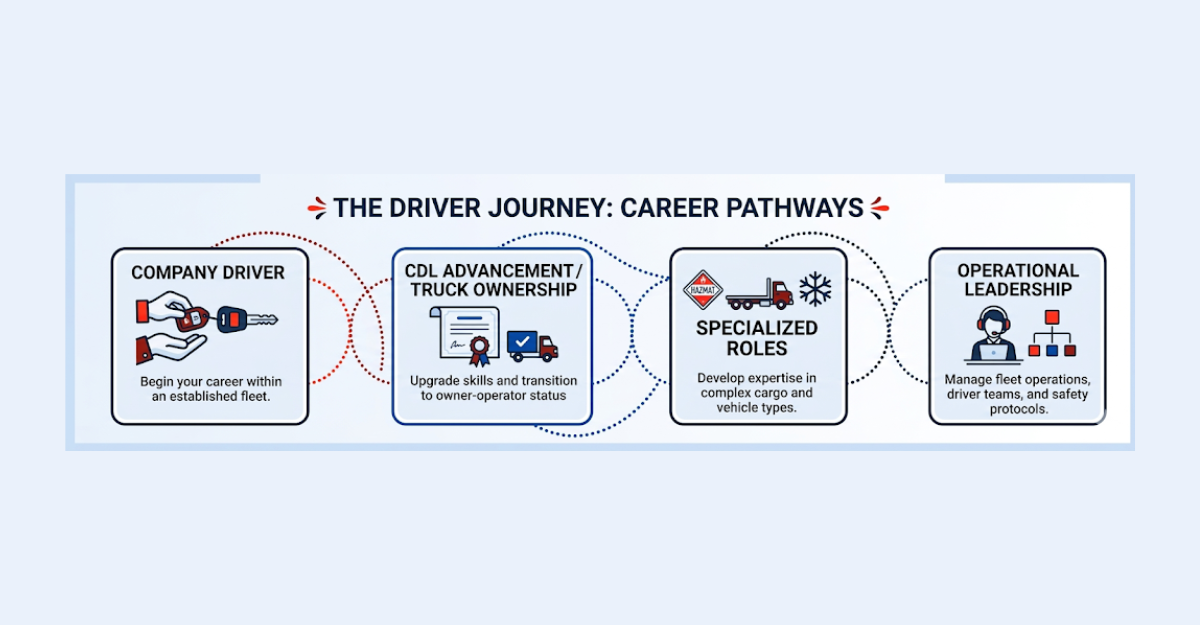
The key is that these pathways must be visible and accessible from the driver's first day. A career path that exists on paper but is never communicated, or that requires extraordinary initiative to discover, functions as a retention tool for zero drivers.
Benefits Consistency: The Fairness Principle
One of the most underappreciated elements of driver retention in trucking is benefits consistency. In many carriers, benefits — particularly PTO, scheduling flexibility, and operational perks — are distributed unevenly based on tenure, route assignment, or informal negotiation. This inconsistency creates perceived unfairness, which erodes trust.
The alternative is a consistency model where foundational benefits are identical for every team member regardless of tenure or position:
- Equal PTO from day one. Rather than graduated PTO accrual that rewards tenure but penalizes newer team members, some carriers offer a consistent allocation — for example, 20 days per year for every employee from their start date. This communicates that the organization values every individual's time equally.
- Structured flexibility. Offering defined flexibility — such as a set number of remote work or flex days per month for office-based staff, or home time commitments that are honored rather than aspirational for drivers — creates reliability in the quality-of-life equation.
- Transparent compensation structures. Drivers who understand exactly how their pay is calculated, what incentives are available, and how performance affects their earnings trust the system more than drivers who perceive their compensation as opaque or subject to discretion.
Equal treatment does not mean identical treatment. Drivers have different needs based on their circumstances, experience levels, and personal situations. But the baseline — the benefits, the respect, the access to resources — should be consistent. Consistency signals fairness, and fairness is a prerequisite for trust.
Cross-Functional Development: Keeping It Interesting
Driver burnout is not always a function of overwork. It is frequently a function of monotony. When the job becomes repetitive and predictable — the same routes, the same procedures, the same interactions — even well-compensated drivers begin to disengage.
Carriers that actively work to remove mundane elements from the business and replace them with development opportunities see measurable improvements in engagement and retention.
Cross-functional exposure is one mechanism. Allowing team members to participate in activities outside their primary role broadens their understanding of the business and helps surface latent strengths that neither the employee nor the organization initially recognized. This is especially true for neurodivergent professionals whose cognitive strengths — pattern recognition, divergent thinking, sustained procedural focus — may only become apparent when they are given exposure beyond a narrowly defined role.
In practical terms, this might include:
- Drivers participating in safety training as peer coaches or mentors to newer drivers
- Operations staff attending client conferences or site visits to understand frontline customer needs
- Accounting or administrative team members spending time with sales or dispatch teams to understand how revenue is generated and freight is managed
- Any team member, regardless of functional role, having the opportunity to explore roles in other departments when interest or aptitude emerges
This lateral mobility is distinct from upward promotion. Not every driver wants to become a manager, and not every dispatcher aspires to an executive role. But many professionals want to grow, learn, and feel that their work experience is expanding rather than contracting. Cross-functional development satisfies this need without requiring hierarchical advancement.
Giving Responsibility Early
A closely related retention principle is the deliberate assignment of meaningful responsibility to team members earlier than conventional management practice would suggest.
Many organizations default to graduated responsibility: prove yourself at level one before gaining access to level two. This approach is well-intentioned but can function as a retention barrier, particularly for younger or newer team members who are capable of performing at higher levels but are constrained by organizational caution.
The alternative is to provide more responsibility than the individual expects, with guardrails and support in place to prevent failure. Carriers that adopt this approach report that team members consistently surprise themselves — and their managers — by rising to challenges they would not have sought independently.
This is not recklessness. It is intentional development. The guardrails exist. Other team members are available to support. But the responsibility is real, and the individual knows it. This combination of challenge and support creates engagement that routine task assignment cannot replicate.
The Dispatch Relationship: The Most Important Interface
Why Dispatch Is the Retention Fulcrum

For most drivers, the dispatcher is the primary — and often only — consistent point of contact with the carrier. The quality of the dispatch relationship determines more about a driver's daily experience than compensation, benefits, or equipment quality combined. (For a deeper look at communication excellence in logistics, see our guide on meeting consignee expectations.)
A dispatcher who knows the driver personally — their strengths, their preferences, their family situation — provides a fundamentally different experience than a rotating pool of dispatch contacts who treat each interaction as a new transaction.
High-retention carriers structure their dispatch function to support relational continuity:
- Dedicated dispatcher-driver pairing. Each dispatcher works with a defined group of drivers over an extended period. Over time, both parties develop familiarity and trust that makes every subsequent interaction more efficient.
- Pre-trip, during-trip, and post-trip engagement. The dispatch relationship extends beyond load assignment. Dispatchers who check in proactively — before pickup, during transit, and after delivery — demonstrate investment in the driver's success and provide opportunities to identify and resolve issues before they escalate.
- Advocacy, not just coordination. Dispatchers who function as advocates for their drivers — pushing back on unreasonable shipper demands and escalating service failures on the driver's behalf — earn loyalty that compensation alone cannot purchase.
When drivers feel that their dispatcher genuinely cares about their success and wellbeing, the switching cost increases dramatically. The driver is no longer evaluating whether another carrier offers a marginally better rate. They are evaluating whether they want to leave a relationship.
Protecting the Driver
The dispatch relationship is also the primary mechanism through which carriers protect drivers from the operational pressures that erode quality of life.
A significant percentage of the urgency that drives freight operations is, in practice, manufactured. Delivery windows are sometimes tighter than the consignee actually requires. Information provided at booking is sometimes incomplete or inaccurate. Shippers may not communicate directly with their own receiving facilities. The result is that drivers often operate under artificial pressure that does not reflect actual operational necessity.
Carriers that protect their drivers — verifying delivery requirements independently, pushing back on unrealistic timelines, and refusing to sacrifice driver safety or hours-of-service compliance for manufactured urgency — a dynamic explored in depth in how to avoid shipping delays — demonstrate through action that the driver's wellbeing is not subordinate to the load.
This protection is particularly important in mission-critical and expedited freight environments, where urgency is real and the stakes are high. In these environments, the carrier must balance operational performance with driver safety — and the driver must trust that the carrier will make that balance correctly. When that trust exists, the driver performs at a higher level because they know the organization has their back.
Driver Appreciation as Operational Practice
Every Day, Not a Week
The trucking industry designates a week in September for driver appreciation. At many carriers, this manifests as a terminal barbecue, a branded t-shirt, or a company-wide email. The intent is positive. The execution frequently misses the mark — particularly for drivers who are on the road during the designated week and cannot participate in terminal-based events.
Meaningful driver appreciation is not an annual event. It is a daily operational practice embedded in how the carrier communicates and assigns loads.
Specific practices that communicate genuine appreciation include:
- Executive accessibility. When a CEO gives every new driver a personal business card with a direct cell phone number and an invitation to call if issues are not being resolved, it communicates a level of organizational commitment that no corporate email can replicate.
- Performance-based recognition. Monthly recognition tied to measurable performance — safety scores, on-time delivery rates, customer feedback — with meaningful incentives demonstrates that individual contribution is observed and valued.
- Response time on driver issues. How quickly a carrier resolves a driver's problem — whether it involves maintenance, pay discrepancy, scheduling conflict, or a personal issue — communicates more about organizational values than any mission statement.
- Public acknowledgment. Sharing driver accomplishments within the organization and with customers reinforces the message that drivers are the tip of the spear in operational delivery, not invisible assets behind the wheel.
The underlying principle is recognition that without drivers, nothing moves. People do not fully appreciate drivers until something does not show up. Carriers that communicate this appreciation proactively — rather than reactively when something goes wrong — build teams that are invested in organizational success.
Measuring Retention: Beyond Turnover Rate
Leading Indicators of Retention Risk
Turnover rate is a lagging indicator. By the time a driver leaves, the retention failure occurred weeks or months earlier. Carriers focused on driver retention in trucking should track leading indicators that signal engagement erosion before it produces a departure:
- Responsiveness changes. A driver who previously responded to communications promptly but has become slower or less communicative may be disengaging.
- Recruiter activity. In an industry where driver contact information circulates freely, carriers should assume that their drivers receive regular recruiter outreach. The question is not whether drivers are being recruited, but whether they have a reason to decline.
- Coaching engagement. Drivers who participate actively in safety coaching, provide feedback on operational issues, and engage in development conversations are demonstrating investment. Declining engagement in these areas may signal emerging dissatisfaction.
- Referral willingness. Drivers who recommend their carrier to other drivers are the strongest possible signal of satisfaction. Carriers with robust driver referral programs — where referral bonuses are meaningful and the referred driver's experience validates the recommendation — create a self-reinforcing retention mechanism.
The Economics of Retention
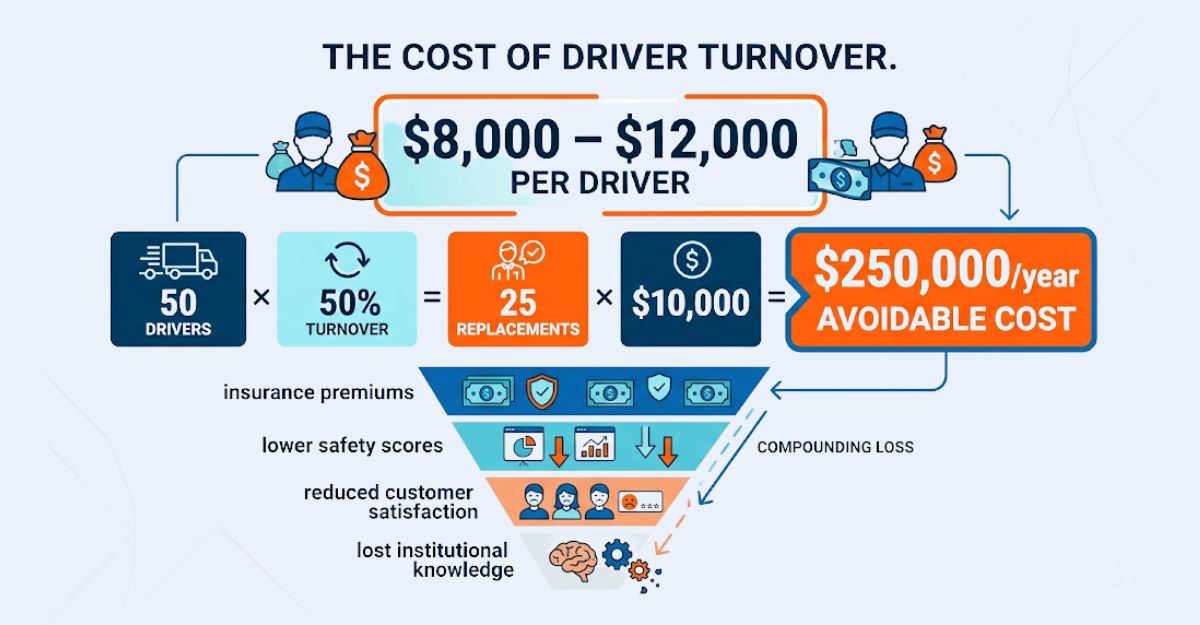
The financial case for driver retention investment is straightforward. According to estimates cited by the American Transportation Research Institute and industry workforce analyses, the fully loaded cost of replacing a single driver typically falls between $8,000 and $12,000, encompassing recruiting, onboarding, training, equipment repositioning, and productivity loss during the transition period. For a carrier with 50 drivers experiencing 50 percent annual turnover, that represents $200,000 to $300,000 in avoidable annual cost.
But the direct replacement cost understates the true impact. High-turnover carriers also experience:
- Elevated insurance premiums due to less experienced driver pools
- Lower safety performance, which affects CSA scores and shipper eligibility
- Reduced customer satisfaction from inconsistent service delivery
- Diminished institutional knowledge as experienced drivers depart
- Recruiter fatigue and declining candidate quality as the carrier's reputation deteriorates
Conversely, carriers with strong retention records attract better candidates through driver word-of-mouth, maintain higher safety performance, deliver more consistent service to shippers across industries, and build the institutional knowledge that enables operational improvement over time. For disability-owned carriers pursuing DOBE certification, strong driver retention metrics further reinforce the value proposition to enterprise shippers evaluating diverse suppliers — demonstrating operational stability that procurement teams prioritize alongside diversity credentials.
Retention is not a cost. It is an investment with compounding returns.
Building a Retention-First Culture: Driver Recruitment and Retention as One Function
It Starts at the Top
Culture flows downward. A carrier whose executive leadership genuinely values drivers — and demonstrates that value through decisions, not just statements — builds an organization where driver recruitment and retention are embedded in every function. The most effective driver turnover solutions in trucking start not with the HR department but with the leadership team's operating philosophy.

Leadership that understands frontline operational reality makes different decisions than leadership that manages from spreadsheets. When the CEO has walked the floor and met the drivers, the resulting culture reflects that understanding.
None of this is performative. It is about whether leadership priorities actually align with how the operation runs day to day. When a carrier's leadership team prioritizes driver experience with the same intensity it applies to revenue growth, the organization behaves differently at every level.
Choose Wisely — And Give Them a Reason to Stay
For drivers evaluating carriers, the advice is the same as it has always been: choose wisely. Look beyond the signing bonus. Evaluate the culture. Talk to other drivers. Get to the executives and see how they treat people.
For carriers, the reciprocal obligation is clear: give them a reason to stay that cannot be replicated by a competitor dangling a higher per-mile rate. Build a career pathway. Invest in the dispatch relationship. Protect their safety and their time. Recognize their contribution — not once a year, but every day.
The carriers that get CDL driver retention right do not worry about driver shortages. They build waiting lists.
Frequently Asked Questions
What is the current truck driver turnover rate? Annual turnover at large truckload carriers has historically ranged between 70 and 95 percent, according to American Trucking Associations data. Smaller carriers and those with strong retention programs typically experience significantly lower turnover. The rate fluctuates with market conditions, but structural turnover driven by quality-of-life factors and transactional carrier-driver relationships remains persistent across market cycles.
What are the most effective truck driver retention strategies? The most effective driver retention strategies address the full spectrum of the driver experience, not just compensation. Key elements include structured career pathways (company driver to owner-operator, driver to operational roles), consistent benefits regardless of tenure, dedicated dispatcher-driver pairing, and executive accessibility. The common thread is a culture that treats drivers as partners rather than interchangeable assets — and backs that up with real investment in their development.
How much does driver turnover cost a trucking company? Industry estimates place the fully loaded cost of replacing a single driver between $8,000 and $12,000, including recruiting, onboarding, training, equipment repositioning, and productivity loss. Additional indirect costs include elevated insurance premiums, lower safety performance, reduced customer satisfaction, and diminished institutional knowledge. For a mid-sized fleet, annual turnover-related costs can reach several hundred thousand dollars.
Why do truck drivers leave their carriers? Drivers leave for a combination of factors that typically extend beyond compensation. Common drivers of turnover include feeling treated as a number rather than a partner, inconsistent or unfair benefits and scheduling, poor dispatch relationships, lack of career development, manufactured operational urgency that compromises safety or quality of life, and the low switching cost between carriers with undifferentiated value propositions.
How does the dispatch relationship affect driver retention? The dispatcher is typically the driver's primary and most frequent point of contact with the carrier. Dedicated dispatcher-driver pairing, where the same dispatcher works with the same group of drivers over time, builds familiarity and trust that significantly increases switching cost. Dispatchers who function as advocates — proactively checking in and pushing back on unreasonable demands — create loyalty that compensation alone cannot purchase.
What is a driver journey in trucking? A driver journey is a structured career pathway that maps the stages of a driver's professional development within a carrier. It typically spans from initial hire through progressive milestones such as transitioning from a company truck to vehicle ownership, obtaining CDL certification, developing specialized skills, or moving into operational leadership roles. Visible, accessible career pathways give drivers a long-term reason to stay with an organization.
How do signing bonuses affect driver retention? Signing bonuses attract candidates but do not retain them. Carriers that rely heavily on signing bonuses to fill seats without addressing underlying retention factors — dispatch relationships, career development, quality of life — typically experience a cycle where new hires collect the bonus and depart within months. Sustainable retention requires structural investment in the driver experience rather than one-time financial incentives.
other blog posts
.png)


.webp)
%2520(5).webp)