What Is DOBE Certification? What Shippers, Suppliers, and Disability-Owned Founders Need to Know
DOBE certification connects disability-owned businesses to Fortune 500 supplier diversity programs. Learn what it is, how it works, and how it creates competitive advantages in trucking and logistics.

DOBE certification — Disability-Owned Business Enterprise certification — is a formal credential issued by Disability:IN that verifies a for-profit business is at least 51 percent owned, managed, and controlled by a person with a disability. The certification connects disability-owned businesses to Fortune 500 supplier diversity programs and government contracting opportunities where procurement teams prioritize diverse suppliers.
Despite growing corporate interest in supplier diversity, DOBE certification remains one of the least understood credentials in the procurement landscape. Many supply chain leaders are familiar with minority-owned (MBE), women-owned (WBE), and veteran-owned (VOSB) business designations but have limited awareness of disability-owned enterprises. That awareness gap creates an opening — particularly in trucking and logistics, where disability-owned carriers can deliver performance that meets or exceeds incumbent providers while simultaneously advancing supplier diversity objectives.
This guide covers how the certification process works, what it means for shippers evaluating their carrier base, and what disability-owned founders should know about converting certification into actual revenue.
What Is a Disability-Owned Business Enterprise (DOBE)?
A Disability-Owned Business Enterprise is a for-profit business entity that meets three criteria:
- Ownership: At least 51 percent of the business is owned by one or more individuals with a qualifying disability as defined under the Americans with Disabilities Act (ADA).
- Management: The day-to-day management and strategic decision-making authority rests with the disabled owner or owners.
- Control: The disabled owner or owners exercise control over operations, including executive functions, financial management, and the direction of business activities.
Disability:IN — formerly the United States Business Leadership Network (USBLN) — is the sole certifying body for DOBE designation. The organization also certifies Veteran Disability-Owned Business Enterprises (V-DOBE) and Service-Disabled Veteran Disability-Owned Business Enterprises (SDV-DOBE).
It is important to note that disability, in this context, encompasses a far broader range of conditions than many procurement teams assume. While visible physical disabilities represent one category, the majority of qualifying conditions are non-apparent. These include autoimmune conditions, organ failure and transplant recovery, neurological conditions such as ADHD and autism, chronic pain conditions, sensory processing differences, and a range of other documented medical conditions that substantially limit one or more major life activities.

The breadth of qualifying conditions means that disability-owned businesses are far more prevalent in the supply chain than most organizations realize. Many business owners who qualify for DOBE certification have not pursued it — either because they are unaware of the program or because they have not previously identified a business reason to formalize their status.
How DOBE Certification Works
The Application Process
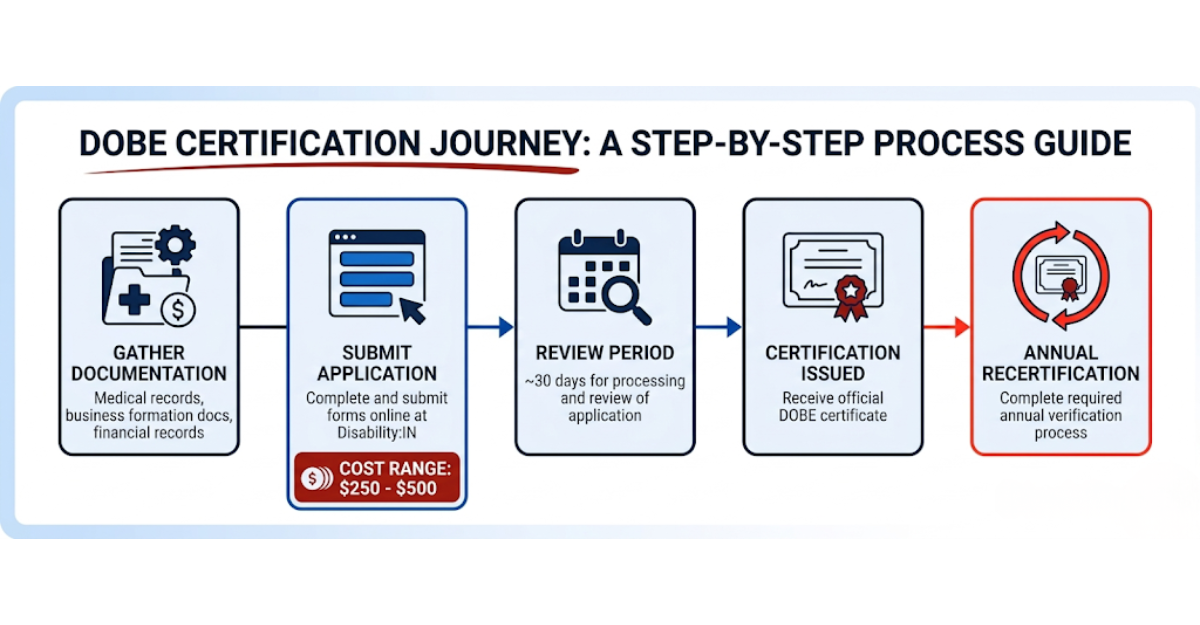
The certification process through Disability:IN involves documentation of the owner's qualifying disability and business ownership structure. Applicants must demonstrate that the disabled owner holds majority ownership and exercises genuine management authority — not nominal or passive ownership.
Required documentation typically includes:
- Medical documentation or verification of qualifying disability
- Business formation documents (articles of incorporation, operating agreements)
- Evidence of management authority (organizational charts, board resolutions)
- Financial statements demonstrating ownership distribution
- Operational documentation showing the disabled owner's active role
The determination process generally takes approximately 30 days as of this writing. Certification fees typically range from $250 to $500, depending on the size and structure of the business; applicants should verify current fee schedules directly with Disability:IN, as these may be updated periodically. Recertification is required annually to maintain active status.
What Certification Provides
DOBE certification provides access to several categories of opportunity:
- Corporate supplier diversity programs: Many Fortune 500 companies maintain active supplier diversity initiatives with dedicated procurement budgets or set-asides for certified diverse suppliers. DOBE-certified businesses become eligible for inclusion in these programs.
- Government contracting preferences: Federal, state, and local government procurement processes frequently include preferences or set-asides for certified diverse suppliers. In sectors such as construction, infrastructure, and defense logistics, these preferences can be a decisive factor in contract awards.
- Networking and introductions: Disability:IN facilitates connections between certified businesses and corporate procurement teams through its annual conference, regional events, and direct introductions. These relationship-building opportunities are often more valuable than portal-based discovery.
- Brand and credibility signaling: DOBE certification serves as a third-party validation of the business's ownership structure, which can be meaningful in procurement contexts where diversity claims require verification.
Why DOBE Certification Matters for Shippers and Supply Chain Leaders
The Supplier Diversity Imperative
Supplier diversity is no longer a peripheral corporate initiative. It is an increasingly material component of procurement strategy and stakeholder reporting. Major corporations, government agencies, and institutional buyers evaluate supplier diversity performance as part of their ESG (Environmental, Social, and Governance) frameworks, and many tie procurement targets directly to diverse supplier utilization.
For shippers and logistics buyers specifically, this means that the composition of their carrier base is subject to scrutiny — not only on cost and service performance, but on diversity representation. Supplier diversity in trucking is no longer a secondary consideration; it is embedded in procurement scorecards.
However, a significant gap exists between corporate stated commitments to disability inclusion and actual procurement behavior. Many organizations maintain supplier diversity portals that allow diverse suppliers to register, but few of these portals generate meaningful business activity. The registration process can be substantial — often requiring an hour or more of detailed information — and many certified businesses report that portal registration alone rarely produces inbound opportunities.
The organizations that generate real value from DOBE-certified suppliers typically share a common approach: they treat supplier diversity as a demand-driven function rather than a registration exercise. This means identifying specific procurement needs first, then matching those needs against the capabilities of certified diverse suppliers — rather than building a database of registered suppliers and hoping that matches emerge organically.
The Competitive Advantage of Working With DOBE-Certified Carriers
In trucking and logistics specifically, engaging DOBE-certified carriers offers shippers several concrete advantages:
- Government and construction contract eligibility: In federal, state, and local government-funded projects — including large-scale commercial construction, data center builds, and infrastructure development — the inclusion of certified diverse suppliers in a proposal can be a competitive differentiator. General contractors and prime vendors who include DOBE-certified logistics partners in their supply chain strengthen their own proposals.
- ESG and sustainability reporting: Supplier diversity metrics are increasingly included in corporate sustainability reports, SEC filings, and stakeholder communications. Shippers who can document utilization of DOBE-certified carriers contribute directly to these reporting requirements.
- Performance without compromise: DOBE certification is a statement about ownership structure, not capability. Disability-owned carriers that operate in the mission-critical, no-fail space are evaluated on the same performance standards as any other provider — safety scores, on-time delivery, communication transparency, and escalation authority. The certification adds a diversity dimension to supplier diversity in trucking without requiring any trade-off in service quality.
- Relationship depth: Disability-owned businesses, particularly in specialized logistics, tend to operate with a partnership orientation rather than a purely transactional model. The certification process itself reflects a commitment to building long-term business relationships, and many DOBE-certified carriers prioritize customer retention and collaborative problem-solving over volume maximization.
What Disability-Owned Founders Need to Know: Converting Certification Into Business
DOBE certification opens doors. It does not, by itself, close deals. Founders who have completed the certification process should approach the subsequent business development phase with realistic expectations and a focused strategy.
The Reality of Corporate Supplier Diversity Programs
Corporate supplier diversity programs vary dramatically in their operational maturity and genuine commitment. Some organizations have deeply integrated diversity procurement into their sourcing workflows, with dedicated budgets, clear targets, and decision-makers who actively seek diverse suppliers for specific projects. Others treat supplier diversity as a compliance exercise with minimal operational impact.
Disability-owned founders should expect to encounter the full spectrum. In practical terms, this means that the path from initial introduction to active business relationship is rarely linear, and it frequently requires sustained effort over months or even years.
Several patterns are common:
- Portal registration with limited follow-through: Many large companies will direct new diverse suppliers to a registration portal. This step is necessary but rarely sufficient. Founders should complete portal registration but should not expect it to generate inbound opportunities independently.
- Turnover in procurement contacts: Supplier diversity functions within large organizations frequently experience staff rotation, which disrupts continuity. A relationship built with one procurement contact may need to be rebuilt when that individual moves to a different role or company.
- Disconnection between diversity teams and operational buyers: The individuals responsible for supplier diversity outreach are often influencers rather than decision-makers. They may not have direct authority over procurement decisions or visibility into specific freight needs. Founders should ask early in any engagement: who are the operational decision-makers, and how can we connect directly with them?
Where DOBE Certification Generates the Highest Return

Not all sectors and procurement contexts value DOBE certification equally. Founders should prioritize business development efforts in areas where the certification provides the greatest competitive leverage:
- Government-adjacent work: Federal, state, and local government contracts — and the private-sector projects that support them — offer the most structured pathways for diverse supplier utilization. Construction logistics, defense logistics, infrastructure projects, and public-sector supply chains typically have explicit diverse supplier requirements that create genuine demand for DOBE-certified providers.
- Construction and large-scale project logistics: General contractors and engineering firms bidding on government-funded projects actively seek diverse subcontractors and suppliers to strengthen their proposals. A DOBE-certified logistics provider — particularly a disability-owned trucking company that can deliver mission-critical freight to construction job sites — adds quantifiable value to the prime contractor's diversity metrics. (For operational context, see Best Practices for Construction Jobsite Deliveries.)
- Fortune 500 companies with mature diversity programs: A subset of large corporations have moved beyond registration-based diversity programs to demand-driven models. These organizations proactively identify procurement needs and match them with certified diverse suppliers. Toyota, Union Pacific, and similar companies with established diversity initiatives represent higher-probability targets for DOBE-certified businesses.
The Network Is the Strategy
For disability-owned businesses in trucking and logistics, business development success correlates far more strongly with relationship quality than with certification status alone. The certification provides access. The network produces revenue.
Founders should invest heavily in building and maintaining professional relationships across three dimensions:
- Within the DOBE community: Disability:IN's annual conference and regional events provide access to corporate procurement leaders that would otherwise be extremely difficult to secure. The value of these events is not the conference itself — it is the face-to-face introductions to decision-makers at Fortune 500 companies. Even when these introductions do not produce immediate business, they create relationship equity that compounds over time.
- Across the broader logistics industry: Pre-existing professional relationships are disproportionately valuable for disability-owned carriers. The supply chain industry is relationship-driven at its core, and a warm introduction from a trusted contact consistently outperforms cold outreach — regardless of certification status.
- With complementary diverse suppliers: Collaboration with other certified diverse businesses — including MBE, WBE, and VOSB-certified firms — creates opportunities for joint proposals, referrals, and bundled service offerings that individual suppliers cannot provide alone.
One practical reality that disability-owned founders should account for: professional networks have a shelf life. Contacts retire, change industries, or move to different organizations. Active network maintenance — not just occasional outreach — is essential to sustaining the relationship pipeline that generates business.

The Mindset Shift: From Favor to Value Proposition
One of the most important adjustments disability-owned founders can make is reframing how they engage with potential customers. Many corporate procurement teams approach diverse supplier relationships with the implicit assumption that they are doing the supplier a favor. This framing is counterproductive for both parties.
Disability-owned carriers that compete in the mission-critical, no-fail space are not asking for preferential treatment. They are offering a performance-validated service with the added benefit of advancing the buyer's supplier diversity objectives. The most effective business development approach leads with capability and operational track record, positioning the DOBE certification as an additional advantage rather than the primary justification for the relationship.
When a disability-owned carrier can demonstrate that it will outperform incumbent providers on service quality and communication transparency, the supplier diversity benefit becomes a meaningful differentiator rather than a charitable gesture.
The Intersection of DOBE Certification and Mission-Critical Logistics
The trucking and logistics industry presents a particularly compelling context for DOBE certification because the performance standards are binary. Freight either arrives on time or it does not. Communication is either transparent or it is not. There is no curve to grade on.
A disability-owned trucking company that operates in the mission-critical space — managing high-value, high-consequence freight for manufacturing, construction, data center, and technology deployments — is evaluated on the same metrics as any carrier. Understanding the structural differences between provider models is essential; for a detailed comparison, see Asset-Based Carrier vs Freight Broker: What Enterprise Shippers Must Understand. A Disability:IN certification does not lower the performance bar. It adds a dimension of diverse supplier logistics value that procurement teams are increasingly required to document and report.
For shippers evaluating their carrier base, the question is not whether to include DOBE-certified providers. It is whether their current procurement process can actually find and engage them.

For disability-owned founders, the question is whether they are investing their business development energy in the channels that produce actual results — human relationships and targeted alignment with real procurement needs — rather than relying on passive portal registrations and hoping for inbound discovery.
The organizations on both sides that get this right build supply chain relationships that are both commercially productive and authentically diverse.
Frequently Asked Questions
What does DOBE stand for? DOBE stands for Disability-Owned Business Enterprise. It is a certification issued by Disability:IN verifying that a for-profit business is at least 51 percent owned, managed, and controlled by a person with a qualifying disability under the ADA.
Who certifies DOBE businesses? Disability:IN (formerly the US Business Leadership Network) is the sole certifying organization for DOBE, V-DOBE (Veteran Disability-Owned), and SDV-DOBE (Service-Disabled Veteran Disability-Owned) designations. The certification process typically takes 30 days, with fees ranging from $250 to $500.
What disabilities qualify for DOBE certification? Any condition that substantially limits one or more major life activities under the ADA may qualify. This includes physical disabilities, autoimmune conditions, organ failure, neurological conditions (ADHD, autism, epilepsy), chronic pain conditions, sensory differences, and many other documented medical conditions. The majority of qualifying conditions are non-apparent.
How does DOBE certification benefit shippers? Shippers who engage DOBE-certified carriers strengthen their supplier diversity metrics for ESG reporting and improve competitiveness in government-adjacent and construction procurement — while gaining access to performance-validated providers who operate with a partnership orientation. The certification does not reduce service expectations — it adds a diversity dimension to an existing performance standard.
Is DOBE certification the same as being a Disability:IN member? No. Disability:IN membership is available to any organization committed to disability inclusion. DOBE certification is a specific verification of majority disability ownership, management, and control. Certification provides access to supplier diversity programs and procurement opportunities that general membership does not.
How do DOBE-certified businesses find corporate customers? The most effective channels are direct relationship building through Disability:IN events and warm introductions from professional networks, followed by targeted outreach to companies with mature supplier diversity programs. Portal registration is a necessary step but rarely generates inbound opportunities on its own. Government-funded projects — particularly in construction and infrastructure — offer the most structured demand for certified diverse suppliers.
Can a trucking company be DOBE certified? Yes. Any for-profit business that meets the ownership, management, and control criteria can apply for DOBE certification. Trucking and logistics companies that are majority-owned by individuals with qualifying disabilities are eligible, and the certification can be particularly valuable in construction logistics, government freight, and other sectors where diverse supplier utilization is a procurement requirement.
What is the difference between DOBE and other diverse supplier certifications? DOBE certification specifically verifies disability ownership. Other common certifications include MBE (Minority Business Enterprise), WBE (Women's Business Enterprise), VOSB (Veteran-Owned Small Business), and HUBZone certification. These designations are not mutually exclusive — a business owner may qualify for multiple certifications simultaneously. Each certification provides access to different procurement set-asides and supplier diversity program categories.
other blog posts


.png)
.webp)