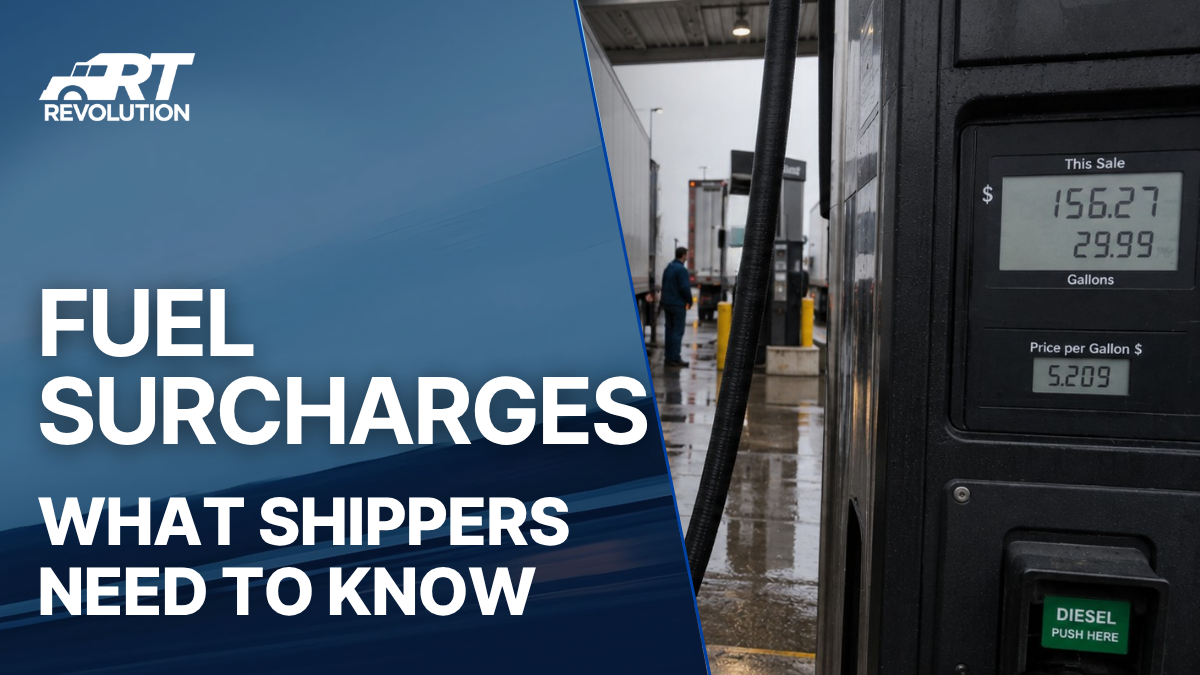
Every freight invoice includes a fuel surcharge. It appears as a separate line item — distinct from the base linehaul rate — and it adjusts week to week based on diesel prices. In 2026, with national average diesel at approximately $3.78 per gallon, fuel surcharges are running $0.42 to $0.55 per mile on truckload shipments. On a 1,000-mile haul, that is $420 to $550 layered on top of the base rate.
Most shippers accept fuel surcharges as a pass-through cost and do not examine the underlying calculation. This is a mistake. Fuel surcharges are not standardized. Every carrier uses its own formula, its own base price, its own fuel-efficiency assumption, and its own update schedule. Two carriers quoting the same base rate can produce materially different total costs because their fuel surcharge calculations differ — and the shipper who does not understand the formula cannot identify the difference.
This guide explains how fuel surcharges work, how they are calculated, which variables drive the number up or down, and what shippers should verify before accepting a carrier's fuel surcharge schedule as reasonable.
Why Fuel Surcharges Exist
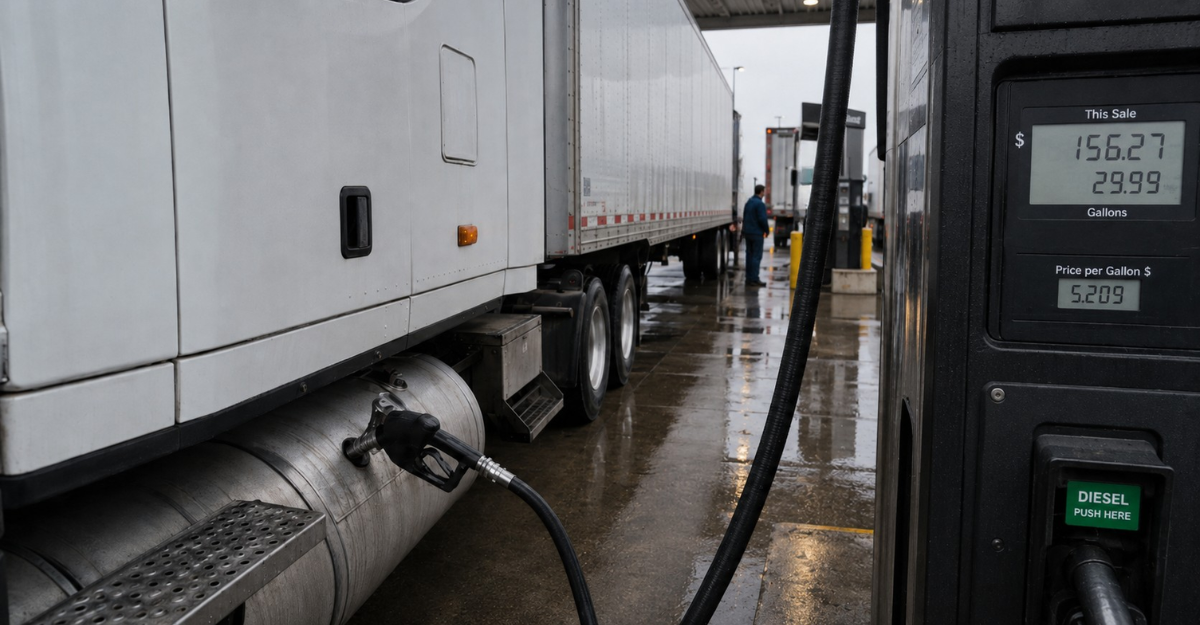
Fuel surcharges exist because diesel prices are volatile and carriers cannot absorb that volatility in a fixed rate. A carrier quoting a linehaul rate of $2.50 per mile is pricing the labor, equipment, insurance, overhead, and profit margin required to move the freight. If diesel rises $0.50 per gallon between the time the rate is quoted and the time the load moves, the carrier's cost per mile increases by approximately $0.08 (at 6.0 MPG) — which represents a meaningful share of the carrier's margin.
Before fuel surcharges became standard in the early 2000s, carriers built fuel cost assumptions into the base rate. When diesel prices spiked, carriers either absorbed the loss or renegotiated rates — neither of which served either party well. The fuel surcharge mechanism separates the volatile component (fuel) from the relatively stable components (everything else), allowing the base rate to hold while the surcharge adjusts with the market.
The fuel surcharge is not a profit center for well-run carriers — it is a cost-recovery mechanism. The surcharge should approximate the carrier's incremental fuel cost above a baseline price that is already embedded in the base rate. In practice, whether the surcharge actually tracks cost depends entirely on the formula's assumptions.
The DOE Diesel Index
The starting point for nearly every fuel surcharge calculation is the U.S. Department of Energy's weekly diesel price report, published by the Energy Information Administration (EIA). The DOE surveys approximately 350 retail diesel stations across the country and publishes a national average retail price every Monday.
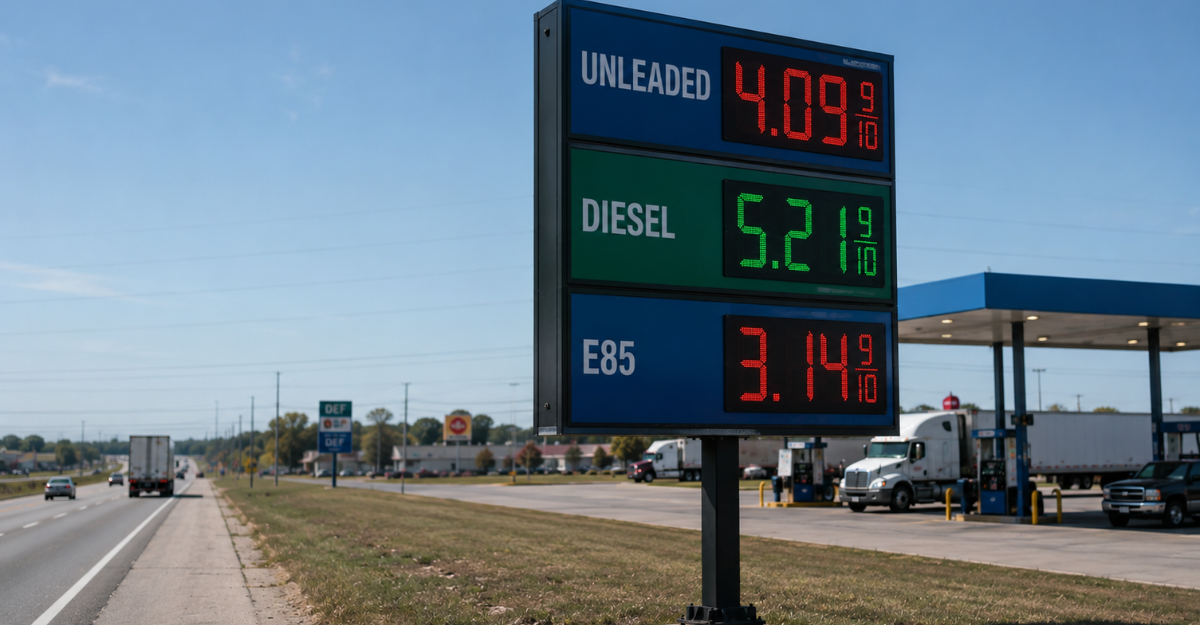
This number — referred to as the DOE diesel index, the EIA national average, or simply "the DOE number" — is the industry-standard reference price for fuel surcharge calculations. As of mid-2026, the national average has been fluctuating between $3.65 and $3.90 per gallon.
Regional Variation
The DOE also publishes regional averages for specific geographic areas: the East Coast, Midwest, Gulf Coast, Rocky Mountain, and West Coast. Regional diesel prices can differ significantly from the national average — the West Coast consistently runs $0.40 to $0.70 above the national number, while the Gulf Coast typically runs below it.
Some carrier fuel surcharge schedules reference a regional DOE number rather than the national average. This is worth noting because a carrier using the West Coast DOE for a West Coast lane will generate a higher surcharge than one using the national average — even if the base rate and all other variables are identical.
Update Frequency
Most carriers update their fuel surcharge weekly, typically on Monday or Tuesday, using the most recently published DOE number. Some update biweekly or monthly. The update lag matters in a volatile diesel market: a carrier updating monthly may be charging a surcharge based on a diesel price that is $0.15 to $0.20 different from the current price — in either direction.
How Fuel Surcharges Are Calculated
The Standard Formula
The most common fuel surcharge calculation uses three variables:
Current DOE price: The most recently published DOE national average diesel price.
Base price (also called the threshold or floor): A diesel price below which no fuel surcharge is charged. The base price represents the fuel cost that is already embedded in the carrier's linehaul rate. Common base prices in 2026 carrier agreements range from $1.10 to $1.25 per gallon, though legacy contracts from the mid-2000s sometimes carry base prices as low as $0.90.
Assumed MPG (miles per gallon): The fuel efficiency the carrier assumes its trucks achieve. Common assumptions range from 6.0 to 6.5 MPG. Some carriers use a higher MPG assumption (7.0 or more) for newer, more fuel-efficient equipment.
The formula: (Current DOE price − Base price) ÷ Assumed MPG = Per-mile fuel surcharge
Example: With a DOE price of $3.78, a base price of $1.20, and an assumed MPG of 6.0:
($3.78 − $1.20) ÷ 6.0 = $2.58 ÷ 6.0 = $0.43 per mile
On a 1,000-mile shipment, this produces a $430 fuel surcharge.
The Per-Penny Method
Some carriers use a simplified schedule that increases the surcharge by a fixed amount for each penny that diesel exceeds the base price. A common structure is a $0.01 per mile increase in the surcharge for every $0.06 increase in diesel above the baseline.
This method is mathematically equivalent to the standard formula with an assumed MPG of 6.0 (since $0.06 ÷ 6.0 MPG = $0.01 per mile). The per-penny method is easier to publish in a surcharge schedule table and is common in LTL carrier tariffs.
Percentage-Based Surcharges
LTL carriers and some truckload carriers express the fuel surcharge as a percentage of the linehaul charge rather than a per-mile amount. For example, a surcharge of 28% means the fuel surcharge is 28% of the base linehaul charge.
The percentage method has a structural feature that shippers should understand: the surcharge scales with the linehaul rate, not with the miles driven. A high-rate, short-haul shipment generates a larger absolute surcharge under the percentage method than the same mileage would under the per-mile method. Conversely, a low-rate, long-haul shipment generates a relatively smaller surcharge.
For shippers comparing LTL rates across carriers, the percentage-based fuel surcharge is the variable that most frequently creates non-obvious cost differences between otherwise similar quotes.
What Drives the Fuel Surcharge Up and Down
Diesel Price Movements
This is the obvious variable. Every $0.10 change in the DOE diesel price changes the per-mile surcharge by approximately $0.015 to $0.017 (at 6.0 to 6.5 MPG). Over a 1,000-mile shipment, a $0.50 swing in diesel — which has occurred multiple times in the past 24 months — translates to a $75 to $85 difference in the fuel surcharge alone.
Shippers with consistent freight volumes should track the DOE diesel index weekly. The number is publicly available on the EIA website. Understanding where diesel is trending provides leverage in rate negotiations and eliminates the possibility of a carrier's surcharge schedule lagging behind a price decline.
The Base Price
The base price is the single most impactful variable in the fuel surcharge formula, and it is the variable shippers most frequently overlook. A carrier with a base price of $1.10 produces a higher surcharge than a carrier with a base price of $1.25 — by $0.025 per mile at 6.0 MPG. On 10,000 miles of freight per month, that $0.15 base price difference generates $250 in additional surcharge cost. Over a year, it is $3,000 — from one variable in one formula.
Older contracts and legacy surcharge schedules sometimes carry base prices that no longer reflect realistic fuel cost assumptions. A base price of $0.90 per gallon — defensible when it was set in 2004 — produces a surcharge that is $0.05 per mile higher than a $1.20 base price. Shippers should verify the base price in every carrier's surcharge schedule and compare it against current market assumptions.
The MPG Assumption
The assumed MPG directly affects the surcharge calculation. A carrier assuming 6.0 MPG produces a surcharge of $0.43 per mile at current diesel prices. The same carrier with an assumed MPG of 6.5 produces $0.397 per mile — a $0.033 difference. A carrier claiming 5.5 MPG produces $0.469 per mile.
The MPG assumption should reflect the carrier's actual fleet fuel efficiency, which is influenced by equipment age, aerodynamic packages, tire specifications, speed-limiter settings, terrain, and cargo weight. Modern Class 8 trucks with aerodynamic fairings, automatic transmissions, and speed limiters routinely achieve 7.0 to 8.0 MPG in favorable conditions. A carrier running modern equipment and assuming 5.5 MPG in its surcharge formula is building margin into the surcharge.
Shippers can ask carriers what their fleet's actual fuel efficiency is and compare it against the MPG assumption in the surcharge schedule. The two numbers should be reasonably close.
What Shippers Should Verify
Compare Surcharge Schedules Side by Side
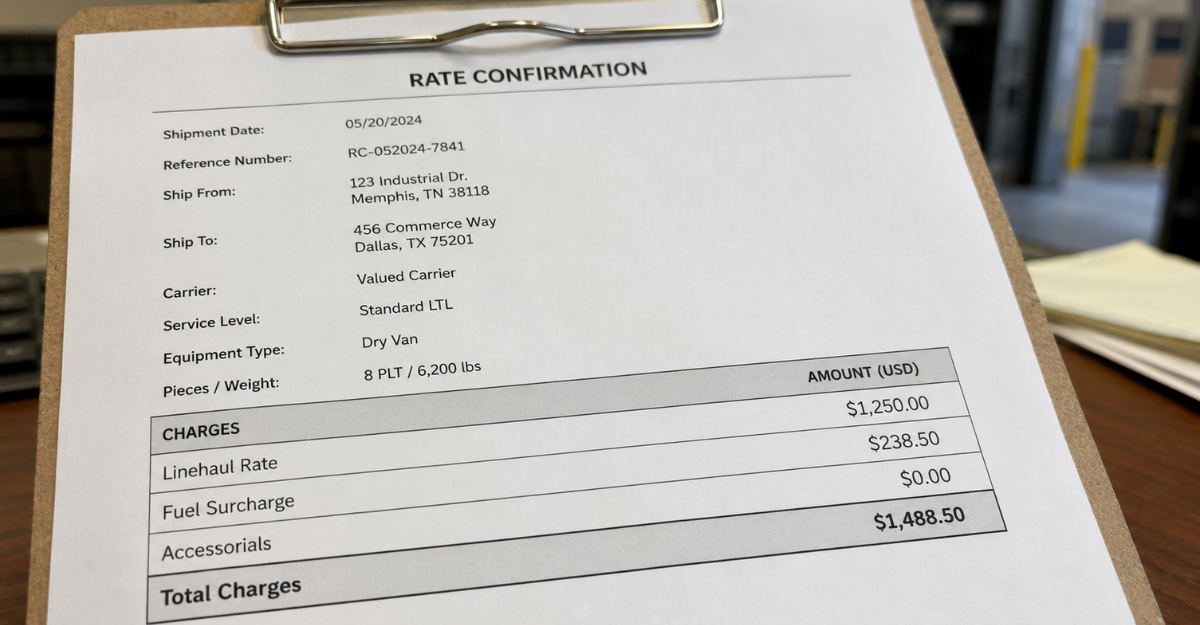
When evaluating carriers, request the full fuel surcharge schedule from each. Place them side by side at the same DOE reference price and calculate the per-mile surcharge each would produce. A carrier with a lower base rate but a higher surcharge may not be the cheaper option once the total cost is computed. Understanding the true cost of service requires looking at the complete picture, not the base rate alone.
Verify the DOE Reference
Confirm which DOE number the carrier uses — national average, regional average, or something else. If the carrier uses a regional average for a region with consistently higher diesel prices, the surcharge will be structurally higher than a carrier using the national number. This is not necessarily wrong (regional carriers operating in high-cost areas have higher actual fuel costs), but it should be understood and accounted for in the total cost comparison.
Check the Update Frequency
A carrier that updates its fuel surcharge monthly in a rising diesel market is undercharging for the first three weeks and overcharging in a declining market. Weekly updates aligned with the DOE publication schedule provide the closest approximation to actual fuel costs for both parties.
Ask About Fuel Hedging
Some larger carriers hedge their diesel exposure in the futures market. A carrier that has hedged fuel at $3.50 per gallon is protected from price increases above that level — but may still charge a surcharge based on the full DOE price. The shipper should understand whether the carrier's surcharge reflects actual fuel costs or DOE index costs. For most mid-size and smaller carriers, hedging is not practical and the surcharge genuinely tracks the carrier's fuel expense.
Fuel Surcharges in Different Modes
Truckload
Truckload fuel surcharges are almost universally calculated on a per-mile basis using the DOE index. The surcharge applies to loaded miles only — the carrier does not charge a fuel surcharge for deadhead miles, though deadhead fuel cost may be built into the base rate. In the spot market, fuel surcharges are often bundled into an all-in rate rather than broken out separately. When comparing spot rates to contract rates, shippers should determine whether the spot quote includes or excludes the fuel surcharge.
LTL
LTL fuel surcharges are typically expressed as a percentage of the linehaul charge and are updated weekly. LTL surcharge percentages are published in the carrier's tariff and apply uniformly to all shipments. Because the surcharge is a percentage of a rate that already includes density, class, and accessorial factors, the absolute dollar amount of the LTL fuel surcharge can vary significantly between shipments of different characteristics — even if the diesel price is the same.
Flatbed and Specialized
Flatbed and specialized carriers may use higher surcharge rates than dry van carriers because their equipment achieves lower fuel efficiency (the open deck creates more aerodynamic drag) and their routes may include more mountainous terrain or urban congestion. Shippers moving flatbed freight should compare surcharge schedules across flatbed-specific carriers rather than benchmarking against dry van surcharge levels.
Intermodal
Intermodal fuel surcharges are generally lower than over-the-road truckload surcharges because rail is approximately four times more fuel-efficient than truck. The intermodal surcharge typically covers both the drayage component (truck fuel from origin to rail terminal and from rail terminal to destination) and the rail component (a pass-through from the railroad's own fuel surcharge). The combined intermodal surcharge is usually 40 to 60 percent lower than the equivalent over-the-road truckload surcharge for the same lane.
Frequently Asked Questions
How is a trucking fuel surcharge calculated? The standard formula is: (Current DOE diesel price − Base price) ÷ Assumed MPG = Per-mile fuel surcharge. With a DOE price of $3.78, a base price of $1.20, and an assumed MPG of 6.0, the surcharge is $0.43 per mile. LTL carriers often use a percentage of the linehaul charge instead. The variables differ by carrier, so two carriers with the same base rate can produce different total costs.
What is the DOE diesel index? The DOE diesel index is the national average retail diesel price published weekly by the U.S. Energy Information Administration (EIA). It is based on surveys of approximately 350 retail diesel stations and serves as the industry-standard reference for fuel surcharge calculations. Regional averages (East Coast, Midwest, Gulf Coast, Rocky Mountain, West Coast) are also published and may be used by carriers operating primarily in those regions.
What is a good base price for a fuel surcharge schedule? In 2026, typical base prices in carrier agreements range from $1.10 to $1.25 per gallon. The base price represents the fuel cost already built into the linehaul rate. A lower base price produces a higher surcharge. Legacy contracts from the mid-2000s may carry base prices as low as $0.90, which significantly inflates the surcharge relative to current market norms.
Why do fuel surcharges differ between carriers? Fuel surcharges differ because each carrier sets its own base price, MPG assumption, DOE reference (national vs. regional), and update frequency. A $0.15 difference in the base price changes the per-mile surcharge by $0.025 at 6.0 MPG. Over 10,000 miles per month, that single variable creates a $3,000 annual cost difference.
Do spot freight rates include fuel surcharges? Spot market rates are often quoted as all-in numbers that include the fuel surcharge. Contract rates almost always break out the fuel surcharge as a separate line item. When comparing spot and contract rates, shippers must determine whether the spot quote includes fuel to make an accurate comparison. Asking "is this rate inclusive of fuel?" should be standard practice on every spot quote.
How do LTL fuel surcharges differ from truckload? LTL fuel surcharges are expressed as a percentage of the linehaul charge, while truckload surcharges are calculated on a per-mile basis. The LTL percentage method means the absolute fuel surcharge amount scales with the shipment's rate rather than its distance. A high-class, high-rate LTL shipment generates a larger fuel surcharge than a low-class shipment covering the same miles.
other blog posts
.webp)
%2520(5).webp)
%2520(3).webp)
.webp)
%2520(1).webp)
%2520(1).webp)