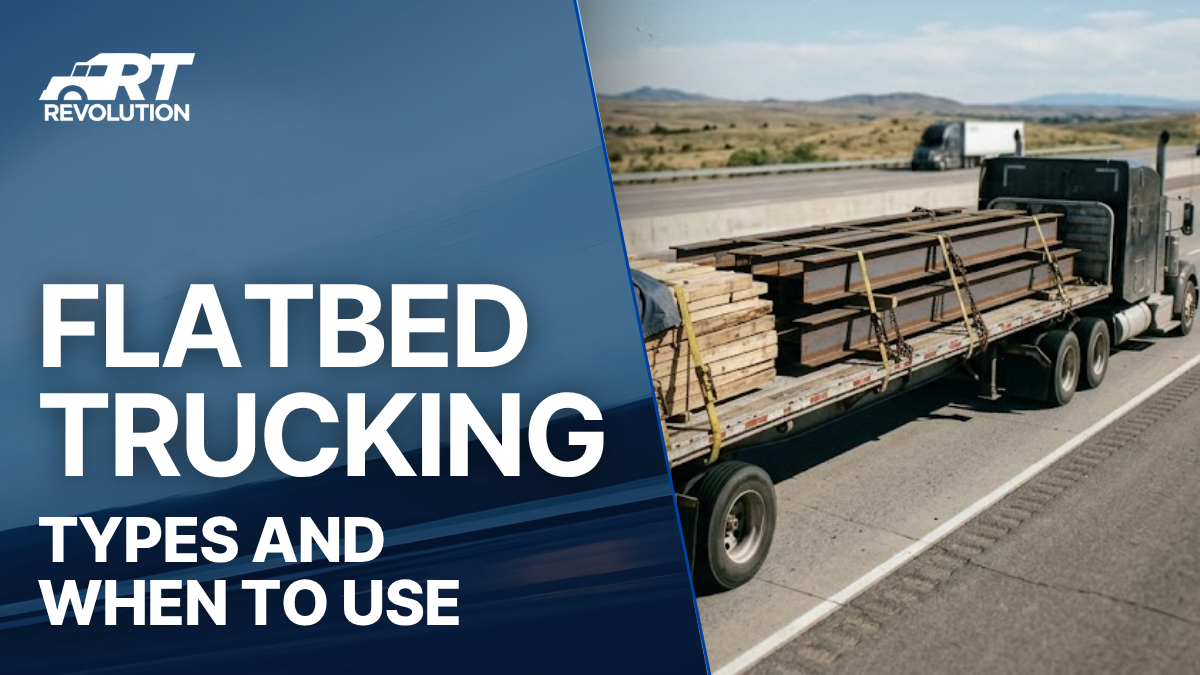
Flatbed freight is the tightest segment of the 2026 trucking market. National average flatbed rates have reached $3.72 per mile — a record — driven by infrastructure spending, construction activity, and the same capacity contraction affecting every mode. Specialized open-deck equipment is harder to source than dry van or reefer capacity, and the gap is widening.
For shippers whose freight does not fit inside an enclosed trailer — oversized equipment, structural steel, machinery, construction materials, pipe, lumber, or anything that must be loaded from the top or side — flatbed is not a preference. It is a requirement. And within the flatbed category, the differences between trailer types determine whether the freight moves safely, legally, and cost-effectively or whether it does not move at all.
This guide covers the five primary flatbed trailer types, FMCSA cargo securement requirements, the cost factors that drive flatbed pricing, and how to determine which open-deck configuration matches your freight.

Why Freight Moves on Flatbed
Enclosed trailers — dry vans, reefers — are boxes. They are loaded through rear doors (and occasionally through side doors), and the freight must fit within the interior dimensions: approximately 53 feet long, 8 feet 6 inches wide, and 9 feet of interior height. Anything that exceeds those dimensions, cannot be loaded through a door, or requires crane or forklift access from above or the side requires open-deck equipment.
The common categories of flatbed freight include structural steel and fabricated metal, construction equipment and building materials, heavy machinery and industrial equipment, lumber and building products, pipe and tubing, oversized manufactured components, military and government equipment, and energy-sector freight (transformers, turbine components, solar panel assemblies).
The unifying characteristic is that the freight either exceeds enclosed trailer dimensions, requires loading access that doors cannot provide, or is heavy enough that it needs the structural capacity of an open-deck platform rather than a box trailer floor.
Flatbed Trailer Types
Standard Flatbed
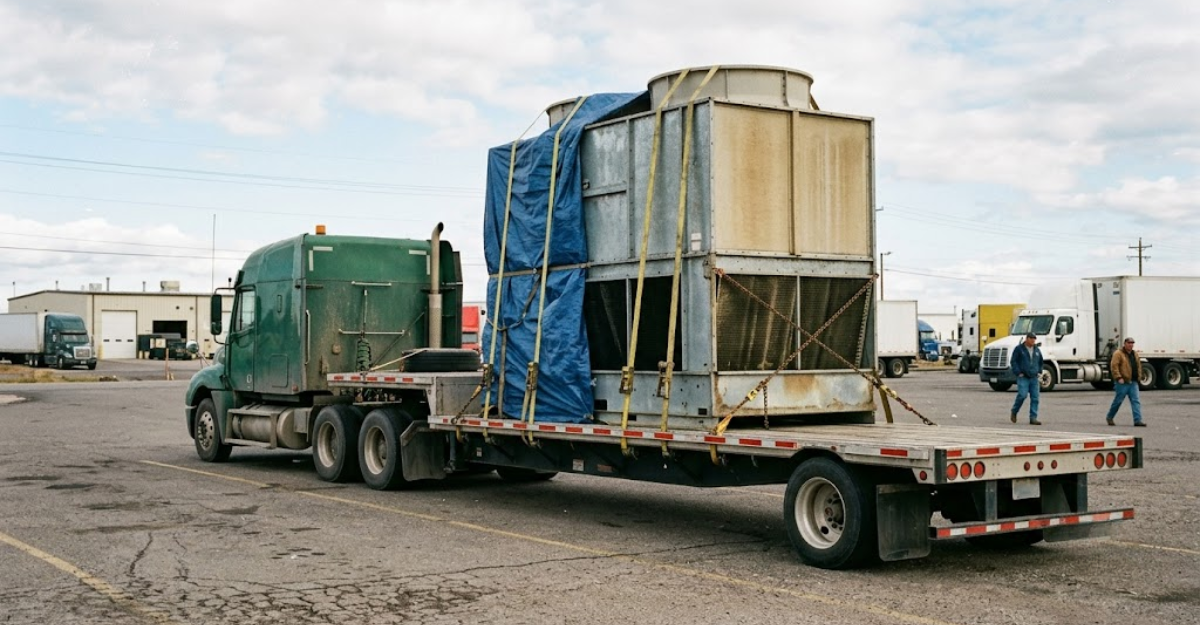
The standard flatbed — sometimes called a skateboard — is the most common open-deck trailer and handles approximately 60 percent of all flatbed freight. It is a flat steel or aluminum deck with no sides, no roof, and no doors.
Dimensions: 48 to 53 feet long, 8 feet 6 inches wide. Deck height is approximately 60 inches (5 feet) from the ground.
Weight capacity: Up to 48,000 pounds, depending on the number of axles and the tractor configuration.
Maximum freight height: With a deck height of 60 inches and a standard legal height limit of 13 feet 6 inches, the maximum freight height on a standard flatbed is approximately 8 feet 6 inches.
Best for: Freight that fits within standard height limits, can be loaded from the top or side with a forklift or crane, and does not require weather protection during transit. Structural steel, lumber, pipe, palletized building materials, and standard-sized industrial equipment are the core standard flatbed commodities.
Loading flexibility: Full top-loading and side-loading access. No door restrictions. Multiple forklifts or cranes can work simultaneously from both sides of the trailer.

Step Deck (Drop Deck)
A step deck trailer has two levels: an upper deck at the front (approximately 60 inches from the ground, same as a standard flatbed) and a lower deck at the rear (approximately 36 to 42 inches from the ground). A step — typically 12 to 22 inches — transitions between the two levels.
Dimensions: 48 to 53 feet total length. The upper deck is typically 10 to 12 feet long. The lower deck is 37 to 40 feet long.
Weight capacity: Up to 43,000 to 48,000 pounds, depending on configuration.
Maximum freight height: The lower deck's reduced height from the ground provides approximately 10 feet of legal freight height — roughly 18 inches more than a standard flatbed. This is the primary reason shippers specify step decks: the freight is too tall for a standard flatbed but does not require the extreme low clearance of a double drop.
Best for: Tall machinery, overheight industrial equipment, large HVAC units, generators, tall fabricated structures. Any freight between 8 feet 6 inches and 10 feet tall that would require an overheight permit on a standard flatbed can often move legally on a step deck without permits.
Loading note: The lower deck is loaded from the rear. The upper deck can be loaded from the top but is limited in accessible length. Some step decks have removable ramps for driving equipment onto the lower deck.
Double Drop (Lowboy)
A double drop trailer — also called a lowboy — has three sections: a raised front (gooseneck), an extremely low center section called the well, and a raised rear over the axles. The well sits just 18 to 24 inches from the ground.
Dimensions: Well length is typically 24 to 29 feet. Total trailer length is 48 to 53 feet.
Weight capacity: 40,000 to 80,000+ pounds, depending on the number of axles. Multi-axle lowboy configurations are specifically designed for extremely heavy freight.
Maximum freight height: With a well height of 18 to 24 inches, the legal freight height in the well is approximately 11 feet 6 inches to 12 feet — the most vertical clearance of any standard trailer configuration.
Best for: Extremely tall or heavy freight: construction equipment (excavators, bulldozers, cranes), industrial machinery, large electrical transformers, oversized fabricated components. Freight that would require overheight permits on any other trailer type often fits legally in a lowboy well.
Loading note: Equipment is typically driven onto the lowboy from a ramp at the rear, or crane-loaded into the well from above. The raised front and rear sections limit the usable length to the well — freight that extends beyond the well in either direction may require special permitting.
RGN (Removable Gooseneck)
An RGN trailer is a lowboy variant where the front gooseneck section detaches and lowers to the ground, creating a drive-on ramp from the front. This eliminates the need for a rear ramp or crane loading for self-propelled equipment.
Dimensions: Similar to a double drop — well length of 24 to 29 feet, total length of 48 to 53 feet.
Weight capacity: 42,000 to 150,000+ pounds. Multi-axle RGN configurations (up to 20+ axles) are purpose-built for the heaviest freight in the transportation system — transformers, reactor vessels, bridge sections, mining equipment.
Maximum freight height: Same as a lowboy — approximately 11 feet 6 inches to 12 feet of legal height in the well.
Best for: Heavy self-propelled equipment that can drive onto the trailer (excavators, dozers, wheel loaders, cranes), or extremely heavy non-self-propelled freight that requires front-loading by pushing or rolling onto the deck. The RGN's drive-on capability eliminates the cost and complexity of crane loading at origin.
Cost note: RGN trailers are more expensive to operate than standard flatbeds or step decks because the specialized equipment, higher insurance requirements, and permit costs for overweight loads are all reflected in the rate. RGN rates routinely exceed $5 per mile for permitted loads.

Conestoga
A Conestoga trailer is a flatbed with a built-in retractable tarp system — a rolling cover that rides on side-mounted tracks. When closed, the Conestoga provides full weather protection equivalent to a dry van. When open, it provides full top and side loading access equivalent to a flatbed.
Dimensions: Available on standard flatbed, step deck, and double drop platforms. Dimensions match the underlying trailer type.
Weight capacity: Slightly less than the equivalent open flatbed due to the weight of the tarp system itself (typically 1,500 to 2,500 pounds of tarp mechanism weight reduces cargo capacity).
Best for: Freight that needs flatbed loading access but also requires weather protection during transit. Finished metal products that cannot be exposed to rain, painted or coated surfaces, electronics or electrical equipment that must ship on a flatbed due to size but cannot tolerate moisture, and high-value goods where tarp damage claims are a concern.
Cost note: Conestoga capacity is significantly scarcer than standard flatbed capacity. Conestoga rates carry a premium of 15 to 30 percent above standard flatbed rates — sometimes more in tight markets — because fewer carriers operate Conestoga equipment and driver demand for Conestoga loads is lower (the tarp systems add setup time at every stop).

FMCSA Cargo Securement Rules
Every flatbed load is subject to FMCSA's cargo securement regulations (49 CFR Part 393, Subpart I). Unlike enclosed trailers where the walls and roof provide passive containment, flatbed freight has no containment structure. Every piece of cargo must be independently secured against movement in all directions — forward, rearward, lateral, and vertical.
Tiedown Requirements
The minimum number of tiedowns depends on the length of the cargo:
Cargo 5 feet or shorter requires at least one tiedown. Cargo longer than 5 feet but no more than 10 feet requires at least two tiedowns. Cargo over 10 feet requires two tiedowns for the first 10 feet plus one additional tiedown for every additional 10 feet or fraction thereof.
Additionally, the combined working load limit (WLL) of all tiedowns must equal at least 50 percent of the cargo weight. A 20,000-pound load requires tiedowns with a combined WLL of at least 10,000 pounds. This is where securement failures most commonly occur: shippers and carriers apply enough straps to meet the count requirement but do not verify that the aggregate WLL meets the weight requirement.

Inspection Requirements
Federal rules require a securement inspection within the first 50 miles of a trip, and then again every 150 miles or 3 hours of driving, whichever comes first. At each inspection, the driver must verify that all tiedowns are tight, that no cargo has shifted, and that no tiedown has become damaged or loose.
Consequences of Non-Compliance
Combined state and federal penalties for cargo securement violations can exceed $8,000 per incident. More significantly, a securement violation during a DOT inspection results in the vehicle being placed out of service until the violation is corrected. The load does not move until the securement meets the standard — which means the delivery is late, the driver's hours are consumed, and the shipper's schedule is disrupted.
For shippers of high-value or mission-critical freight, carrier securement practices are not a detail to assume. They are a qualification criterion. Ask the carrier: what securement training do drivers receive? What equipment (chains, binders, straps, edge protectors, dunnage) does the carrier provide on every flatbed? How are securement inspections documented?
What Drives Flatbed Pricing
Flatbed rates are consistently higher than dry van or reefer rates, and the premium has widened in 2026. Several factors specific to open-deck freight drive the cost structure:
Equipment Scarcity
Flatbed trailers represent a smaller share of the total trailer population than dry vans. When demand for flatbed capacity increases — as it has in 2026 with infrastructure and construction spending — the supply constraint bites faster. There is no surplus flatbed capacity to absorb demand spikes the way there is (or was) in the dry van market.
Driver Specialization
Flatbed driving requires skills that enclosed-trailer driving does not: tarping, securement, load planning, and physical handling of chains, binders, and straps in all weather conditions. Flatbed drivers are harder to recruit and retain, and they command a pay premium. That premium is embedded in the rate.
Tarping and Securement Time
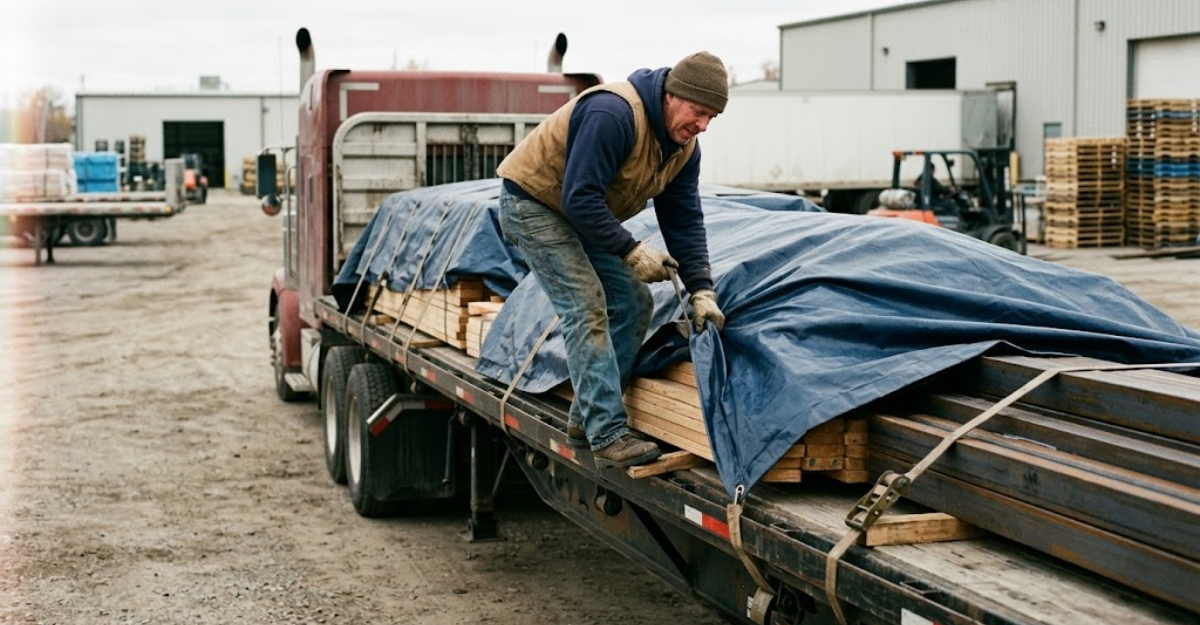
A standard flatbed load requires 45 minutes to 2 hours of tarping and securement at origin, and a comparable amount of time for untarping and de-securement at destination. This non-driving time reduces the driver's available driving hours and the carrier's daily productivity. The time cost is reflected in the rate.
Deadhead Exposure
Flatbed freight is more directionally imbalanced than dry van freight. A carrier that delivers steel from a mill in Indiana to a construction site in Florida may have limited options for a backhaul load from Florida — flatbed freight originates disproportionately from manufacturing and industrial regions. The deadhead miles back to a productive origin are built into the loaded rate.
Permit and Escort Costs
Oversize or overweight flatbed loads require state-specific permits, and some require pilot cars or escort vehicles. These costs — which can range from a few hundred dollars for a single-state overwidth permit to $10,000 or more for a multi-state heavy-haul move with escorts — are passed through to the shipper as line items or are baked into the rate.
How to Choose the Right Flatbed Trailer
The decision framework is driven by four freight characteristics:
Height. If the freight is under 8 feet 6 inches tall, a standard flatbed works. Between 8 feet 6 inches and 10 feet, a step deck avoids overheight permits. Above 10 feet, a double drop or RGN is required.
Weight. Standard flatbeds and step decks handle up to 43,000 to 48,000 pounds. Loads exceeding that threshold require multi-axle lowboy or RGN configurations, with the associated permits and rate premiums.
Loading method. Self-propelled equipment that can drive onto the trailer favors an RGN (front ramp) or a step deck with a rear ramp. Crane-loaded freight works on any platform. If no crane is available at origin and the freight is not self-propelled, the loading method constraints narrow the trailer options.
Weather sensitivity. Freight that cannot be exposed to weather during transit requires either a Conestoga or manual tarping. Conestoga provides more reliable protection than manual tarps but carries a rate premium and is harder to source.
For shippers evaluating whether open-deck freight should move flatbed, partial truckload, or via another configuration, the decision often depends on dimensions and weight rather than volume. A shipment that is physically small but oversized for enclosed equipment — a 12-foot-tall piece of machinery that weighs 8,000 pounds — needs flatbed capacity even though its weight would fit easily on a dry van.
Understanding how mode selection intersects with freight characteristics prevents mismatches between the freight and the equipment — mismatches that produce delays, damage, and costs that exceed the rate premium of the correct trailer type.
The 2026 Flatbed Market
The flatbed segment entered 2026 at record pricing and has not softened. Several market forces are compounding:
Infrastructure spending from federal programs continues to generate demand for steel, concrete, heavy equipment, and building materials — all core flatbed commodities.
The capacity contraction affecting all trucking modes hits flatbed disproportionately because flatbed carriers skew smaller (more exposed to insurance cost pressure and carrier exits) and flatbed drivers are harder to replace.
Regional rate variation is significant. The Southeast is running $4.05 per mile, while the West Coast averages $3.23 per mile. Shippers whose freight moves through high-rate regions should factor the geographic premium into their budgets.
For shippers who regularly move flatbed freight, the strategic response is the same as in every tight-capacity segment: build carrier relationships with asset-based carriers who own flatbed equipment, commit volume to secure capacity allocation, and plan lead times that account for the equipment sourcing challenge.
Frequently Asked Questions
What is the difference between a flatbed and a step deck? A standard flatbed has a single flat deck approximately 60 inches from the ground, providing about 8 feet 6 inches of legal freight height. A step deck has a lowered rear section (36 to 42 inches from the ground) that provides approximately 10 feet of legal freight height. Shippers choose step decks when the freight is too tall for a standard flatbed but does not require the extreme low clearance of a double drop.
When do I need an RGN trailer? An RGN (removable gooseneck) is required when self-propelled equipment needs to drive onto the trailer from the front, or when extremely heavy freight (over 48,000 pounds) requires a multi-axle configuration. The removable gooseneck lowers to the ground to create a drive-on ramp, eliminating the need for crane loading. RGN rates are higher due to specialized equipment, permitting, and insurance costs.
What are FMCSA cargo securement requirements for flatbed loads? FMCSA requires at least one tiedown for cargo 5 feet or shorter, two for cargo up to 10 feet, and one additional tiedown for every 10 feet beyond that. The combined working load limit of all tiedowns must equal at least 50 percent of the cargo weight. Securement must be inspected within the first 50 miles and every 150 miles or 3 hours thereafter. Violations can exceed $8,000 and result in out-of-service orders.
What is a Conestoga trailer? A Conestoga is a flatbed with a retractable rolling tarp system that provides weather protection when closed and full top/side loading access when open. Conestoga trailers are ideal for freight that needs flatbed loading access but cannot be exposed to weather — finished metals, painted surfaces, electrical equipment. Conestoga rates carry a 15 to 30 percent premium over standard flatbed due to limited equipment availability.
Why are flatbed rates higher than dry van rates? Flatbed rates are higher because of equipment scarcity, driver specialization requirements, non-driving time for tarping and securement, directional freight imbalances that create deadhead miles, and permit costs for oversized loads. In 2026, national average flatbed rates are $3.72 per mile, driven to record levels by infrastructure spending and the broader capacity contraction.
How do I determine the right flatbed trailer type for my freight? Four factors drive the decision: height (standard flatbed for under 8'6", step deck for 8'6" to 10', double drop/RGN for over 10'), weight (standard equipment up to ~48,000 lbs, multi-axle for heavier), loading method (self-propelled equipment favors RGN, crane-loaded works on any platform), and weather sensitivity (Conestoga or manual tarping for weather-sensitive freight).
other blog posts

%2520(1).webp)
%2520(1).webp)

.webp)
.png)