LTL, Partial, Expedite, or White Glove: A Manufacturer's Guide to Shipping Mode Selection
When should a manufacturer use LTL, partial truckload, expedited, or white glove freight? This mode selection guide uses right-when/wrong-when decision logic and real failure scenarios to match shipping modes to manufacturing freight risk.
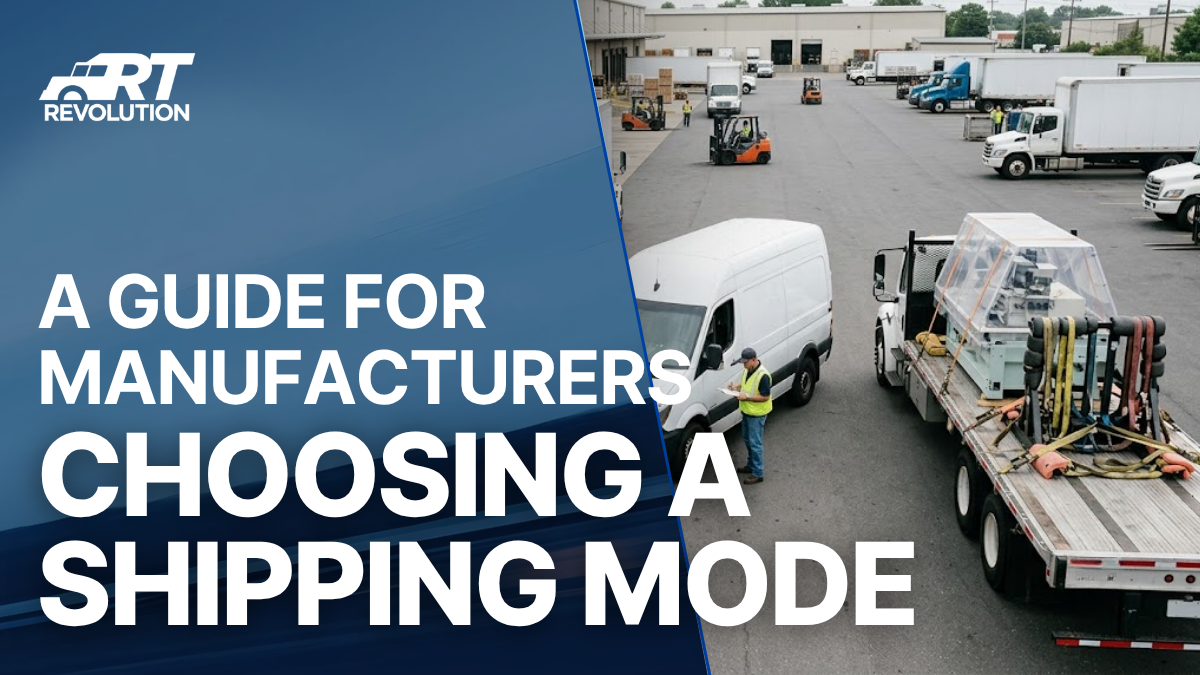
Four shipping modes handle the vast majority of outbound and inbound freight for tooling manufacturers, machine shops, and precision component producers: LTL (less-than-truckload), partial truckload, expedited, and white glove. Each mode exists because it solves a specific logistics problem. None of them is universally correct. The manufacturers that spend the least on freight — measured in total cost, not invoice cost — are the ones that match mode to shipment rather than defaulting to one mode for everything.
That matching is where most manufacturing freight programs break down. The shipping dock has a rate board and a list of LTL carriers. Anything that does not fit a standard LTL pickup gets a phone call to the sales rep who answers fastest. The decision between LTL, partial, expedited, and white glove is made reactively, under time pressure, with incomplete information about the downstream consequences of the choice. The result is a freight program that overspends on some shipments and underprotects others — sometimes both in the same week.
This guide provides the decision logic for matching mode to shipment. For each of the four modes, it specifies the conditions under which the mode is the right choice and — equally important — the conditions under which it is the wrong choice. It then walks through three anonymized scenarios drawn from actual manufacturing freight failures to illustrate how the decision logic applies in practice.
LTL (Less-Than-Truckload)
What It Is
LTL shipping consolidates freight from multiple shippers onto shared trailers, with each shipper paying for the space their freight occupies rather than the entire trailer. Shipments move through a network of carrier terminals, where they are sorted and transferred between trailers based on destination. A typical LTL shipment involves four to six handling events between pickup and delivery: loading at origin, one or more terminal sorts, cross-docking between line-haul trailers, and final delivery.
LTL is the most cost-efficient mode for shipments that do not require a full trailer — typically freight weighing between 150 and 15,000 pounds. It is the default mode for the majority of manufacturing freight, and for good reason: for freight that fits its operating model, LTL provides reliable service at rates that reflect shared infrastructure costs rather than dedicated equipment charges.
Right When
LTL is the correct mode when five conditions are met simultaneously. The freight is well-packaged and mechanically robust — it can withstand forklift handling, pallet stacking, and the lateral movement that occurs during terminal sorting. The delivery timeline has flexibility — a one- to two-day variance from the quoted transit time will not trigger production disruptions or customer escalations. The parts are replaceable within a reasonable window — if damage occurs, replacement stock is available or can be produced without displacing critical production capacity. The value-to-weight ratio does not create a significant gap between the part's actual worth and the carrier's weight-based liability coverage. And the notification requirements are simple — the recipient does not need proactive communication about transit status beyond what standard carrier tracking portals provide.
When all five conditions hold, LTL is not just acceptable. It is optimal. Paying for partial truckload or dedicated service on freight that meets LTL's operating parameters is a misallocation of logistics budget that could be directed toward shipments where the risk profile actually warrants premium service.
Wrong When
LTL becomes the wrong mode when any of those five conditions breaks. The most common failure pattern in manufacturing is shipping precision components via LTL because the rate is right while ignoring that the freight's risk profile has changed. A part that was routine when it shipped to a customer's warehouse for inventory becomes high-risk when the same part ships directly to an assembly line with a 48-hour installation window. The freight is identical. The failure cost is not.
Specific conditions that disqualify LTL for precision manufacturing freight include surface finishes that cannot tolerate contact with other freight or packaging debris, dimensional tolerances tight enough that minor handling impacts could push the part out of spec, delivery commitments tied to fixed-schedule events where a one-day delay cascades into multi-week rescheduling, and components whose replacement timeline exceeds the customer's tolerance for delay.
The decision to move freight off LTL should not require a crisis. It should be a planned, scorecard-driven decision made before the shipment is booked. (For a structured assessment framework, see 5 Questions to Ask Before Shipping Precision Parts.)
.png)
Partial Truckload
What It Is
Partial truckload shipping occupies the space between LTL and full truckload. The freight is loaded onto a trailer at origin and stays on that trailer until it reaches the destination — no terminal sorts, no cross-docking, no intermediate handling. The shipper shares the trailer cost with one or two other shippers whose freight is routed in the same direction, but the individual shipment never leaves the original trailer.
The operational advantage is straightforward: fewer touches mean fewer opportunities for damage, delay, or scheduling failures. A typical partial truckload shipment involves two handling events — loading and unloading — compared to four to six for LTL. The transit time is generally faster than LTL because the shipment bypasses the terminal network. The rate falls between LTL and dedicated full truckload, typically 30 to 80 percent above standard LTL for comparable weight and distance.
Right When
Partial truckload is the correct mode for shipments where the freight's value, fragility, or schedule dependency exceeds what LTL's handling model can reliably protect — but the shipment does not require the dedicated equipment, driver, or service level that full truckload or white glove provides.
The sweet spot for partial truckload in manufacturing is freight in the 4,000 to 12,000 pound range where the parts are too valuable for terminal handling but the shipment is not large enough or time-critical enough to justify a full truckload rate. Custom-machined components with critical surface finishes, partially assembled fixtures that cannot be restacked, oversized tooling components that require specific trailer positioning, and multi-piece shipments where the relationship between pieces must be maintained are all candidates.
Partial is also the correct mode when the primary risk driver is handling frequency rather than speed. A shipment that can tolerate a three-day transit time but cannot tolerate six handling events belongs in partial — not because the delivery needs to be faster, but because the freight needs to be touched fewer times.
Wrong When
Partial truckload is wrong when the shipment genuinely needs LTL (low risk, routine freight, no schedule dependency) or when it genuinely needs dedicated service (time-critical, ultra-high-value, installation-specific handling requirements). Using partial for a pallet of catalog hardware with flexible delivery is overspending. Using partial for a $200,000 calibrated instrument that needs climate-controlled transport and white glove installation is underprotecting.
Partial is also the wrong mode when the shipper's primary concern is delivery speed. Partial truckload routes are driven by consolidation opportunities — the carrier matches multiple shipments heading in compatible directions. If the lane does not have a consolidation partner, the shipment may wait for one, extending transit beyond what a dedicated truck would require. For time-definite delivery requirements, expedited or dedicated service provides the schedule control that partial cannot guarantee.
Expedited Freight
What It Is
Expedited freight is dedicated transportation with time-definite delivery. A truck — sometimes a full tractor-trailer, sometimes a sprinter van or straight truck — is dispatched exclusively for the shipper's freight and runs directly from origin to destination. There are no consolidation stops, no terminal transfers, and no shared trailer space. The driver may run team (two drivers alternating to eliminate mandatory rest stops) for the most time-critical shipments.
Expedited rates reflect the dedicated nature of the service. A shipment that would cost $400 via LTL or $700 via partial might cost $2,500 to $5,000 via expedited, depending on distance, timing, and equipment requirements. The rate premium is substantial, and it should be — the shipper is buying certainty, not just transportation.
Right When
Expedited is the correct mode in two categories of situation, and the distinction between them matters.
The first is planned expedite — a shipment that, based on its risk profile and schedule requirements, is identified in advance as requiring time-definite dedicated service. A one-of-one prototype shipping to a customer validation event. A replacement die component shipping to a production line that is down. A final assembly shipping to meet a contractual delivery deadline with liquidated damages for late performance. These are shipments where the cost of failure is known, quantified, and substantially exceeds the expedite premium.
The second is emergency expedite — a recovery action taken after a prior freight decision has failed. The original LTL shipment was damaged. The partial truckload missed its delivery window. The supplier's inbound material arrived late and now the outbound customer delivery is at risk. Emergency expedite is the cost of correcting a prior mistake, and the rate reflects the urgency.
Both categories produce the same carrier experience: dedicated equipment, direct routing, time-definite delivery. The difference is financial. Planned expedite is a budgeted logistics cost. Emergency expedite is an unplanned recovery expense that often exceeds what appropriate mode selection on the original shipment would have cost.
Wrong When
Expedited is the wrong mode when it becomes a habit rather than a response. One of the most expensive patterns in manufacturing freight is chronic expedite spending — a manufacturer that spends $15,000 to $30,000 per month on emergency shipments because the underlying freight program does not match service levels to shipment risk.
When expedite spending reaches this level, the problem is almost never speed. It is coordination. The manufacturer's inbound suppliers are missing pickup windows. The production schedule does not account for realistic freight transit times. Carrier communication failures are causing exceptions that go undetected until recovery requires dedicated trucks. The solution is not more expedited freight. It is a freight program that identifies and addresses the upstream failures driving the expedite demand.
A manufacturer spending $20,000 per month on emergency expedite should examine whether $5,000 of that spend, redirected to better inbound coordination and appropriate mode selection on outbound shipments, would eliminate the conditions that create the emergencies. In most cases, it will.
Expedited is also the wrong mode for freight that does not actually require time-definite delivery. A shipment with a flexible two-week delivery window does not need a dedicated truck running direct, regardless of the part's value. Value alone does not dictate mode — value combined with schedule dependency and failure cost dictates mode.
White Glove Delivery
.png)
What It Is
White glove delivery provides specialized handling beyond standard freight transportation. The definition varies by provider, but in the manufacturing context, white glove typically includes inside delivery (freight placed in a specific location within the facility, not just left at the dock), uncrating or depalletizing, debris removal, installation assistance, and specialized equipment (air-ride trailers, climate control, hydraulic liftgates, rigging equipment).
White glove is the highest-cost freight mode and the most labor-intensive. Rates depend heavily on the specific services required, the equipment needed, and the delivery environment. A white glove delivery requiring a two-person crew, inside placement to a second-floor mezzanine, and debris removal will cost substantially more than dock-to-dock LTL for the same freight.
Right When
White glove is the correct mode when the freight requires handling that exceeds what a standard driver delivery can provide. This includes shipments to facilities without loading docks, freight that must be placed in a specific location within a building, equipment that requires uncrating and inspection at the destination, components that need climate-controlled transit to maintain calibration or material properties, and deliveries to active construction sites or data center builds where the freight must be moved from the truck to a precise interior location.
In manufacturing, white glove is most frequently specified for finished equipment deliveries — CNC machines, precision measurement instruments, custom tooling assemblies — where the freight's value, fragility, and installation requirements demand specialized handling from trailer to final placement. The decision to use white glove on these shipments is rarely controversial because the consequences of standard handling are visibly catastrophic.
Wrong When
White glove is wrong when the services it provides are not required by the freight or the delivery environment. A precision component shipping to a customer's receiving dock — where the customer has forklifts, dock plates, and trained receiving personnel — does not need inside delivery, uncrating, or placement services. Paying for white glove on dock-to-dock freight that the customer's team will handle upon arrival is waste.
The most common misapplication of white glove in manufacturing is using it as a proxy for "careful handling" when what the shipment actually needs is reduced touches (partial truckload) or time-definite delivery (expedited). White glove addresses the final-mile handling problem. If the risk is in the line-haul portion of the transit — terminal damage, cross-dock delays, carrier communication gaps — white glove does not solve it. The freight still moves through whatever line-haul arrangement the provider uses. The white glove service begins at the destination.
Three Scenarios: Mode Decisions in Practice
Scenario 1: The "Fine for LTL" Call That Was Not Fine
A precision component manufacturer receives an order for a custom hydraulic manifold block — 180 pounds, $4,800 in production cost, destined for a customer's assembly operation with a dock appointment in six days. The shipping coordinator checks the rate board. Three LTL carriers can pick up tomorrow with four-day quoted transit. The best rate is $340. The coordinator books it.
The shipment picks up on time. At the origin terminal, the pallet is sorted onto a line-haul trailer bound for a hub 400 miles east. At the hub, the shipment is cross-docked to a regional delivery trailer. During the cross-dock, the pallet shifts and the manifold block contacts an adjacent shipment's steel banding. The anodized surface is scratched across two critical seal faces.
The driver delivers the freight to the customer's dock on day four — on time. The customer's receiving team notes the damage, photographs it, and marks the delivery receipt "damaged." The manifold block is rejected. The manufacturer must now produce a replacement (three-day machining cycle, two-day anodizing queue), ship it expedited ($2,800 for next-day dedicated), manage the carrier claim (8 hours of documentation, 60-day resolution timeline, $90 maximum recovery under released-value terms), and rebuild confidence with a customer who received damaged goods from a $4,800 order.
Total realized cost: approximately $12,400. Total freight "savings" from choosing the $340 LTL rate over a $780 partial truckload option that would have eliminated the cross-dock handling: negative $11,620.
The scorecard would have flagged this shipment. The part scored high on replaceability timeline (three-day machining plus two-day coating), moderate on schedule dependency (six-day window with limited float), high on handling touches (five events in the LTL network), severe on recovery scenario (production displacement plus expedited replacement), and moderate on notification complexity. A total score of 12 out of 15 — firmly in the premium service range.
Scenario 2: The Expedite Habit That Was Not a Freight Problem
A mid-size manufacturer of precision turned parts was spending $22,000 per month on emergency expedited shipments — roughly 15 percent of total freight spend. The operations team viewed this as a carrier reliability problem. Their LTL carriers were "always late." Their solution was to build expedite costs into their pricing model and treat emergency shipping as a normal operating expense.
A freight review revealed a different pattern. The expedite shipments were not random. Eighty percent of them traced back to three inbound suppliers whose pickup compliance was below 70 percent. These suppliers were consistently making material available one to two days later than their committed ship dates. The manufacturer's production schedule, built on the committed dates, would complete machining on time — and then discover that the customer's delivery window had been consumed by the inbound delay. The outbound shipment, which could have moved standard LTL if production had started on time, now required expedited service to meet the customer commitment.
The root cause was not freight. It was inbound supplier coordination. The manufacturer's logistics partner implemented pickup compliance monitoring on the three problem suppliers, including proactive notification when material was not ready at the committed time. Within 90 days, inbound pickup compliance improved from 68 percent to 91 percent. Monthly expedite spending dropped from $22,000 to $4,200 — a $213,600 annualized reduction that required zero change in outbound carrier selection or freight rates.
The lesson is structural: chronic expedite spending is a diagnostic indicator, not a line item to manage. When a manufacturer is routinely paying 5 to 10 times standard rates to recover from failures, the question is not "how do we get better expedite rates." The question is "what upstream failure is generating the demand."
.png)
Scenario 3: When Standard Service Was Right All Along
A manufacturer of MRO (maintenance, repair, and operations) components had contracted a dedicated carrier for weekly replenishment deliveries to four regional distribution centers. The service included scheduled pickup windows, dedicated trailer capacity, and priority loading at origin. The weekly freight cost was $3,400 — roughly double what standard LTL would have cost for the same four-stop routing.
The freight was standard MRO inventory: replacement wear parts, consumable tooling, packaged hardware kits. All items were stocked at depth, with 30- to 60-day safety stock at each distribution center. Nothing was custom. Nothing was time-critical. Nothing was fragile beyond normal packaging standards. The delivery windows at the distribution centers were flexible — a two-day variance would not affect any downstream operation.
The manufacturer had originally contracted the dedicated service during a period when LTL transit times in the region were unreliable — a market condition that had since normalized. The dedicated service had become institutional habit rather than a risk-based decision. No one had re-evaluated whether the freight's risk profile still justified the service level.
Transitioning these shipments to standard LTL with a reliable regional carrier reduced weekly freight cost from $3,400 to $1,700 — an $88,400 annual savings — with no measurable impact on delivery performance, damage rates, or customer satisfaction at the distribution centers. The freed budget was redirected to partial truckload service on the manufacturer's outbound precision component shipments, where the risk profile actually warranted it.
The decision to downgrade service requires the same analytical discipline as the decision to upgrade. Both decisions should be driven by the freight's risk profile, not by inertia, habit, or the assumption that more expensive service is always better.
The Right-When/Wrong-When Decision Guide
LTL Right when: Robust freight, flexible schedule, replaceable parts, simple notification needs. Wrong when: Fragile surfaces, fixed-schedule delivery, irreplaceable components, high value-to-weight ratio.
Partial Truckload Right when: High-value or fragile freight, handling-sensitive, 4,000–12,000 lbs, no time-definite requirement. Wrong when: Low-risk routine freight (overspend) or time-critical delivery (insufficient schedule control).
ExpeditedRight when: Planned time-definite delivery for high-consequence freight, or emergency recovery from prior failure.Wrong when: Chronic use as a substitute for better inbound coordination and mode selection.
White Glove Right when: Inside delivery, uncrating, placement, climate control, or specialized equipment required at destination. Wrong when: Dock-to-dock delivery where the customer handles receiving (paying for services not needed).
This table is a starting point, not a complete decision framework. The 5-question risk scorecard provides the detailed assessment that determines which column a specific shipment falls into. Used together — scorecard for assessment, decision table for mode mapping — they replace the rate-board-and-phone-call approach that generates most freight failures in manufacturing.
Frequently Asked Questions
When should a manufacturer use partial truckload instead of LTL? When the freight's risk profile — replaceability, schedule dependency, handling sensitivity, and failure cost — exceeds what LTL's multi-touch terminal model can reliably protect. Partial truckload reduces handling events from four to six (LTL) down to two (load and unload), eliminating the terminal sorts and cross-docks where most LTL damage and delay occurs. The cost premium of 30 to 80 percent over LTL is justified when a single handling failure would generate costs exceeding the premium by a factor of five or more.
How do I know if I need expedited freight? Expedited freight is appropriate when delivery must occur within a specific, non-negotiable window and the consequences of missing that window — production shutdown, contractual penalties, customer relationship damage — substantially exceed the expedite premium. If you are using expedited freight routinely (more than twice per month), the underlying issue is likely inbound coordination or mode selection, not delivery speed. Addressing those root causes typically reduces expedite spending by 50 to 80 percent.
What is the difference between partial truckload and full truckload? Full truckload dedicates an entire trailer to a single shipper. Partial truckload shares the trailer with one or two other shippers but keeps each shipment on the same trailer from origin to destination — no terminal handling. The cost difference is significant: partial typically runs 40 to 60 percent of full truckload rates for comparable lanes. Partial is the correct choice when the shipment needs reduced handling but does not fill or justify a full trailer.
What does white glove delivery include for manufacturing freight? In the manufacturing context, white glove typically includes inside delivery to a specified location within the facility, uncrating and depalletizing, debris and packaging removal, and specialized equipment such as air-ride trailers, climate control, or rigging. It is most commonly specified for finished equipment deliveries, calibrated instruments, and freight that must be placed at a precise location rather than left at the receiving dock.
How can manufacturers reduce emergency expedite spending? Start by categorizing expedite shipments for the trailing 90 days. Identify the root cause of each: was it an inbound supplier delay, a production schedule miscalculation, a carrier failure on a prior shipment, or a genuinely unforeseeable customer requirement? Most manufacturers find that 60 to 80 percent of expedite spending traces to a small number of recurring upstream causes. Addressing those causes — through inbound supplier monitoring, freight exception management, and risk-based mode selection — eliminates the conditions that generate the emergencies.
Is it worth paying more for an asset-based carrier? It depends on the freight. For routine, low-risk shipments, a brokered LTL solution at the lowest available rate is often appropriate. For precision manufacturing freight with elevated risk profiles, an asset-based carrier provides direct driver communication, proactive exception management, and accountability that brokered models structurally cannot match. The question is not "is asset-based worth more" but "does this shipment's failure cost justify the communication and control premium that asset-based provides."
other blog posts
.png)

%2520(5).webp)
%2520(1).webp)