Neurodivergence in Logistics: Why the Industry's Best Performers Think Differently
Neurodivergent professionals — including those with ADHD, autism, and dyslexia — are among the highest performers in trucking and logistics. Learn why the industry rewards different minds and how inclusive companies gain a competitive edge.
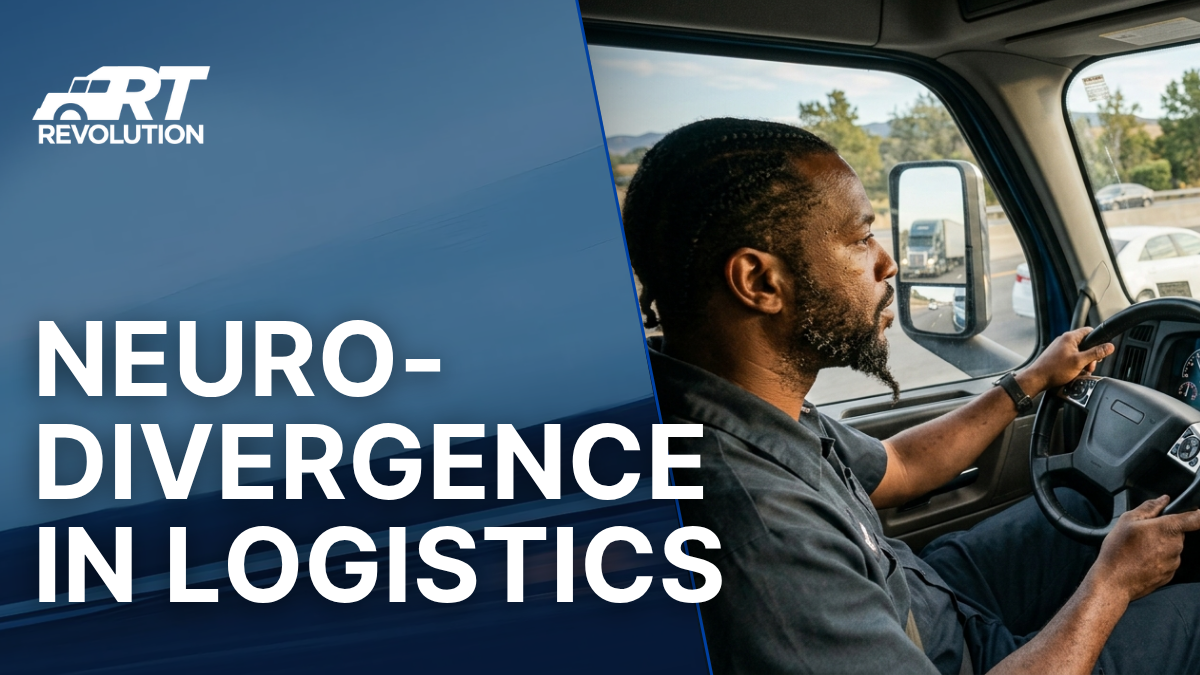
Neurodivergence — a term encompassing ADHD, autism spectrum conditions, dyslexia, and related cognitive differences — affects an estimated one in five people, according to widely cited prevalence data. In neurodivergent trucking and logistics environments, that ratio is likely higher. The industry has long attracted individuals whose minds are wired for pattern recognition and rapid environmental scanning, even when those traits were never formally identified or diagnosed.
What is often overlooked in conversations about neurodiversity in the supply chain is that logistics does not simply accommodate neurodivergent employees in logistics roles. In many cases, it rewards them. The operational demands of freight transportation — constant variability, high-consequence decision-making, days that never repeat — align with cognitive profiles that traditional office settings frequently filter out.
This is not a theoretical claim. It reflects what leading carriers observe in their own operations every day.
What Is Neurodivergence and Why Does It Matter in Trucking?
Neurodivergence refers to natural variations in how the human brain processes information and manages attention. The most common forms include ADHD (Attention Deficit Hyperactivity Disorder), autism spectrum conditions, dyslexia, and dyspraxia. These are not deficits in capability. They are differences in cognitive architecture that produce distinct strengths and challenges depending on the environment.
In logistics and transportation, several of these cognitive profiles map directly to operational performance:
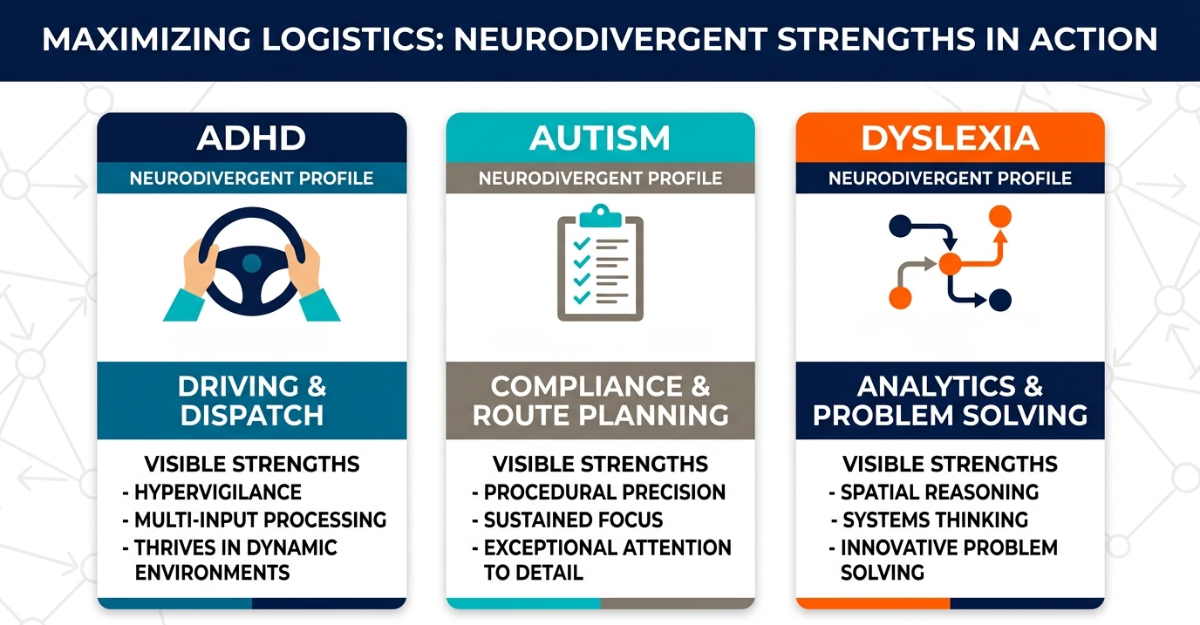
- ADHD is associated with hypervigilance and rapid multi-input attention processing — the ability to track several streams of information simultaneously under time pressure. These traits show up directly in driving safety and dispatch coordination.
- Autism spectrum conditions often correlate with exceptional procedural precision and sustained focus on structured tasks — compliance documentation, route optimization, load sequencing — where attention to detail determines whether the job gets done right.
- Dyslexia is frequently accompanied by strong spatial reasoning and an ability to see systemic relationships that are not immediately obvious in text-based reporting.
The trucking industry, unlike many white-collar sectors, tends to evaluate people on execution rather than social performance. A driver's safety record, a dispatcher's load coverage rate, and a logistics coordinator's exception resolution speed are measurable outcomes. They do not depend on navigating office politics or open-plan workspace dynamics that can be challenging for neurodivergent professionals.
That merit-based structure goes a long way toward explaining why neurodivergent trucking professionals have historically found the industry accessible and rewarding, even when neither the employer nor the individual had language for it.
Pattern Recognition: The Hidden Advantage Behind Safety Performance
Pattern recognition is a cognitive function that allows individuals to detect regularities and make rapid assessments based on incomplete information. In logistics, this function operates at every level of the business — from the driver scanning traffic four seconds ahead to the analyst identifying pricing anomalies across thousands of shipments.
On the Road
Commercial driving is often described as monotonous by those outside the profession. In reality, it demands continuous environmental processing across hundreds of simultaneous variables: vehicle behavior in adjacent lanes, road surface conditions, weather changes, intersection geometry, pedestrian movement, and the mechanical feedback of the vehicle itself.
An ADHD truck driver with hypervigilance-associated traits often processes this information differently than neurotypical counterparts. Rather than scanning sequentially, their attention distributes across multiple inputs simultaneously, enabling what safety professionals describe as predictive risk management — the ability to identify a developing hazard before it becomes an incident.
This is not anecdotal. Carriers using AI-powered telematics platforms such as Samsara, which employ inward-facing and outward-facing cameras with continuous AI analysis, are able to quantify driver safety performance through behavioral scoring. What these systems reveal is that certain drivers consistently outperform their peers on safety metrics — and when those drivers are examined more closely, cognitive differences are frequently part of the picture.
In practical terms, a driver with strong pattern recognition may notice that a vehicle approaching a stop sign is decelerating too slowly to stop completely, or that a car merging onto the highway is accelerating at a rate that will create a convergence point. These micro-assessments, made in fractions of a second, translate directly into fewer hard-braking events, fewer near-misses, and higher composite safety scores.

Notably, when carrier safety teams analyze incidents flagged by in-cab AI systems, carriers in the mission-critical logistics space report that the vast majority of flagged events — in many fleets, upward of 90 percent — are not attributable to the driver. External factors — sudden lane changes by other motorists, debris, wildlife — account for the majority of triggers. The drivers who consistently avoid escalation of these external events into actual incidents tend to be the same drivers whose cognitive wiring enables faster situational processing.
In the Office
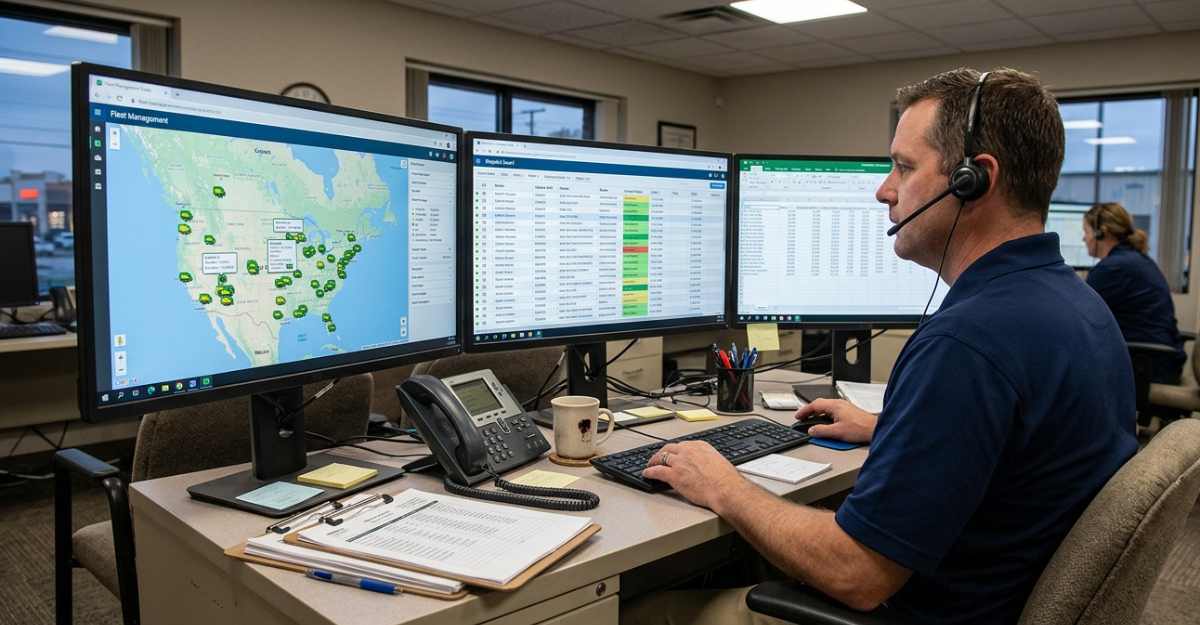
The operational advantages of neurodivergent cognition are not limited to the cab. Within logistics operations, dispatch, analytics, and customer management functions all benefit from cognitive diversity.
Consider the role of fleet analytics. A logistics operation generates enormous volumes of data across pricing, fuel consumption, route efficiency, detention time, and safety scoring. Identifying actionable patterns within this data requires more than technical skill. It requires the kind of divergent thinking that connects seemingly unrelated variables — a cognitive strength commonly associated with ADHD and autism.
In practice, this manifests as the analyst who notices that fuel cost fluctuations are influencing gross profit margins in ways the pricing model does not account for, or the dispatcher who recognizes that a particular customer's stated urgency does not align with actual consignee requirements. These insights are not produced by following standard operating procedures. They emerge from minds that naturally seek connections across data sets.
Organizations that recognize these cognitive strengths — rather than penalizing the unconventional communication styles that sometimes accompany them — end up with better analysis and faster problem resolution. (For more on how technology is reshaping logistics operations, see The Future of Tech Logistics: Trends to Watch in 2026.)
Why Neurodivergent Professionals Thrive in Logistics Environments
The alignment between neurodivergent cognitive profiles and logistics work is not coincidental. Several structural characteristics of the industry create conditions where neurodivergent professionals perform at or above the level of their neurotypical peers.
Variability Replaces Monotony
Logistics is operationally variable by nature. Every shipment introduces a different combination of origin, destination, cargo profile, timeline, and stakeholder requirements. For professionals with ADHD, who often struggle with repetitive tasks but excel when stimulation and novelty are present, this variability is a feature rather than a challenge.
Environments that remove mundane, repetitive elements and replace them with dynamic problem-solving tend to produce higher engagement and lower burnout among neurodivergent team members. Companies that intentionally cross-train employees across functions — allowing accounting staff to attend client conferences, or dispatchers to participate in sales discussions — further amplify this effect by ensuring that no role becomes static.
Structure With Autonomy
Trucking provides a combination that many neurodivergent professionals find optimal: clear regulatory structure (DOT compliance, hours of service, pre-trip inspection requirements) paired with significant operational autonomy. A driver operating over the road manages their own schedule within defined parameters. A dispatcher manages their own book of drivers within established service standards.
That blend of external structure and internal independence mirrors the conditions under which many neurodivergent individuals perform best. The rules are clear and consistent, but the execution requires independent judgment.
Outcome-Based Evaluation
Perhaps most importantly, logistics tends to evaluate performance on outcomes rather than process conformity. A driver is measured by safety scores, on-time performance, and customer feedback. A logistics coordinator is measured by load coverage, exception resolution, and margin performance. These metrics do not penalize unconventional thinking, atypical communication styles, or non-linear approaches to problem solving.
In industries where advancement depends on self-promotion and conformity to unstated cultural norms, neurodivergent professionals are often disadvantaged regardless of their output quality. Logistics, by contrast, rewards execution — which is why many neurodivergent professionals describe the industry as a uniquely accessible career path.

Building an Inclusive Logistics Organization: Beyond Accommodation
Disability inclusion in trucking and logistics is frequently discussed in terms of accommodation — the adjustments made after a diagnosis is disclosed. While accommodation is important and legally required, it represents only one layer of an effective inclusion strategy.
A more comprehensive approach starts with organizational culture and runs through hiring, onboarding, and how performance is actually managed day to day.
Start With Appreciation, Not Diagnosis
Effective inclusion does not require every employee to disclose a diagnosis. It requires that the organization operate with an understanding that all individuals process information, learn, and communicate differently. Training that builds awareness of cognitive diversity — without requiring disclosure — creates an environment where neurodivergent team members can perform without masking, and where managers can recognize and support different working styles proactively.
Every new team member should be introduced to the principle that people learn differently, hear differently, react differently, and come with their own experiences. This is not an accommodation. It is a foundational operating assumption.
Provide Pathways, Not Just Positions
Neurodivergent professionals do not always enter a role knowing where their greatest strengths will emerge. An individual hired into fleet operations may discover that their analytical capability far exceeds expectations, while their interest in the original role diminishes. Organizations that provide lateral mobility — the ability to move across functions based on emerging strengths — retain talent that rigid hierarchies would lose.
This principle extends to drivers. A clear driver journey — from operating a company truck, to support in purchasing their own vehicle, to CDL training for those who are unregulated — creates a pathway that treats drivers as long-term partners rather than interchangeable assets. (For practical guidance on entering the industry, see Tips for New Truck Drivers.) When the relationship is purely transactional, the human element is removed, and with it the trust that allows neurodivergent individuals to disclose challenges and receive meaningful support.
Recognize That Equal Does Not Mean Identical
Treating all team members with equal respect and equal opportunity does not mean providing identical support. Some individuals need daily check-ins and structured coaching. Others prefer autonomy and minimal oversight. Some drivers want to be highly engaged in company communications. Others are most productive when given space.
The key is consistency in standards paired with flexibility in support. Equal access to benefits — PTO, flexibility, professional development — combined with individualized engagement. This is not special treatment. It is the recognition that a one-size-fits-all management model underserves everyone, not only neurodivergent employees in logistics roles. (For a broader look at driver health and quality of life, see our guide on driver wellness.)
The Role of Technology in Supporting Neurodivergent Drivers
Advances in fleet technology have created new opportunities to support neurodivergent drivers in ways that were not previously available.
AI-Powered Safety Systems
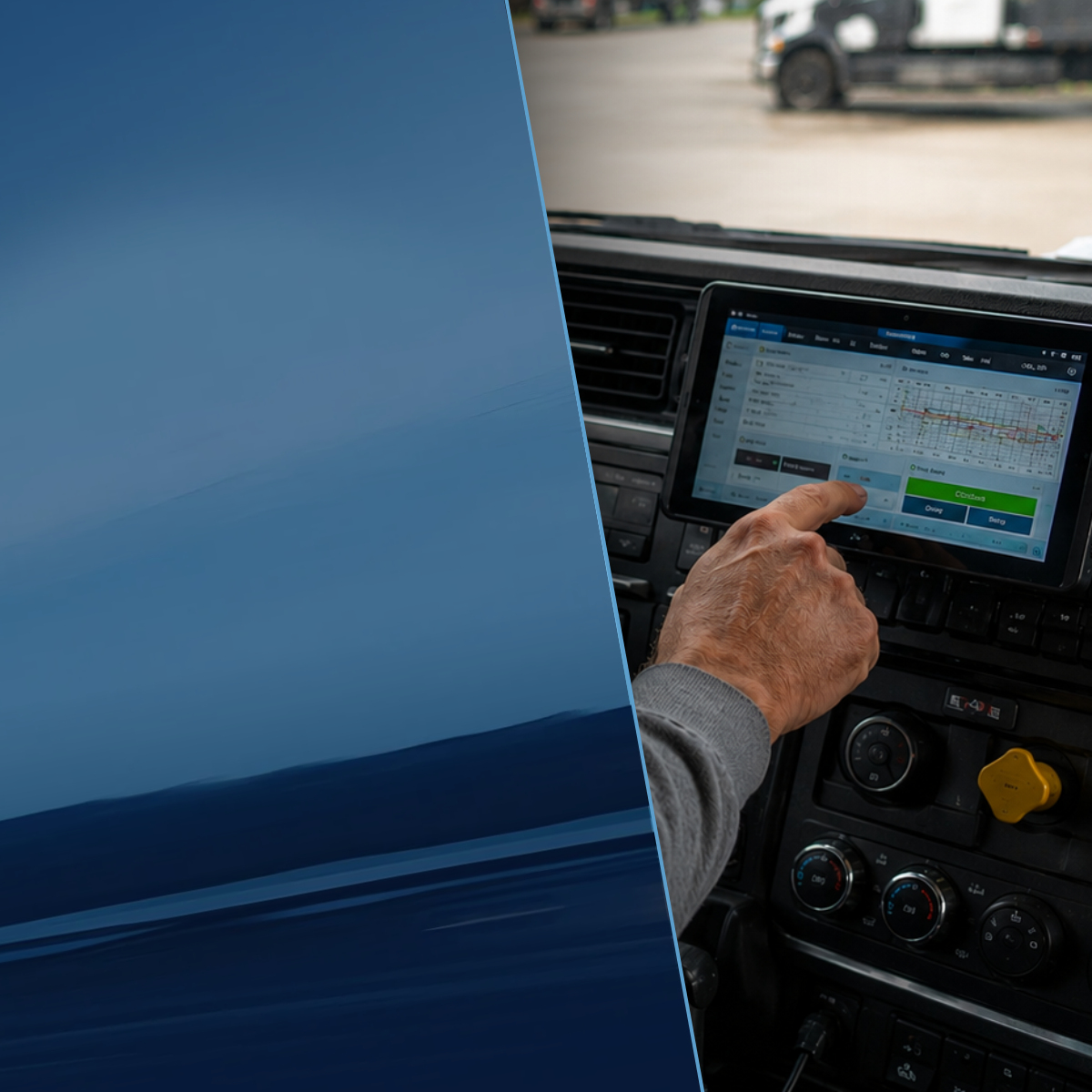
Modern telematics platforms use AI to analyze both inward-facing and outward-facing camera feeds continuously. These systems detect potential safety events — hard braking, lane departure, following distance, distracted driving indicators — and provide real-time in-cab alerts that function as behavioral coaching.
For neurodivergent drivers, these systems serve a dual purpose. First, they provide immediate, objective feedback that supports continuous improvement without requiring subjective human evaluation. Second, they generate data that allows safety teams to distinguish between driver-attributable events and external factors, ensuring that coaching is targeted and fair.
Carriers that implement incentive programs tied to safety scores — rewarding the highest-performing drivers monthly — create a positive reinforcement loop that is particularly effective for neurodivergent individuals who respond strongly to clear, measurable goals.
However, these systems also introduce challenges. AI flags are not always accurate. Activities such as eating, yawning, or adjusting controls may trigger alerts that are not safety-relevant. Effective programs distinguish between genuine behavioral concerns and false positives, and they communicate this distinction clearly to drivers to maintain trust in the system.

AI as a Cognitive Multiplier
Beyond safety systems, artificial intelligence tools — including large language models and data analysis platforms — are emerging as powerful force multipliers for neurodivergent professionals in logistics.
The fit between neurodivergent cognition and AI tools is becoming increasingly clear. Both operate through what cognitive scientists call bottom-up processing: building understanding from granular data inputs rather than applying top-down assumptions. Neurodivergent professionals often excel at providing AI systems with the detailed, specific inputs that produce high-quality outputs — a skill that neurotypical users, who may treat AI tools as simple search engines, frequently underutilize.
In practical terms, this means that a neurodivergent analyst who pairs strong pattern recognition with AI-powered data tools can produce insights at a speed and depth that traditional analytical approaches cannot match. Organizations that give their people access to these tools are often surprised by what their existing teams can produce.
The Business Case for Neurodiversity in Logistics
The argument for neurodiversity inclusion in logistics is not purely ethical. It is operational and financial.
Driver retention is one of the most persistent challenges in the trucking industry, with annual turnover rates at large truckload carriers historically exceeding 90 percent according to American Trucking Associations data. Companies that create environments where neurodivergent drivers feel valued and understood reduce this turnover. The cost savings are substantial: industry estimates place the cost of replacing a driver — recruiting, onboarding, training — between $8,000 and $12,000, not including the productivity loss during the transition period. (For more on what drives retention, see Life of a Truck Driver: What Is a Career as a Driver Like?)

Beyond retention, neurodiversity in team composition produces better operational outcomes. Research consistently demonstrates that cognitively diverse teams outperform homogeneous teams on complex problem-solving tasks. In an industry defined by complexity — where any given shipment can involve 10 to 20 stakeholders and where a third of the information received is incomplete or inaccurate — this advantage is material.
Companies that build inclusion into their operating model — rather than treating it as an HR initiative — attract talent that competitors overlook and keep that talent longer. The performance gap between an inclusive fleet and a conventional one compounds over time.
Frequently Asked Questions
What is neurodivergence in the context of trucking and logistics? Neurodivergence refers to natural variations in brain function, including ADHD, autism spectrum conditions, dyslexia, and related cognitive differences. In trucking and logistics, neurodivergent individuals often excel due to strengths in pattern recognition, hypervigilance, procedural precision, and the ability to process multiple information streams simultaneously.
Can people with ADHD be safe truck drivers? Yes. ADHD-associated traits such as hypervigilance and rapid multi-input attention processing can be significant safety advantages in commercial driving. Some carriers using AI-powered safety scoring systems have observed that drivers with ADHD rank among the highest safety performers in their fleets, particularly in predictive hazard avoidance.
How does neurodiversity improve logistics operations? Neurodivergent professionals bring cognitive strengths that complement traditional operational approaches — advanced pattern recognition in data analysis, sustained focus on compliance documentation, and an ability to spot systemic relationships that standard reporting misses. Research on cognitively diverse teams shows measurable performance gains on complex problem-solving tasks compared to homogeneous groups.
What accommodations should logistics companies provide for neurodivergent employees? Effective inclusion extends beyond formal accommodations. Best practices include building awareness of cognitive diversity into onboarding, providing lateral mobility across functions, offering individualized coaching rather than one-size-fits-all management, ensuring clear and consistent performance metrics, and creating pathways for long-term professional development. Formal accommodations should be available when requested, but the goal is to build an environment where disclosure is not required for an individual to perform at their best.
Is neurodivergence considered a disability for business certification purposes? Yes. Under the Americans with Disabilities Act (ADA), many neurodivergent conditions qualify as disabilities. Business owners with qualifying conditions may be eligible for Disability-Owned Business Enterprise (DOBE) certification through Disability:IN, which provides access to corporate supplier diversity programs and government contracting opportunities.
How does AI technology support neurodivergent truck drivers? AI-powered telematics systems provide objective, real-time safety feedback that supports continuous improvement without subjective evaluation. These systems also generate data that allows safety teams to distinguish between driver-attributable events and external factors, ensuring fair and targeted coaching. Additionally, AI data analysis tools serve as cognitive multipliers for neurodivergent analysts and coordinators, amplifying their natural pattern recognition strengths.
other blog posts
%2520(5).webp)

.png)