A dot on a map tells you where the truck is. It does not tell you what should happen next.
That distinction explains why companies that have invested heavily in real-time freight tracking still experience missed deliveries, detention charges, cascading production delays, and the same exception-management fire drills they had before the tracking platform was installed. The technology works. The GPS pings are accurate. The dashboards update in real time. And shipments still fail, because knowing where freight is and knowing what to do about it are two fundamentally different operational capabilities.
Nearly 70 percent of companies do not have real-time supply chain visibility, and only 13 percent report full visibility into their sourcing networks. But the companies that do have visibility are not immune to service failures. They have better data. They do not necessarily have better outcomes. The gap between data and outcomes is not a technology problem. It is an ownership problem. The data arrives, but no one has been designated to act on it, and the processes that would convert an alert into a corrective action before the delivery window closes do not exist. Visibility is an input. Management is the system that converts that input into action while useful options still exist.
That is the difference between watching freight move and controlling how freight moves. It should reshape how enterprise shippers evaluate logistics providers and how they determine whether their visibility technology investment is producing the operational outcomes they expected.
What Freight Visibility Actually Provides
Real-time freight visibility platforms collect location data from GPS devices, ELD systems, carrier integrations, and telematics feeds. They translate that data into dashboard views with estimated arrival times and generate alerts when a shipment deviates from its expected timeline or route.
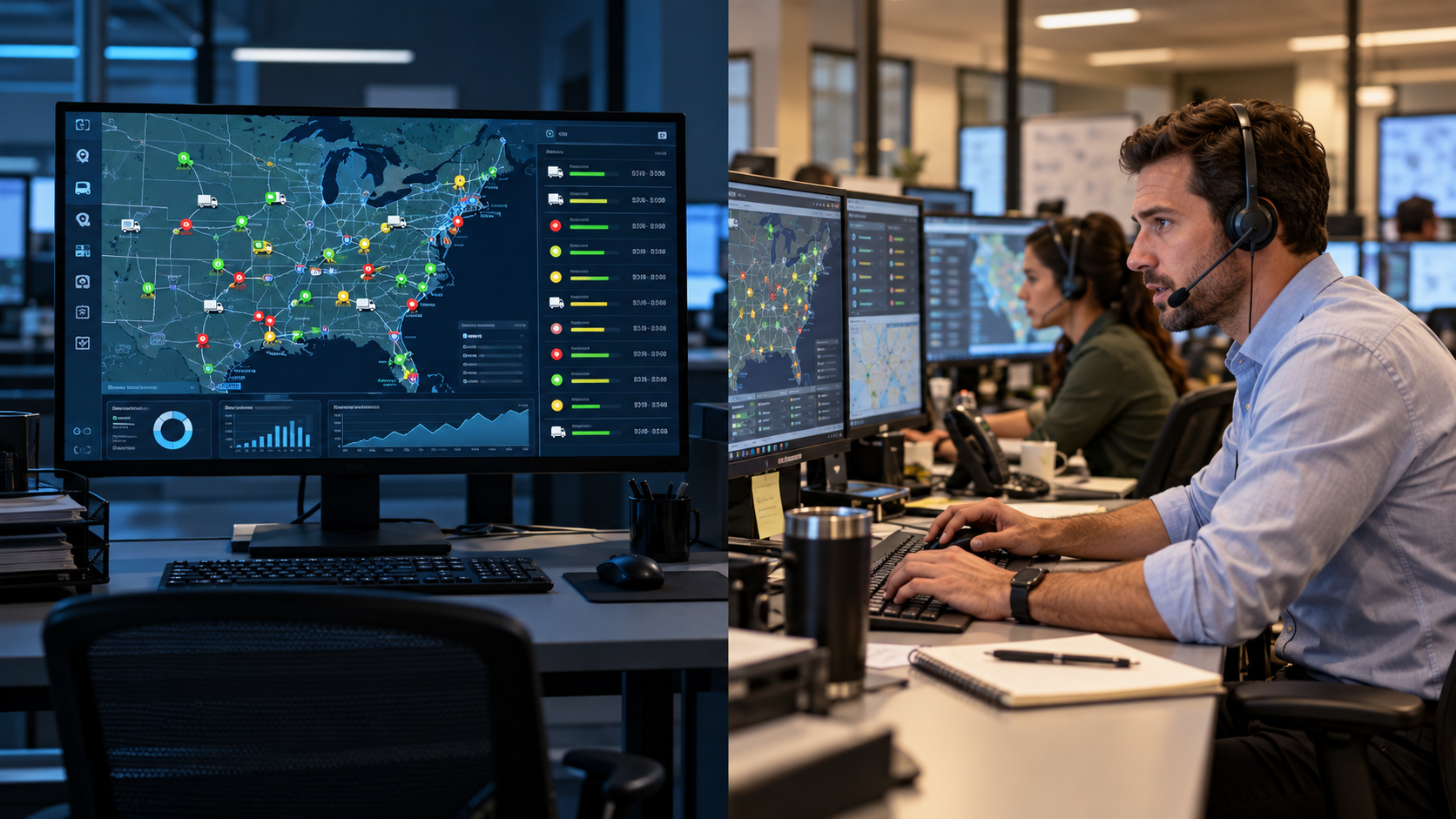
At their best, visibility platforms provide three things:
Location awareness. Where is the truck right now? Is it moving or stationary? Is it on the expected route?
ETA calculation. Based on current position, speed, and traffic conditions, when will the shipment arrive? How does the current ETA compare to the scheduled delivery window?
Deviation alerts. The shipment is running late. The truck has stopped for longer than expected. The driver has deviated from the planned route. The temperature in a reefer trailer has exceeded the threshold.
These are valuable capabilities. They replace the manual check-call process that consumed hours of logistics coordinator time and produced unreliable, point-in-time information. A shipper with a visibility platform knows more about their freight, more often, with less effort than a shipper making phone calls to carriers.
But visibility answers only one question: what is happening right now? It does not answer the questions that determine whether a service failure occurs: what should happen next, and who has authority to act before the recovery window closes?
What Freight Management Does That Tracking Cannot
Scenario: A Truck Will Miss Its Delivery Window
Consider a straightforward scenario that plays out thousands of times per day across the freight industry. A truckload shipment is in transit from a supplier in Indiana to a manufacturing plant in North Carolina. The delivery appointment is scheduled for 7:00 a.m. tomorrow. At 2:00 p.m. today, the visibility platform calculates that the truck will arrive at approximately 9:30 a.m., two and a half hours late.
Here is what visibility provides: an alert. The dashboard shows the shipment in yellow or red. A notification fires to whoever is configured to receive it. The ETA has changed.
Here is what freight management does with that same information:
Assess the operational impact. The 7:00 a.m. appointment was scheduled because a production line needs that material to start its second shift. A 9:30 a.m. arrival means the material will not be staged, inspected, and available until approximately 11:00 a.m. The second shift starts at 2:00 p.m. That leaves a three-hour buffer. Is that enough? It depends on how long inspection takes and whether a forklift and staging space will be open at 11:00 a.m. Someone who knows the plant's receiving operation has to make that call.
Determine whether the appointment can be rescheduled. The plant's dock schedule is managed by the receiving team. Does the 9:30 a.m. arrival conflict with other inbound deliveries? Is there a dock door available at that time, or will the truck wait in the yard and accrue detention charges? The freight manager contacts the receiving team, confirms the revised window, and adjusts the dock appointment before the truck arrives.
Evaluate recovery options. If the three-hour buffer is not sufficient and the production line is at risk, what are the alternatives? Can the carrier push the driver to a relay point for a team finish? Is there a closer expedited option? Is a partial air shipment of critical components faster and cheaper than a full production delay? These decisions require market knowledge the tracking platform does not have — and pre-established authority to spend recovery dollars before the window closes.
Communicate to every affected party. The plant's production manager needs to know the revised timeline. The supplier needs to know whether the shipment will be refused or rescheduled. The carrier needs updated delivery instructions. The shipper's logistics team needs a documented record connecting the deviation to the corrective action and its cost. A tracking alert communicates to whoever checks the dashboard. Freight management communicates to everyone who needs to act.
Record the root cause and prevent recurrence. Why was the truck late? Did the carrier tender a driver who was running out of hours of service? Did the shipper tender the load too late for the required transit? Did traffic, weather, or a mechanical issue cause the delay? The root cause determines whether this is a carrier performance issue, a shipper process issue, or an uncontrollable event. Without root-cause tracking, the same failure repeats next month and the month after that. The visibility platform shows that the truck was late. It does not record why, and it does not change the process that caused it.
This scenario is not exceptional. Roughly 8 to 12 percent of all shipments generate at least one exception before delivery. A shipper moving 500 loads per month faces 40 to 60 exceptions requiring human judgment. The question is not whether exceptions will occur. The question is whether the organization has a system for resolving them, or whether each one is handled ad hoc by whoever happens to notice the alert.
The Five Gaps Between Visibility and Management
Gap 1: Alert vs. Ownership
A visibility platform generates an alert. A managed freight operation assigns an owner. The alert says "this shipment is late." Ownership means one person carries the event from detection to resolution and documents what happened. Without ownership, alerts accumulate in inboxes and dashboards until someone escalates the problem, usually after the cost has already been incurred.
The structural problem is that most visibility platforms are configured to send alerts to distribution lists or general inboxes. Nobody is specifically responsible for any individual alert. In a managed operation, every exception has a named owner within minutes of detection, and that owner has the authority and the information to act.
Gap 2: ETA vs. Site Readiness
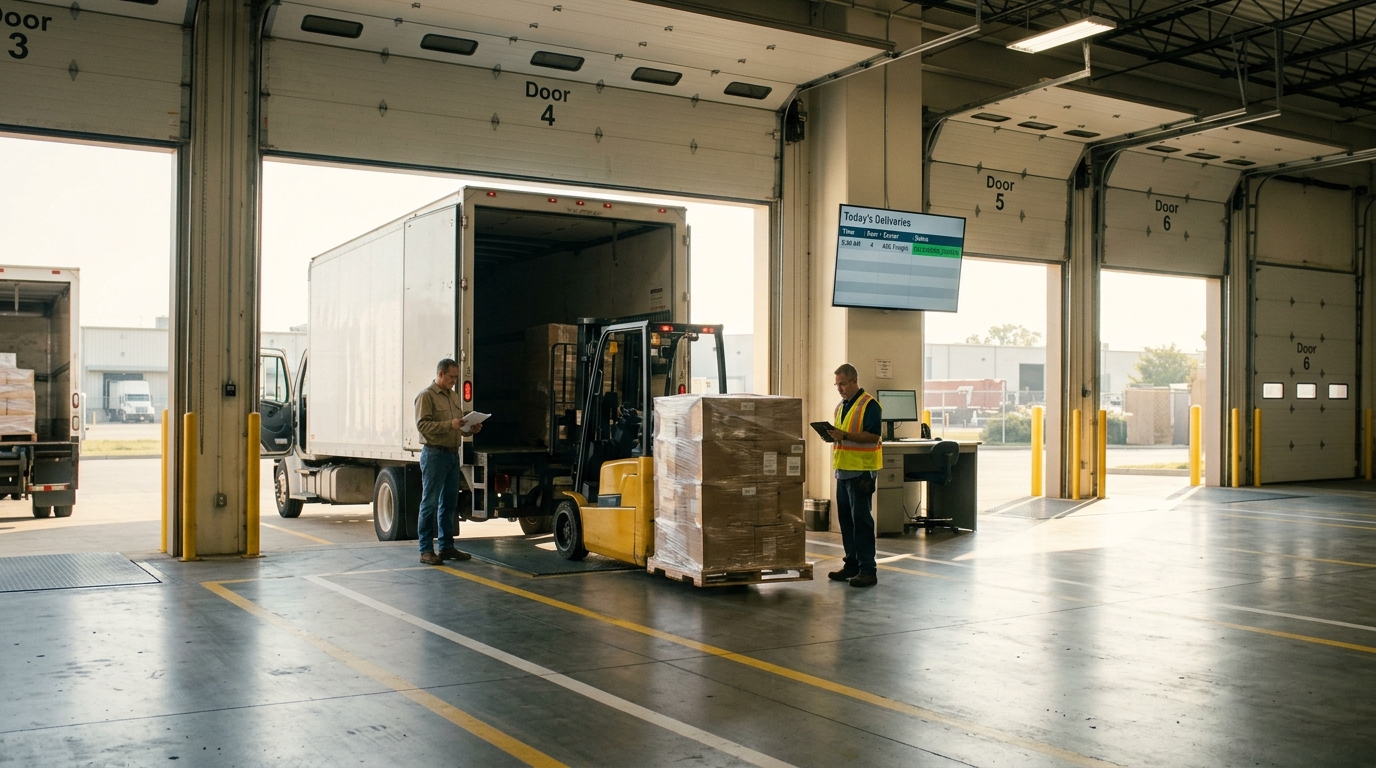
An ETA tells you when the truck will arrive. Site readiness means the facility is prepared to accept the truck when it arrives. The ETA lives in the visibility platform. The dock schedule lives in the warehouse management system. Nobody is connecting the two. A visibility platform calculates the ETA. It does not check whether the dock can receive the truck at that time.
This gap is where detention costs originate. A truck arrives on time, but the dock is occupied, the forklift is assigned elsewhere, or nobody told the receiving team the shipment was coming. The visibility platform showed a green status because the truck was on schedule. The actual outcome was a two-hour wait and a $400 detention charge. Freight management connects the ETA to the dock schedule and the labor plan so that arrival and readiness are synchronized.
Gap 3: Data Availability vs. Decision Authority
Visibility platforms make data available. They do not make decisions, and they do not have authority to change carrier assignments, reroute shipments, approve expedited recovery costs, or modify dock schedules. In most organizations, those decisions require approval chains that were not designed for the speed at which freight exceptions unfold.
The first 15 minutes of a freight exception determine the outcome. Manual exception processes take two to four hours to work through approval chains and coordination steps. By the time the decision is made, the cheapest recovery options have expired. A managed freight operation pre-authorizes response protocols by severity level. A Severity 1 exception (production line at risk, customer penalty exposure) triggers a predefined response with pre-approved spending authority. The account team does not need to wait for three levels of approval to book a recovery load.
Gap 4: Carrier Notification vs. Operational Recovery
When a shipment is delayed, the visibility platform notifies the shipper. But notification is not recovery. Recovery starts with the carrier: can the current driver still make a revised window? If not, the freight manager needs to source alternative capacity while the original load is still in transit. That requires a spot market pricing read, knowledge of what equipment is within range, and a fast judgment on whether the recovery cost is justified by the downstream impact.
A shipper whose logistics team goes home at 5:00 p.m. cannot recover a shipment that fails at 7:00 p.m. A managed freight operation with 24/7 coverage can. This is not a technology difference. It is a coverage gap, not a data gap.
Gap 5: Incident Data vs. Continuous Improvement
Visibility platforms store shipment data: timestamps, locations, status changes. What they typically do not store is the context around exceptions: why the failure occurred, what the response cost, how long resolution took, and whether anything changed as a result. Without that context, the data cannot drive process improvement.
A managed freight operation maintains exception logs that connect the deviation to a root cause, the root cause to a corrective action, and the corrective action to a measurable outcome. Over time, that data reveals patterns. Maybe a specific carrier consistently misses Tuesday pickups on the Indianapolis-to-Charlotte lane. Or a single facility generates 40 percent of your total detention charges because of dock congestion that nobody has addressed. Those patterns do not surface in tracking data. They surface in management data that someone is actively reviewing.
What a Control Tower Does That a Dashboard Does Not
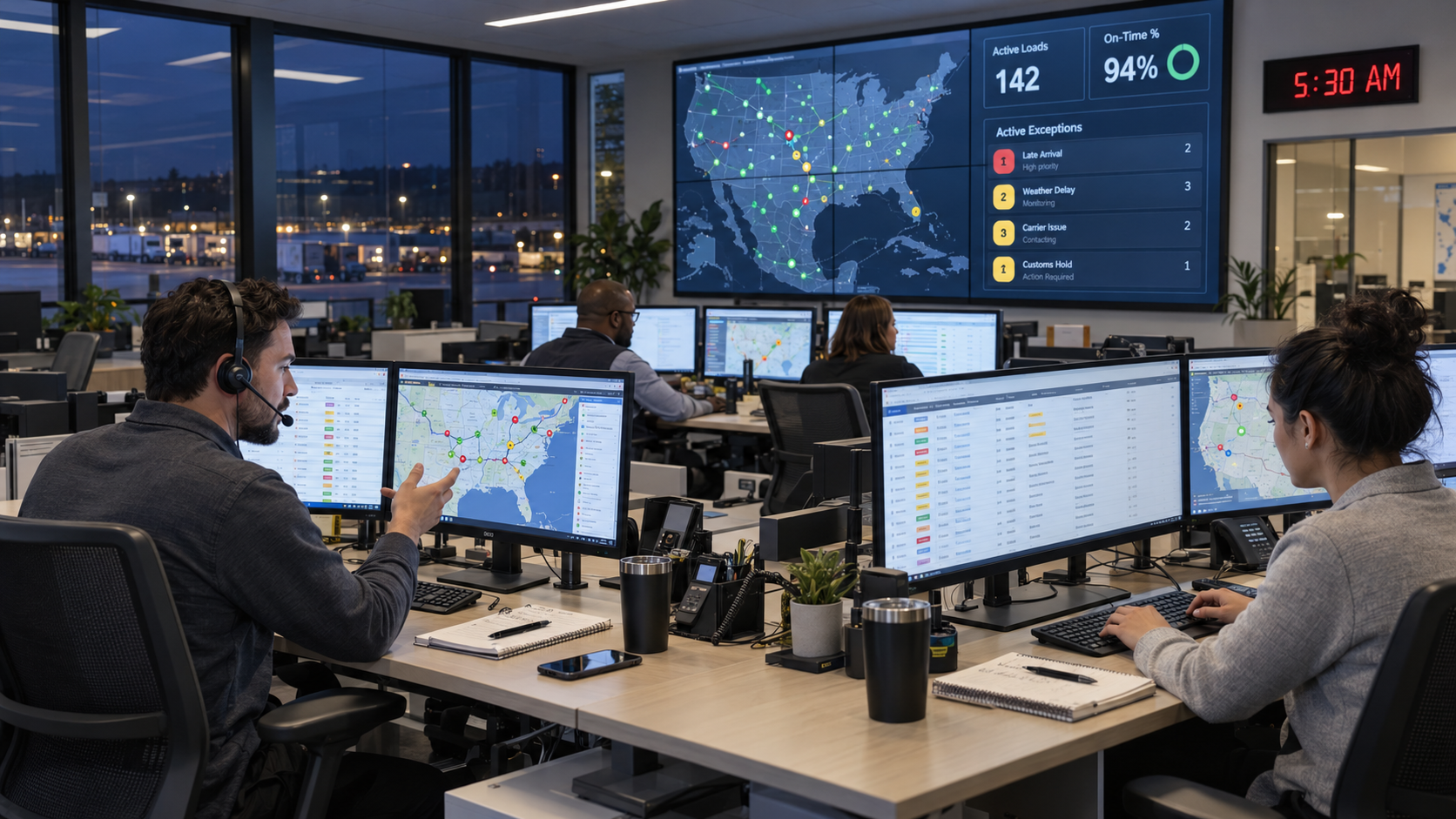
The term "control tower" has been adopted by software vendors who sell dashboard products, which has diluted its meaning. A control tower is not a screen. It is an operating model.
A genuine logistics control tower centralizes freight execution management across the shipper's entire network. The technology platform provides the data layer — real-time tracking, predictive ETAs, automated exception detection. But the technology is the infrastructure, not the operation.
The operation is the team. They monitor active shipments across all modes and flag deviations before those deviations become service failures. They own exception resolution from first alert through corrective action — contacting carriers, adjusting dock appointments, sourcing recovery capacity when needed. They audit freight invoices against contracted rates. And they review performance data weekly to find the systemic problems that no single alert will reveal.
At Revolution, our control tower operates 24/7/365 with dedicated account teams who know each client's freight profile and facility requirements — which dock doors accept which trailer types, what the receiving hours are, who to call when a load is critical. The difference between our operating model and a visibility dashboard is the difference between a fire department and a smoke detector. The smoke detector tells you there is a problem. The fire department puts it out.
How to Evaluate Whether You Have Visibility or Management
Enterprise shippers who want to assess where their freight operation falls on the visibility-to-management spectrum should ask four questions:
When a shipment exception occurs, who owns it? If the answer is "whoever sees the alert first" or "it depends," you have visibility without ownership. In a managed operation, every exception has a named owner within minutes, and that person has authority to act.
How fast do you move from detection to corrective action? If the typical cycle is measured in hours, you are losing recovery options with every passing minute. Best-in-class exception response completes the detection-to-action cycle in under 15 minutes for high-severity events.
Do you know why your last 10 service failures occurred? If you can cite the root cause and what changed as a result for each one, you have a management process. If you can identify that the shipment was late but not why, you have a data gap that visibility alone cannot close.
Does your freight operation perform the same at 2:00 a.m. on a Saturday as it does at 10:00 a.m. on a Tuesday? Freight exceptions do not observe business hours. A shipper whose logistics coverage ends when the office closes has visibility without coverage, and coverage gaps become service gaps.
The Investment Question
Visibility platforms cost $50,000 to $500,000 per year depending on shipment volume and integration complexity. That investment buys data and dashboards. The return on that investment depends entirely on what the organization does with the data it receives.
A shipper who invests in a visibility platform but does not build the operational team and decision-making authority to act on the data will have better-informed service failures. The failures will still occur. They will just be documented more thoroughly.
The alternative is a managed freight model where visibility is embedded within an operational framework. Someone owns every exception. Response protocols are pre-authorized by severity level so the team can act without waiting for approval chains. Carrier performance data feeds back into routing decisions. In that model, visibility is one component of the management system, not a standalone technology purchase that the shipper's internal team must figure out how to operationalize.
The shippers who get value from their visibility investment are the ones who pair the platform with a team that has authority to act on what it surfaces. The platform identifies the problem. The team solves it. Neither works without the other, and investing in one while neglecting the other produces the frustration that many shippers experience: better data, same outcomes.
Frequently Asked Questions
What is the difference between freight visibility and freight management? Freight visibility provides real-time location data, ETA calculations, and deviation alerts for shipments in transit. Freight management is the operational system that acts on that data — an owner is assigned to each exception, corrective actions are executed while recovery options still exist, and incident data feeds back into process changes that prevent recurrence. Visibility tells you what is happening. Management determines what should happen next.
Why do shipments still fail even with real-time tracking? Real-time tracking identifies deviations from plan but does not resolve them. Resolution requires a named owner for each event, pre-approved spending authority for recovery actions, staff coverage when exceptions occur (including nights and weekends), and defined response protocols by severity level. Without these elements, tracking alerts accumulate without action.
What is a logistics control tower? A logistics control tower is a centralized operating model that combines people, technology, and decision authority to manage freight execution across a shipper's network. It goes beyond a visibility dashboard by actively monitoring shipments, owning exception resolution from detection through corrective action, and feeding performance data back into carrier management and process improvement.
How fast should freight exceptions be resolved? The first 15 minutes after exception detection determine the outcome for high-severity events. Manual exception processes typically take two to four hours. Managed freight operations with pre-authorized response protocols complete the detection-to-action cycle in under 15 minutes, preserving recovery options that expire as time passes.
What does freight visibility cost? Freight visibility platforms cost $50,000 to $500,000 per year depending on shipment volume and integration complexity. The return on that investment depends on whether the organization has the operational capability to act on the data. A visibility platform without a management process produces better-informed service failures, not fewer of them.
How do I know if I need freight management vs. just better tracking? If your team can name the root cause and what changed as a result for your last 10 service failures, you likely have a management process and may benefit from better tracking technology. If your team knows shipments were late but cannot explain why or what changed as a result, you have a management gap that no tracking platform will close. The test is whether better data leads to better outcomes or just more alerts.
other blog posts
%2520(1).webp)
%2520(1).webp)