Freight Class and NMFC Codes Explained: The 2026 Guide to Density-Based LTL Classification
The NMFTA overhauled LTL freight classification in July 2025, shifting from commodity-based to density-based. This 2026 guide explains the new 13-tier system, how to calculate freight class, and what Docket 2026-1 means for your shipping costs.
If the freight class printed on your bill of lading was determined before July 19, 2025, it was probably assigned using a system that no longer exists. On that date, the National Motor Freight Traffic Association (NMFTA) completed the most significant structural change to LTL freight classification in decades — replacing the legacy commodity-based system with a density-based classification model built on a new 13-tier scale. Two entirely new freight classes (50 and 55) were added. Approximately 2,000 commodity listings were consolidated or eliminated. And Docket 2026-1, released in February 2026, continued the overhaul by canceling additional legacy items and tightening the structure further.
Every shipper-facing guide to freight class published before mid-2025 is now at least partially obsolete. This guide reflects the system as it operates today.
What Is Freight Class?
Freight class is the standardized classification system that LTL (less-than-truckload) carriers use to price shipments. Every commodity shipped via LTL is assigned a freight class ranging from 50 (the lowest, least expensive) to 500 (the highest, most expensive). The class assigned to a shipment directly determines the base rate the carrier charges — a shipment classified at Class 150 will cost substantially more per hundred pounds than the same weight classified at Class 70.
The classification system exists because LTL carriers consolidate freight from multiple shippers onto shared trailers. Unlike full truckload, where a shipper pays a flat rate for an entire trailer, LTL pricing must account for the fact that different commodities occupy different amounts of space, present different handling challenges, and carry different liability risks. A pallet of lead ingots and a pallet of lampshades weigh the same but occupy vastly different volumes and require vastly different handling. Freight class captures those differences in a single number that translates to a rate.
The system is administered by the NMFTA through the National Motor Freight Classification (NMFC) — a tariff document that assigns specific NMFC codes to individual commodities and maps those codes to freight classes. When a shipper books an LTL shipment, the commodity must be identified by its NMFC code, which determines the freight class, which determines the rate.

What Changed in July 2025 (and Why It Matters in 2026)
The Old System: Commodity-Based Classification
Under the legacy system, freight class was assigned primarily by commodity type. The NMFTA maintained thousands of individual commodity listings, each with specific classification rules based on what the item was, how it was packaged, and sometimes how it was loaded. Two different machine parts with identical dimensions and weights could receive different freight classes because they fell under different commodity descriptions in the NMFC tariff.
This system was defensible when it was created — different commodities genuinely present different handling and liability characteristics — but it had become unwieldy. The tariff contained commodity descriptions that were decades old and no longer matched how goods are manufactured, packaged, or shipped. Classification disputes between shippers and carriers were common, and the subjective element of commodity identification created inconsistency across the industry.
The New System: Density-Based Classification
The July 2025 overhaul simplified the system by making density the primary classification factor. Under the new model, the freight class for most shipments is determined by a single calculation: how much the freight weighs relative to the space it occupies, expressed in pounds per cubic foot (PCF).
The logic is straightforward. Dense freight — heavy relative to its volume — is efficient for carriers to transport. It fills trailer space without wasting capacity. Less dense freight — light relative to its volume — is inefficient. A pallet of foam packaging weighs very little but occupies the same floor space as a pallet of steel plate. The carrier earns less revenue per cubic foot of trailer capacity consumed.
The new density-based system captures this efficiency difference directly, without needing to identify the specific commodity. A 200-pound shipment that measures 48 × 40 × 36 inches has a specific density regardless of whether it contains machine parts, consumer electronics, or automotive components. That density maps to a freight class. The commodity identification becomes secondary.
The New 13-Tier Density Scale
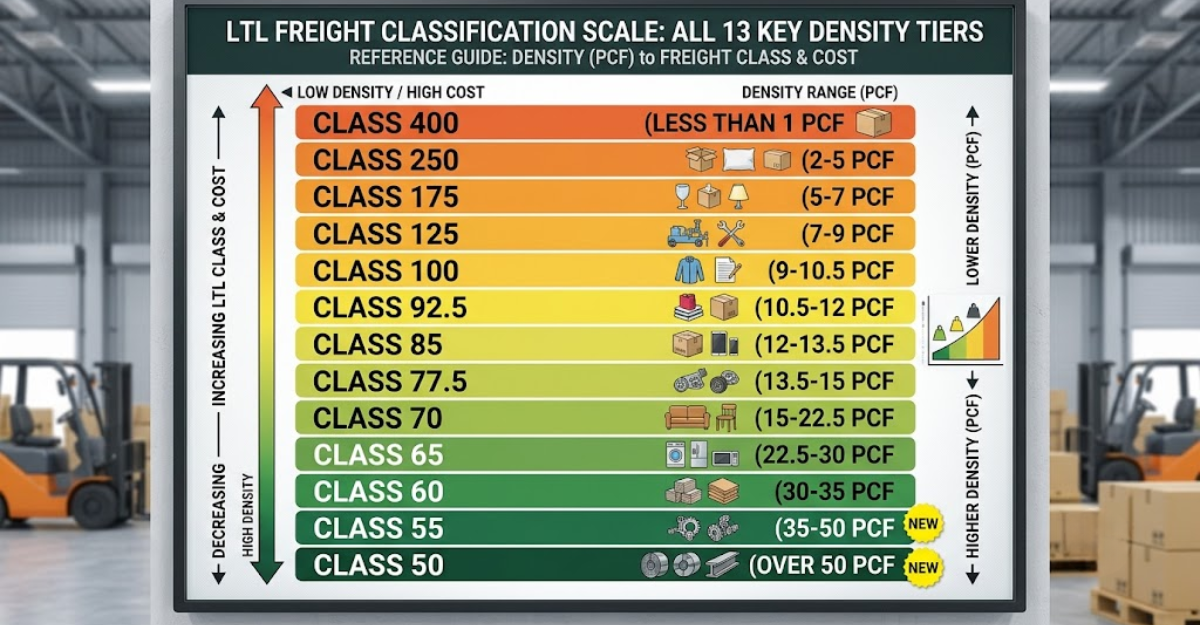
The previous classification system used an 11-tier scale. The 2025 overhaul expanded it to 13 tiers by adding two new classes at the dense end of the scale:
ClassDensity (PCF)Typical Freight5050.0 and aboveExtremely dense: steel plate, lead, solid metal castings5535.0 to 49.99Very dense: heavy machinery components, dense metal parts6030.0 to 34.99Dense manufactured goods, heavy automotive parts6522.5 to 29.99Engine parts, dense industrial components7015.0 to 22.49Machine parts, food items, standard manufactured goods77.513.5 to 14.99Moderately dense consumer goods8512.0 to 13.49Crated machinery, packaged food products92.510.5 to 11.99Appliances, standard packaged consumer goods1009.0 to 10.49Furniture, large electronics, moderate-density goods1108.0 to 8.99Cabinets, framed artwork, moderate-volume items1257.0 to 7.99Bulky consumer goods, partially assembled furniture1506.0 to 6.99Low-density goods, auto body panels, some plastics1755.0 to 5.99Very low density: clothing, lightweight plastics2004.0 to 4.99Mattresses, lightweight fixtures2503.0 to 3.99Pillows, foam products, extremely light goods3002.0 to 2.99Displays, signs, very bulky lightweight items4001.0 to 1.99Deer antlers, ping pong balls (the classic textbook example)500Below 1.0Freight so light relative to volume it barely registers
Classes 50 and 55 are the most significant additions for manufacturers. Before July 2025, the densest freight was capped at Class 60. Shippers of extremely dense commodities — heavy machined components, solid steel parts, dense castings — were paying Class 60 rates even though their freight was more carrier-friendly than anything else on the trailer. The new classes reward that density with lower rates.
For precision manufacturers shipping heavy, compact parts — the exact profile described in Revolution's manufacturing logistics work — the introduction of Classes 50 and 55 is a direct cost reduction on qualifying shipments.
Docket 2026-1: The Consolidation Continues
The structural shift did not end in July 2025. On February 6, 2026, the NMFTA released Docket 2026-1, which continued the consolidation by canceling additional legacy commodity items and tightening classification rules. The docket consolidated similar commodities into single items, further reducing the number of NMFC listings shippers need to navigate.
This matters practically because shippers who updated their classification practices after the July 2025 changes but have not reviewed Docket 2026-1 may be using NMFC codes that have since been canceled or consolidated. Carriers audit freight classification regularly, and a shipment booked under a canceled NMFC code will trigger a reclassification — potentially at a higher class — along with an adjustment charge.
How to Calculate Freight Class by Density
The density calculation is the foundation of the new system, and every shipping coordinator should be able to perform it manually — even when using carrier-provided calculators — to verify that quoted classes are accurate.
Step 1: Measure the Shipment
Measure the length, width, and height of the shipping unit (pallet, crate, or package) in inches. Use the outermost dimensions — if the freight overhangs the pallet, measure the overhang. If the freight is irregularly shaped, measure to the farthest extent in each dimension.
Step 2: Calculate Cubic Feet
Convert the measurements to cubic feet using this formula:
Cubic Feet = (Length × Width × Height) ÷ 1,728
The divisor (1,728) converts cubic inches to cubic feet (12 × 12 × 12 = 1,728).
Step 3: Calculate Density
Divide the total weight by the cubic feet:
Density (PCF) = Weight (lbs) ÷ Cubic Feet
Step 4: Map to Freight Class
Match the calculated density to the 13-tier scale. The resulting class determines the base rate.
Worked Example
A manufacturer ships a machined component on a pallet. The palletized shipment measures 48 × 40 × 36 inches and weighs 850 pounds.
Cubic feet: (48 × 40 × 36) ÷ 1,728 = 69,120 ÷ 1,728 = 40.0 cubic feet
Density: 850 ÷ 40.0 = 21.25 PCF
This density falls in the Class 70 range (15.0 to 22.49 PCF). Under the old system, the class would have depended on the commodity description. Under the new system, the math is the same regardless of whether the component is a hydraulic manifold, an automotive bracket, or a precision gear housing.
Now consider a second shipment: a solid steel fixture weighing 1,200 pounds on a pallet measuring 48 × 40 × 24 inches.
Cubic feet: (48 × 40 × 24) ÷ 1,728 = 46,080 ÷ 1,728 = 26.67 cubic feet
Density: 1,200 ÷ 26.67 = 44.99 PCF
Under the old system, this shipment would have classified at Class 60 — the lowest available. Under the new system, it qualifies for Class 55 (35.0 to 49.99 PCF), potentially reducing the base rate. For manufacturers shipping dense metal parts regularly, the cumulative savings across dozens or hundreds of annual shipments is meaningful.
Why Freight Class Still Matters When Carriers Negotiate Everything
A reasonable question from experienced shippers: if LTL pricing is heavily negotiated through discount structures and tariff agreements, does the base freight class actually matter?
It does, for three reasons.
Discounts are applied to the base rate. A shipper with a 70 percent discount off published rates is still paying 30 percent of whatever the published rate is. If the shipment is classified at Class 100 instead of Class 70 — because the density calculation was not performed correctly, because the commodity was misidentified, or because the shipper used a legacy NMFC code that has been reclassified — the 30 percent is 30 percent of a higher number. The discount percentage is the same. The invoice is not.

Carrier audits trigger reclassification charges. LTL carriers increasingly use dimensioning technology — automated measurement systems at terminals that capture the actual dimensions and weight of freight — to verify the classification printed on the bill of lading. When the dimensioner's calculation produces a different class than what the shipper declared, the carrier reclassifies the shipment and issues an adjustment. These adjustments are often not discovered until the invoice arrives, and disputing them requires documentation that the shipper's original classification was correct. Shippers who calculate density accurately before booking avoid this cycle entirely.
Minimum density requirements affect pricing. Many LTL carriers apply minimum density rules to their tariffs — if a shipment's density falls below a specified threshold for the quoted class, the carrier reserves the right to reclassify based on actual dimensions. Understanding the density thresholds in the new 13-tier scale allows shippers to package and palletize freight with classification efficiency in mind — not overpacking volume for lightweight goods, and not underutilizing pallet space for dense freight.
Common Freight Classification Mistakes
Measuring the Commodity Instead of the Shipping Unit
The density calculation must use the dimensions of the entire shipping unit — pallet, crate, or packaging — not the commodity inside it. A 50-pound precision component that measures 12 × 12 × 12 inches has a high density as a standalone item. But when that component sits on a 48 × 40 × 36-inch pallet with protective crating, the density of the shipping unit is dramatically lower because the volume has expanded while the weight has not.
Shippers who calculate density based on the product dimensions rather than the shipping dimensions will under-classify their freight and face reclassification charges when the carrier's dimensioner captures the actual pallet measurements.
Using Canceled or Consolidated NMFC Codes
The NMFTA's consolidation of approximately 2,000 commodity listings means that many NMFC codes previously used by shippers are no longer active. Shippers whose ERP or TMS systems auto-populate NMFC codes from historical records should verify those codes against the current tariff. A code that was valid in 2024 may have been consolidated into a broader category in 2025 or canceled entirely in Docket 2026-1.
Ignoring Packaging Configuration
The same product can classify differently depending on how it is packaged. A manufacturer shipping loose parts in an oversized box creates a low-density shipment that classifies high. The same parts packed tightly in a right-sized container create a higher-density shipment that classifies lower. Freight classification is not an afterthought to packaging decisions — it is a consequence of them.
For manufacturers concerned about how packaging and handling affect total freight cost, a freight risk assessment that accounts for both classification efficiency and cargo protection is the right starting point.
What the Changes Mean for Different Types of Shippers
Manufacturers Shipping Dense Metal Parts
The introduction of Classes 50 and 55 is an unambiguous win. Shippers of heavy, compact freight — machined components, castings, forgings, dense assemblies — now have access to lower base rates that the old system could not accommodate. The savings are proportional to density: the denser the freight, the greater the rate improvement relative to the old Class 60 floor.
Manufacturers should audit their current LTL shipment records to identify freight that qualifies for the new classes. Any shipment with a density above 35 PCF should be reclassified from Class 60 to Class 55, and anything above 50 PCF should move to Class 50. This is not a carrier negotiation — it is a classification correction that the carrier's own system should recognize.

Shippers of Lightweight, Bulky Goods
The density-based system is less favorable for shippers of lightweight, high-volume freight — consumer goods, plastics, packaging materials, unassembled furniture. Under the old commodity-based system, some of these goods had negotiated or exception-based classifications that kept them in lower classes despite their low density. The density-based system removes those exceptions. If the freight is bulky and light, it classifies high.
For these shippers, the response is operational: right-size packaging to eliminate dead space, consolidate multiple lightweight items onto shared pallets to increase unit density, and evaluate whether partial truckload makes more sense than LTL for shipments that classify at 150 or above.
Shippers New to LTL
For shippers moving freight via LTL for the first time — which includes manufacturers who have historically used full truckload and are now shipping smaller, more frequent loads to support just-in-time production — the density-based system is actually simpler than the old model. There is no need to navigate commodity descriptions or identify the correct NMFC code from thousands of legacy listings. Measure the shipment, calculate the density, look up the class. The calculation is the same regardless of what is on the pallet.
Freight Class and Total Shipping Cost
Freight class determines the base rate, but it is one component of total LTL shipping cost. Accessorial charges (liftgate, inside delivery, appointment scheduling, limited access), fuel surcharges, and declared value charges are applied on top of the classified rate. For a comprehensive view of what a shipment actually costs — including the hidden costs that only materialize when something goes wrong — shippers need to evaluate the full cost structure, not just the line-haul rate driven by freight class.
The relationship between freight class and total cost is also influenced by carrier selection. Different LTL carriers apply different discount structures, density-based pricing programs, and minimum charge thresholds. A shipment that is expensive with one carrier's tariff structure may be significantly cheaper with another's — not because the classification changed, but because the discount architecture is different. Working with a logistics provider that rates shipments across multiple carrier tariffs ensures the classification is accurate and the pricing is competitive.
Frequently Asked Questions
What are NMFC codes? NMFC (National Motor Freight Classification) codes are standardized identifiers assigned by the NMFTA to specific commodities shipped via LTL. Each code maps to a freight class that determines the base shipping rate. The NMFTA overhauled the system in July 2025, consolidating approximately 2,000 commodity listings and shifting to a density-based classification model. Docket 2026-1, released in February 2026, continued the consolidation.
How do I calculate freight class? Measure the shipping unit (pallet, crate, or package) in inches. Calculate cubic feet by multiplying length × width × height and dividing by 1,728. Divide the total weight by the cubic feet to get density in pounds per cubic foot (PCF). Match the density to the 13-tier classification scale — higher density means a lower freight class and generally a lower rate.
What changed about freight classification in 2025? On July 19, 2025, the NMFTA replaced the legacy commodity-based classification system with a density-based model. The old system assigned classes based on what the freight was. The new system assigns classes based on how dense the freight is. Two new classes (50 and 55) were added for extremely dense freight, and approximately 2,000 commodity listings were consolidated or eliminated.
What is Docket 2026-1? Docket 2026-1, released February 6, 2026, is the NMFTA's continuation of the classification overhaul. It cancels additional legacy commodity items and tightens the density-based structure. Shippers should verify that the NMFC codes in their shipping systems are still active — codes that were valid before Docket 2026-1 may have been canceled or consolidated.
Do freight classes 50 and 55 save manufacturers money? Yes, for shippers of dense freight. Before July 2025, the densest freight was capped at Class 60 regardless of actual density. The new Classes 50 (50+ PCF) and 55 (35–49.99 PCF) provide lower base rates for freight that exceeds the old Class 60 density threshold. Manufacturers shipping heavy machined parts, solid metal castings, and dense assemblies should audit their shipment records to identify freight that qualifies for reclassification.
Can incorrect freight classification increase my shipping costs? Significantly. If a shipment is under-classified (assigned a lower class than its actual density warrants), the carrier's dimensioning technology will catch the discrepancy and issue a reclassification charge — often at a higher class than the shipper would have selected if the density had been calculated correctly upfront. If a shipment is over-classified (assigned a higher class than necessary), the shipper pays more than the freight warrants with no adjustment. Accurate classification at the time of booking prevents both scenarios.
How does freight class relate to LTL mode selection? Freight class affects the base rate, but it does not capture the full cost picture. Shipments that classify at 150 or above — lightweight, bulky goods — may find that the LTL rate is unfavorable compared to partial truckload or other modes that price on space and weight rather than classification. Conversely, dense shipments that qualify for the new Class 50 or 55 may find LTL more competitive than it was under the old system.
other blog posts
.webp)
%2520(1).webp)
%2520(3).webp)

%20(1).png)