Intermodal freight is the use of two or more transportation modes — typically truck and rail — to move a single container or trailer from origin to destination without handling the freight itself between modes. The container or trailer moves from a truck chassis to a rail car and back to a truck chassis, but the freight inside is never touched. The efficiency of rail over long distances combined with the flexibility of truck for first-mile and last-mile delivery produces a cost structure that is 10 to 40 percent cheaper than over-the-road truckload for the lanes where it works.
In 2026, domestic intermodal volumes have reached 7.7 million units year-to-date, up 0.8 percent from the same period in 2025. Domestic containers — the primary growth segment — are up 5.1 percent year over year. The Intermodal Association of North America (IANA) projects approximately 1.25 percent annual growth through the end of 2026, driven by capacity constraints in over-the-road trucking, fuel cost advantages of rail, and a surge in data center and AI infrastructure freight that favors long-haul containerized shipping.
For shippers who have never considered intermodal — or who considered it years ago and dismissed it — the economics have shifted. This guide covers how intermodal works, what freight is suited to it, where the cost advantages come from, and how to evaluate whether intermodal fits your lanes.
How Intermodal Works
An intermodal shipment has three legs:
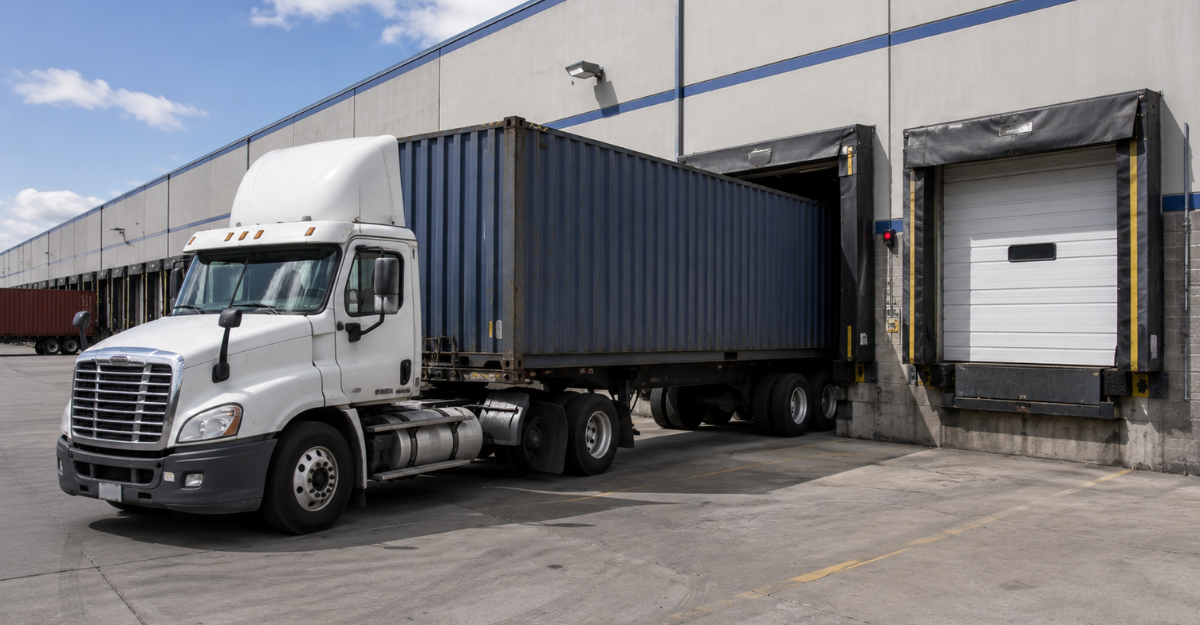
Drayage at origin: A truck picks up the container or trailer at the shipper's facility and transports it to the nearest intermodal rail terminal (called a ramp). This drayage leg is typically 25 to 75 miles, though it can be longer depending on the shipper's distance from a ramp.
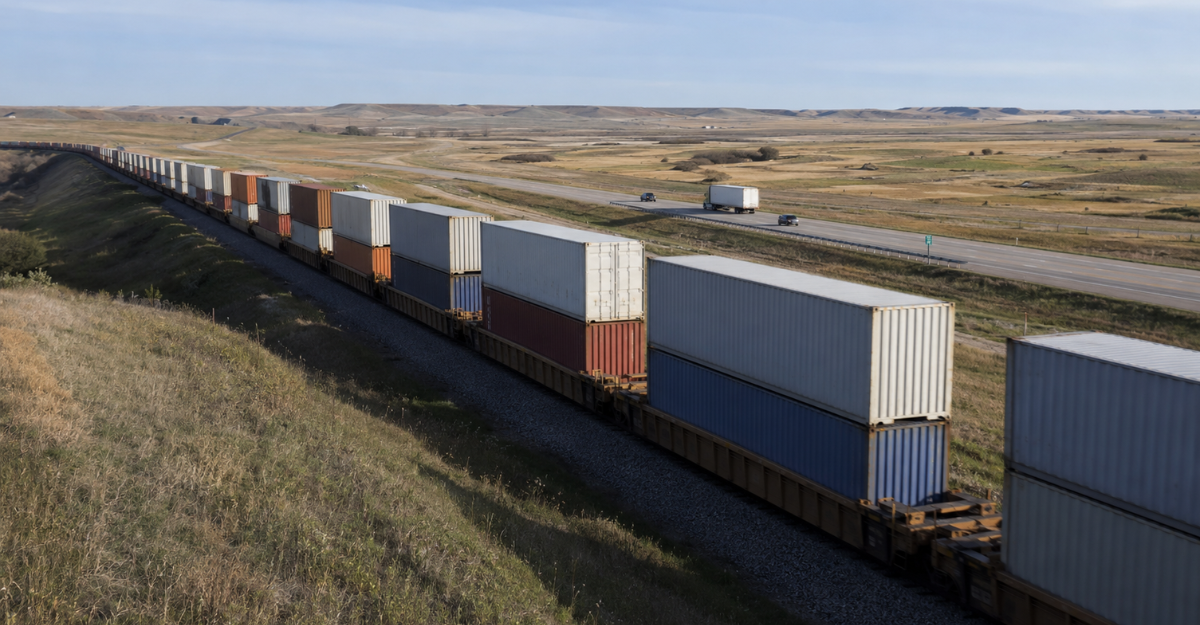
Rail linehaul: The container or trailer is loaded onto a rail car at the origin ramp and transported by rail to the destination ramp. This is the long-haul segment — typically 500 to 2,500 miles — where the cost advantage of rail over truck is generated. A single freight train can move 200 to 300 containers, and rail fuel efficiency is approximately four times greater than truck: one gallon of diesel moves one ton of freight approximately 470 miles by rail, compared to roughly 120 miles by truck.
Drayage at destination: A truck picks up the container or trailer at the destination ramp and delivers it to the consignee's facility. Like origin drayage, this leg is typically 25 to 75 miles.
The shipper interacts with a truck at both ends. The rail leg is managed by the railroad (or by an intermodal marketing company acting as an intermediary). The freight inside the container is never handled, sorted, or transferred — it stays in the same container from origin dock to destination dock.
TOFC vs. COFC
Intermodal freight moves in two configurations, and the distinction matters for cost, capacity, and equipment compatibility:
TOFC: Trailer on Flatcar
TOFC involves placing a standard highway trailer — the same 53-foot trailer used for over-the-road trucking — onto a rail flatcar. The entire trailer, including its wheels and undercarriage, rides on the flatcar.
TOFC is the simpler conversion from over-the-road to intermodal because the equipment is the same. A trailer loaded at a shipper's dock can be driven to the rail ramp and placed directly on a flatcar without any equipment change. At destination, the trailer is lifted off the flatcar and driven directly to the consignee.
The limitation of TOFC is that trailers cannot be double-stacked on a rail car. Each flatcar carries one trailer, which means TOFC uses rail capacity less efficiently than container-based intermodal. TOFC has been declining as a share of total intermodal volume for this reason — it is being replaced by the more capacity-efficient COFC configuration.
COFC: Container on Flatcar
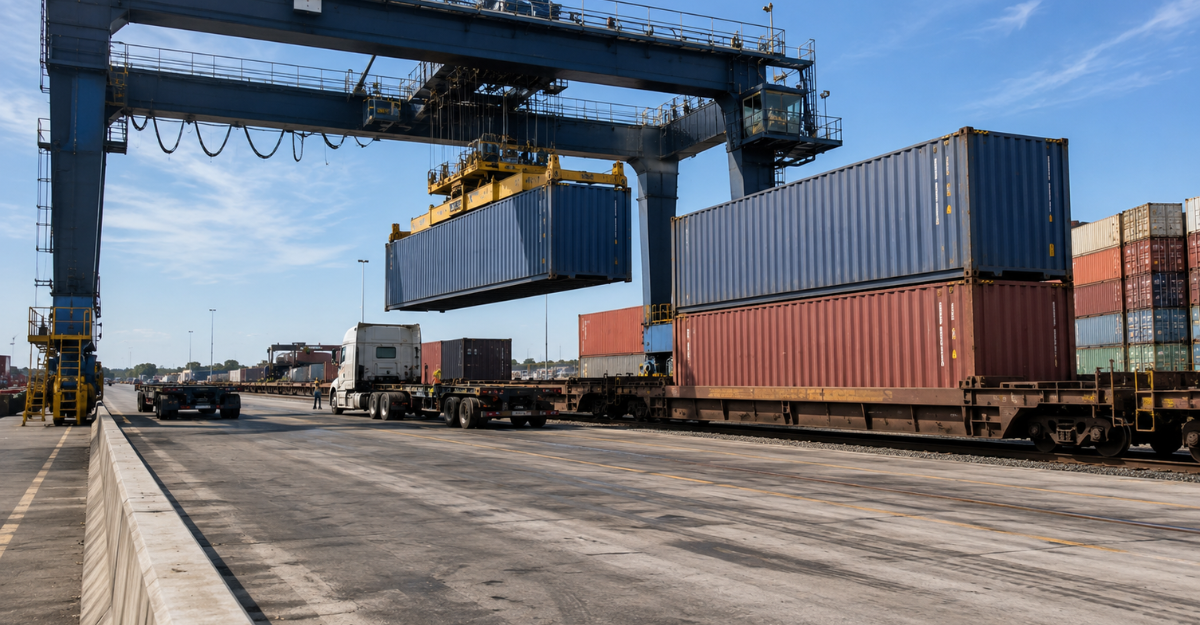
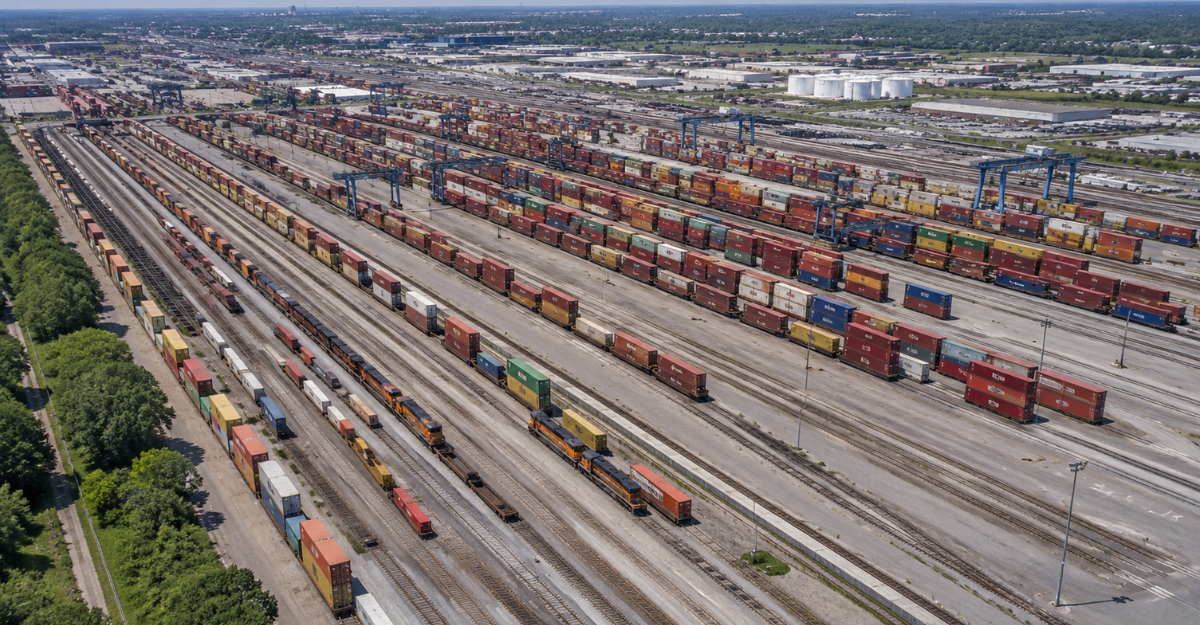
COFC involves placing intermodal containers — which are shorter than trailers and do not have wheels or an undercarriage — onto specially designed rail well cars. The critical advantage of COFC is double-stacking: two containers can be stacked vertically on a single well car, effectively doubling the rail capacity per car.
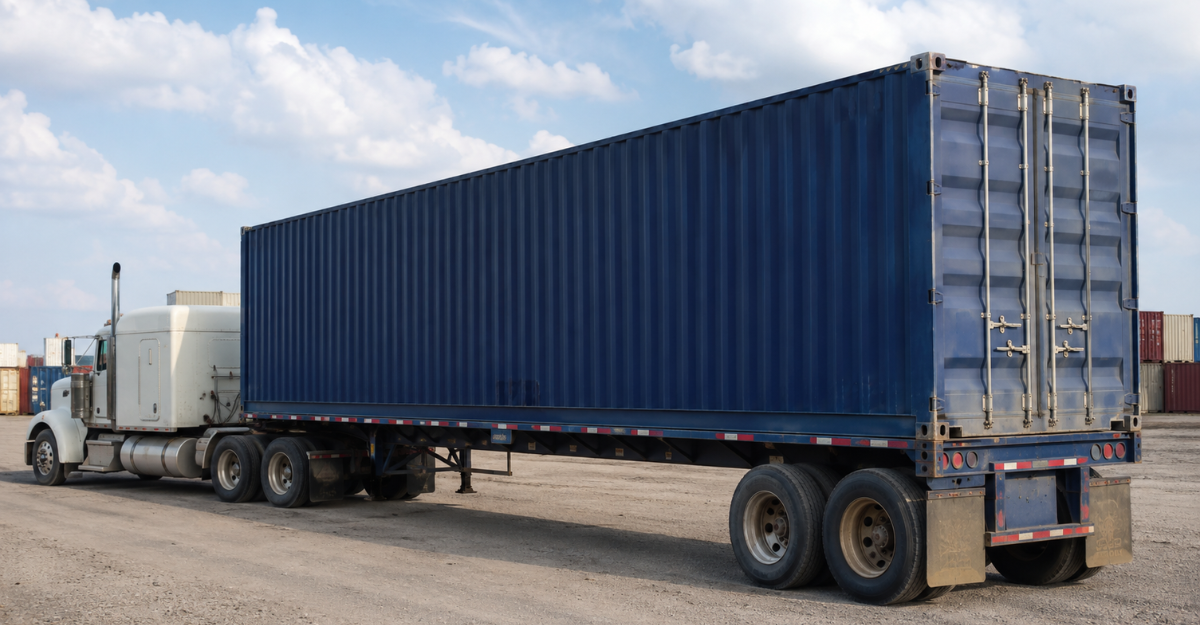
Domestic intermodal containers are typically 53 feet long (the same as a highway trailer) but are structurally different — they are designed to stack, to lock into well car fittings, and to be lifted by cranes at rail terminals. At origin and destination, the container rides on a truck chassis (a wheeled frame that the container is placed on for highway transport). The chassis is separate from the container.
COFC is the dominant configuration in domestic intermodal and the primary driver of intermodal's cost advantage. Double-stacking allows railroads to move twice as many containers per train, which drives down the per-unit rail cost. The 5.1 percent year-over-year growth in domestic containers in 2026 is almost entirely COFC volume.
Where the Cost Advantage Comes From
Fuel Efficiency
Rail is approximately four times more fuel-efficient than truck per ton-mile. A freight train carrying 280 containers burns substantially less total fuel than 280 individual trucks would burn covering the same distance. This fuel advantage is the foundation of intermodal's cost structure, and it becomes more pronounced as diesel prices rise. When diesel is at $3.78 per gallon, the fuel surcharge on an over-the-road truckload shipment adds $0.42 to $0.55 per mile. The intermodal equivalent is typically 40 to 60 percent less because the rail linehaul component consumes far less fuel per unit.
Driver Cost Reduction
An over-the-road truckload shipment from Chicago to Los Angeles requires a driver for approximately 2,000 miles — roughly 4 days of driving within HOS limits, possibly requiring a team driver for time-sensitive loads. An intermodal shipment on the same lane requires drayage drivers at each end (50 to 75 miles each) and no driver for the rail linehaul. The driver cost for the intermodal option is a fraction of the over-the-road cost — which matters in a market where driver availability and retention are persistent constraints.
Equipment Utilization
Railroads amortize the cost of track, locomotives, and well cars across enormous volumes. A single intermodal train replaces 200 to 300 trucks on the highway. The infrastructure cost per container is lower than the equivalent per-truck cost of highway maintenance, fuel, tires, and equipment depreciation. This structural cost advantage allows railroads to price intermodal below over-the-road trucking on competitive lanes while maintaining margins.
The Trade-Offs
Transit Time
Intermodal is slower than over-the-road trucking. A truckload shipment from Chicago to Los Angeles takes approximately 3 to 4 days. The same lane by intermodal takes 5 to 7 days. The additional time comes from rail terminal dwell (the time the container sits at the origin ramp waiting to be loaded onto a train), rail transit time (trains are fast but make scheduled stops and may be held for track maintenance or congestion), and destination terminal dwell (the time between train arrival and drayage pickup).
For freight that is not time-sensitive — inventory replenishment, scheduled production inputs, retail distribution to warehouses — the additional 1 to 3 days of transit is an acceptable trade-off for 10 to 40 percent cost savings. For time-critical or mission-critical freight, over-the-road or expedited remains the appropriate mode.
Service Variability
Intermodal transit times are less consistent than over-the-road trucking. Rail schedules are affected by track congestion, weather across multiple states, railroad operational decisions, and terminal capacity. A lane that averages 5 days may occasionally take 7. Over-the-road trucking, while not immune to variability, is generally more predictable day to day because the driver has more control over the route and schedule.
Shippers using intermodal should plan for the variability by building buffer time into receiving schedules and maintaining safety stock that accounts for the wider transit window. The cost savings should more than offset the inventory carrying cost of the additional buffer.
Cargo Limitations
Not all freight is suited to intermodal. Containers are subject to the same dimensional constraints as trailers (53 feet × 102 inches × approximately 110 inches of interior height for domestic containers), but the intermodal handling process introduces additional considerations. Freight that is extremely fragile, that cannot tolerate the lateral forces of rail transit (which differ from highway vibration), or that requires temperature control over long distances with high precision may not be well-suited to intermodal. Hazardous materials have additional regulatory requirements for rail transport that may restrict eligibility.
The best intermodal freight is dense, stable, not time-sensitive, and moving 500 miles or more. Consumer packaged goods, building materials, paper products, non-perishable food and beverage, automotive parts, and data center equipment are all strong intermodal commodities.
How to Evaluate Whether Intermodal Fits Your Lanes
Distance Threshold
The general rule is that intermodal becomes cost-competitive on lanes of 500 miles or more, and the cost advantage widens as distance increases. Below 500 miles, the drayage costs at both ends and the rail terminal handling costs eat into the rail linehaul savings. Above 750 miles, intermodal is almost always cheaper than over-the-road truckload — sometimes by 30 to 40 percent on lanes of 1,500 miles or more.
Ramp Proximity
The cost and feasibility of intermodal depend heavily on how far the shipper and consignee are from rail terminals. If the origin is 200 miles from the nearest ramp, the drayage cost may eliminate the rail savings. Shippers located within 75 miles of a major intermodal ramp (Chicago, Los Angeles, Dallas, Atlanta, Memphis, Kansas City, and other hub cities) have the most favorable intermodal economics.
Volume Consistency
Railroads and intermodal providers offer the best pricing to shippers with consistent, predictable volumes. A shipper moving 20 containers per week on the same lane is a stronger candidate for favorable intermodal pricing than a shipper moving 2 containers per month on an irregular schedule. The mode selection decision should consider not only the individual shipment economics but the aggregate volume commitment.
Transit Time Tolerance
If the freight can absorb 1 to 3 additional days of transit without affecting production schedules, delivery commitments, or customer satisfaction, intermodal is worth evaluating. If the freight is on a just-in-time schedule with no buffer, over-the-road remains the right mode — the cost savings of intermodal are worthless if the freight arrives too late to be useful.
The 2026 Intermodal Market
Several factors are making intermodal more attractive in 2026 than it has been in recent years:
Over-the-road capacity is tightening. The freight market contraction that has pushed truck rates upward has widened the cost gap between truck and intermodal on competitive lanes. As truckload rates rise, the intermodal discount becomes larger in absolute terms.
Diesel prices remain elevated. At $3.78 per gallon, the fuel efficiency advantage of rail is worth more per mile than it was when diesel was below $3.00. The fuel component alone can account for 30 to 50 percent of the cost advantage on long-haul lanes.
Railroad service has improved. After several years of service disruptions and network congestion, the Class I railroads have invested in terminal capacity, intermodal equipment, and train scheduling. Service metrics — on-time performance, terminal dwell time, and damage rates — have improved in 2025 and into 2026, making intermodal a more reliable option than it was during the 2021-2023 period.
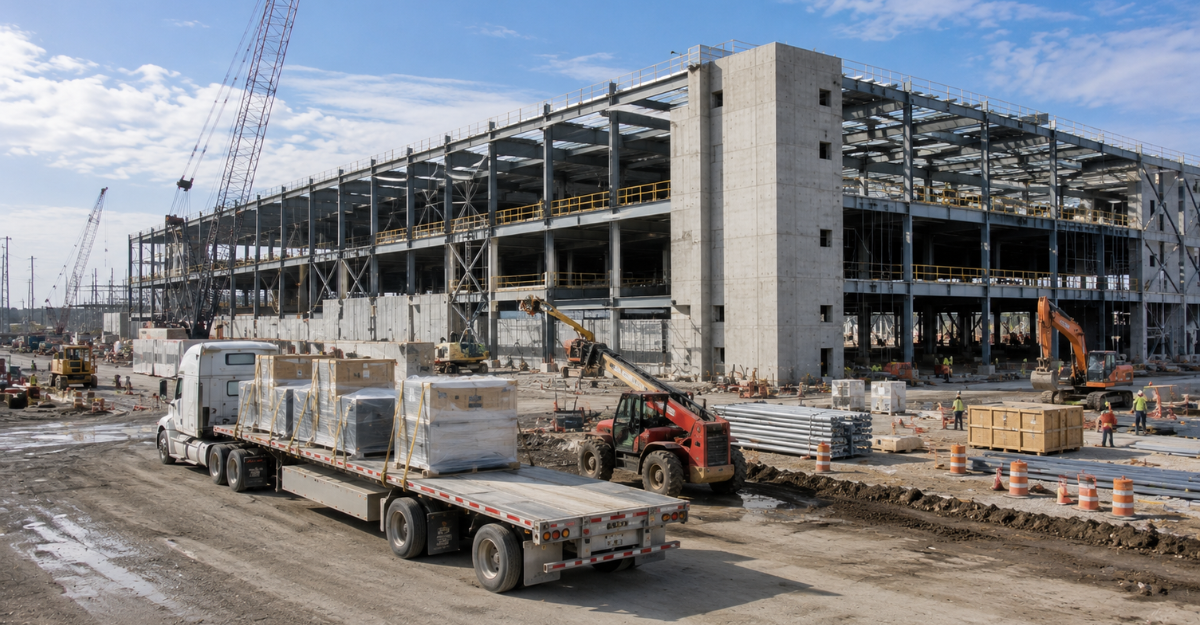
Data center and AI freight is growing. The construction of data centers and AI compute facilities has created a new category of heavy, long-haul freight — servers, networking equipment, power systems, cooling infrastructure — that moves well in containers and originates primarily from manufacturing hubs in the Midwest and Southeast to deployment sites across the country. This freight is driving the 5.1 percent growth in domestic intermodal containers.
Working with an Intermodal Provider
Shippers new to intermodal often work through an intermodal marketing company (IMC) rather than directly with the railroad. An IMC acts as an intermediary — booking rail capacity, arranging drayage carriers at both ends, tracking the container through the rail network, and providing a single point of contact for the entire move. Most 3PLs and freight brokers offer intermodal service through IMC relationships.
For shippers with sufficient volume, direct contracts with the railroads (BNSF, Union Pacific, Norfolk Southern, CSX, and Canadian National/Canadian Pacific Kansas City) can produce lower rates — but require volume commitments and more internal logistics management. The decision between IMC and direct typically depends on weekly container volume: shippers moving fewer than 10 containers per week on a given lane generally benefit from IMC flexibility, while shippers moving 20 or more may benefit from direct railroad contracts.
Regardless of the provider, shippers should evaluate drayage reliability (on-time pickup and delivery at the ramp), container tracking visibility (real-time updates through the rail leg, not just departure and arrival notifications), claims handling and damage rates, and the provider's ability to reroute to over-the-road trucking when rail service disruptions occur. The ability to flex between intermodal and over-the-road on the same lane — without rebidding the freight — is a capability that the best asset-based logistics providers offer as standard practice.
Frequently Asked Questions
What is intermodal freight? Intermodal freight uses two or more transportation modes — typically truck and rail — to move a container or trailer from origin to destination without handling the freight itself between modes. A truck handles first-mile and last-mile drayage (typically 25-75 miles at each end), and rail handles the long-haul linehaul. The freight stays in the same container throughout.
What is the difference between TOFC and COFC? TOFC (Trailer on Flatcar) places a standard highway trailer onto a rail flatcar — simple but cannot be double-stacked. COFC (Container on Flatcar) uses intermodal containers on well cars that can be stacked two high, doubling rail capacity per car. COFC is the dominant and growing configuration because double-stacking drives lower per-unit costs.
How much cheaper is intermodal than over-the-road trucking? Intermodal typically costs 10 to 40 percent less than over-the-road truckload on lanes of 500 miles or more. The savings increase with distance — lanes of 1,500+ miles can see 30 to 40 percent savings. The cost advantage comes from rail fuel efficiency (approximately 4x more efficient than truck), reduced driver costs, and equipment utilization efficiencies.
How much longer does intermodal take? Intermodal typically adds 1 to 3 days compared to over-the-road trucking on the same lane. Chicago to Los Angeles is approximately 3-4 days by truck and 5-7 days by intermodal. The additional time comes from rail terminal dwell at origin and destination plus the rail transit schedule. Transit time variability is also higher than truck.
What freight works best for intermodal? The best intermodal freight is dense, stable, not time-sensitive, and moving 500+ miles. Strong intermodal commodities include consumer packaged goods, building materials, paper products, non-perishable food and beverage, automotive parts, and data center equipment. Freight that is extremely fragile, requires precise temperature control, or is on a just-in-time schedule is typically better suited to over-the-road trucking.
How do I know if intermodal works for my lanes? Evaluate four factors: distance (500+ miles is the threshold, 750+ miles is where savings are most compelling), ramp proximity (within 75 miles of a major rail terminal at both ends), volume consistency (predictable weekly volumes get the best pricing), and transit time tolerance (can your schedule absorb 1-3 additional days). If all four factors are favorable, intermodal is almost certainly worth quoting.
other blog posts
%20(2).webp)

%2520(1).webp)