The Non-Domiciled CDL Rule: What the 2026 FMCSA Final Rule Means for Carriers and Shippers
FMCSA's non-domiciled CDL final rule, effective March 16, 2026, restricts CDL eligibility for ~194,000 drivers. Learn how the rule works, which visa categories qualify, and what capacity impacts shippers should prepare for.
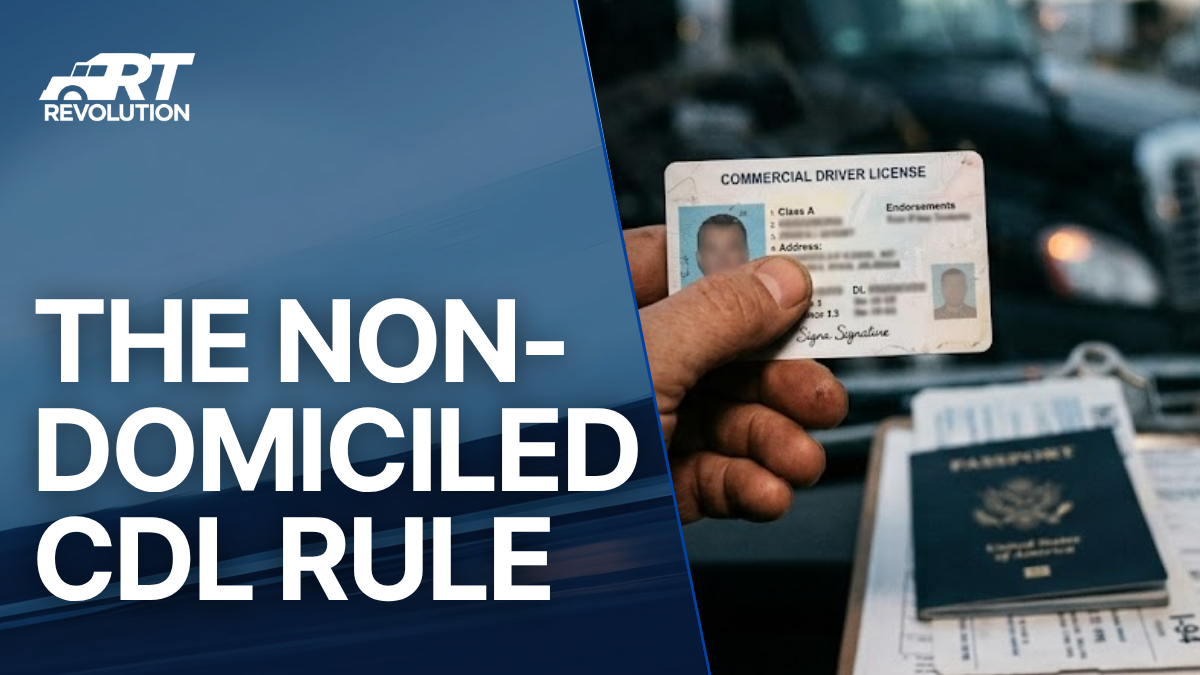
On March 16, 2026, FMCSA's final rule on non-domiciled commercial driver's licenses took effect. The rule fundamentally changes who is eligible to hold a CDL without being domiciled — legally residing — in a U.S. state, and its consequences for trucking capacity are already measurable.
The numbers are not subtle. FMCSA estimates that approximately 200,000 CDL holders currently operate under non-domiciled status. Of those, 97 percent — roughly 194,000 drivers — do not hold the visa categories that the new rule requires. Their existing licenses remain valid until expiration, but renewal under the new standards will disqualify the vast majority. California has already revoked approximately 17,000 non-domiciled CDLs. Federal funding has been withheld from states that have not implemented the new verification requirements.
This is not a future problem. It is a capacity event that is unfolding now, and it is reshaping rate structures, carrier availability, and lane-level service reliability in ways that every shipper managing freight in 2026 needs to understand.
What the Rule Actually Says
Eligibility Under the New Standards
The final rule restricts non-domiciled CDL and CLP (commercial learner's permit) eligibility to foreign-domiciled individuals who hold one of three specific employment-based nonimmigrant visa categories:
H-2A — temporary agricultural workers. These visa holders are employed by U.S. agricultural operations under a Department of Labor-certified temporary labor agreement. The CDL eligibility applies because some agricultural operations require employees to operate commercial vehicles for crop transportation, livestock hauling, or farm-to-processor delivery.
H-2B — temporary non-agricultural workers. These visa holders are employed in non-agricultural industries — including trucking directly — under temporary labor agreements. H-2B is the visa category most directly relevant to the commercial transportation industry, but the annual H-2B cap (66,000 visas, with some supplemental allocations) limits the number of drivers who can enter through this pathway.
E-2 — treaty investors. This category applies to nationals of countries with qualifying trade treaties who invest in or manage U.S. businesses. The E-2 category is numerically small in the trucking context but relevant for owner-operators who hold foreign nationality and operate under investor status.
All other nonimmigrant categories — including individuals with employment authorization documents (EADs), asylum applicants, TPS (Temporary Protected Status) holders, DACA recipients, and holders of other work-authorized immigration statuses — are no longer eligible for non-domiciled CDLs under the new rule.
Documentation Requirements
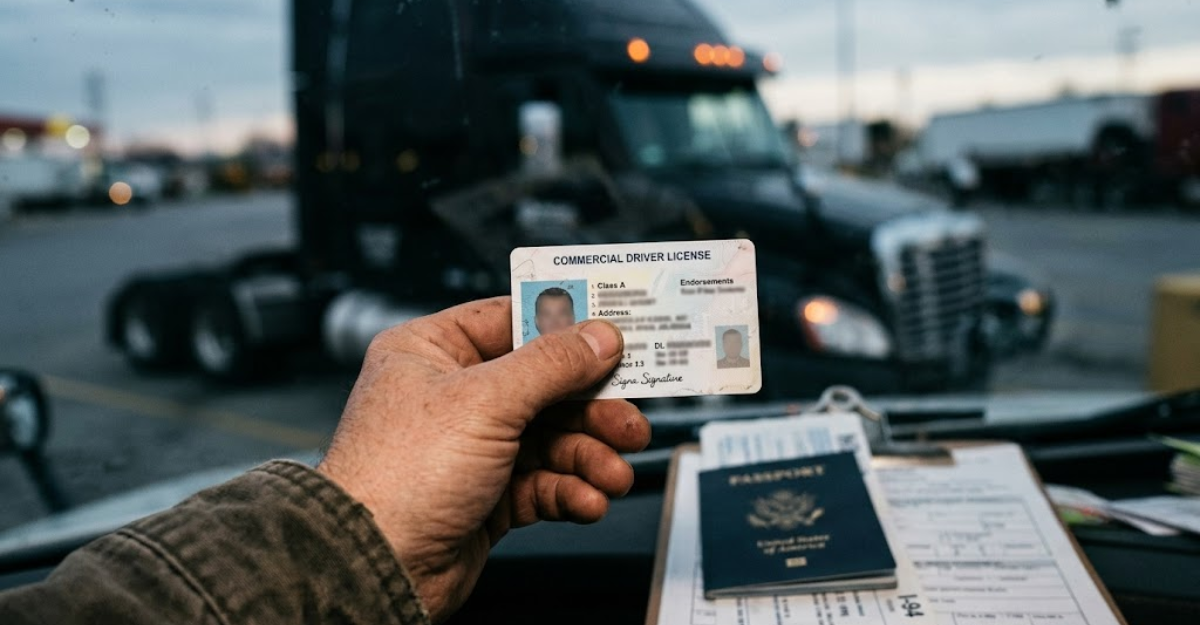
Applicants must present an unexpired foreign passport and a specific Form I-94 or I-94A with an unexpired "Admit Until Date" indicating H-2A, H-2B, or E-2 status. Employment authorization documents alone — which were previously accepted by many State Driver's Licensing Agencies (SDLAs) as proof of eligibility — are no longer sufficient.
.png)
License Duration Limits
The rule caps non-domiciled CDL validity at one year, and the credential cannot extend beyond the "Admit Until Date" on the applicant's Form I-94. This creates a maximum-one-year renewal cycle for every non-domiciled CDL holder, regardless of the SDLA's standard CDL validity period. For carriers, this means annual re-verification of driving credentials for every non-domiciled driver in their fleet.
Existing Licenses
CDLs issued under prior rules generally remain valid until their printed expiration date. However, renewal, transfer, or upgrade of a non-domiciled CDL requires meeting the new eligibility standards. A driver whose current license expires in September 2026 must demonstrate H-2A, H-2B, or E-2 status to renew. If they cannot, the license lapses.
Why FMCSA Made the Change
FMCSA's stated rationale centers on safety verification and regulatory integrity. The agency identified 17 fatal crashes in 2025 that were caused by actions of non-domiciled CDL holders whose fitness — including medical qualification, driving record verification, and residency confirmation — could not be reliably ensured under the prior system. Those crashes resulted in 30 fatalities and numerous severe injuries.
The prior system allowed SDLAs to issue non-domiciled CDLs based on a broad range of immigration documents. FMCSA determined that some of these documents did not provide the agency with sufficient means to verify the applicant's identity, legal status, or driving history in their country of origin. The final rule narrows the documentation requirements to visa categories where the applicant's identity and employment status have already been verified through the Department of State (passport and visa issuance) and U.S. Customs and Border Protection (Form I-94 processing).
The safety argument is specific: FMCSA's analysis concluded that the prior system's documentation gaps created conditions where individuals whose fitness to operate commercial vehicles could not be verified were nonetheless holding valid CDLs. The 17 fatal crashes cited in the rulemaking are the cases where that verification gap produced a quantifiable safety outcome.
The Capacity Impact: Where the Numbers Hit
National Scale
An industry already facing a structural driver shortage — the American Trucking Associations estimates the current gap at 60,000 to 80,000 drivers — is absorbing a regulatory change that affects 194,000 CDL holders. Not all 194,000 will lose their licenses simultaneously — the attrition is paced by individual license expiration dates — but the trajectory is clear. As non-qualifying licenses expire over the next 12 to 36 months, the available driver pool contracts.
The practical impact is not evenly distributed. Some affected drivers will adjust their immigration status to qualify under the new categories. Some will obtain state-domiciled CDLs by establishing legal residency in a state. Some will exit the U.S. trucking industry entirely. The relative proportions of these outcomes are uncertain, but even conservative estimates suggest that tens of thousands of drivers will not be behind the wheel by mid-2027 who are behind the wheel today.
Regional Concentration
The capacity impact is geographically concentrated. Non-domiciled CDL holders are disproportionately represented in three areas:
Port drayage at Los Angeles / Long Beach, Oakland, and the New York / New Jersey port complex. Container drayage from marine terminals to warehouses and intermodal facilities relies heavily on non-domiciled CDL holders, particularly independent owner-operators. California's early revocation of approximately 17,000 licenses has already reduced drayage capacity in the state's port corridors.
Agricultural freight corridors in California's Central Valley, the Pacific Northwest, and southeastern states where H-2A visa holders operate farm-to-processor routes. These corridors will see less disruption because H-2A is one of the qualifying categories, but carriers operating mixed fleets of H-2A and non-qualifying drivers will still feel the contraction.
Construction and industrial freight in metro areas where immigrant-owned small carriers and owner-operators provide last-mile delivery for building materials, equipment, and manufacturing components. For shippers using carrier networks that include independent operators in these segments, the available capacity is declining.
What This Means for Shippers
Rate Pressure Is Structural, Not Cyclical
Typical freight rate fluctuations follow demand cycles — rates rise when freight demand exceeds available capacity, and they soften when capacity catches up. The non-domiciled CDL rule creates a different dynamic: a permanent reduction in the driver pool that persists regardless of freight demand levels. Even in a soft market, the supply side is contracting.
The current market data reflects this. Tender rejection rates have climbed above 15 percent — the highest since early 2022. Spot truckload rates have moved above contract rates for the first time since 2021. Dry van cost per mile is forecast at 8 percent above 2025 levels, and flatbed has reached a record high. These movements are not purely demand-driven. The supply contraction from the CDL rule, combined with ongoing carrier exits and elevated insurance costs from the nuclear verdict crisis, is tightening the market from both sides.
For shippers building 2026 and 2027 freight budgets, the implication is that rate expectations based on cyclical historical patterns will underestimate the actual cost environment. The capacity contraction is structural, and the rate impact will persist even when freight demand softens.

Carrier Vetting Becomes More Important
The CDL rule creates a compliance burden that falls directly on carriers — they must verify the immigration status and CDL validity of every non-domiciled driver in their fleet, on an annual cycle. Carriers that manage this verification rigorously will maintain operational continuity. Carriers that do not will face driver-availability disruptions that cascade into service failures.
For shippers, this means that carrier vetting should now include a question that was not previously standard: how does the carrier manage non-domiciled CDL verification, and what percentage of their driver fleet is affected by the rule? A carrier that draws 30 percent of its driving capacity from non-domiciled CDL holders faces a fundamentally different operational risk than one that draws 5 percent.
The distinction between carriers that have proactively addressed the CDL transition and those that have not is a meaningful differentiator in 2026. Asset-based carriers with company-driver fleets generally have more visibility into and control over their drivers' credential status than brokered models that rely on third-party carriers and independent owner-operators.
Lane-Level Service Reliability Will Vary
Because the capacity impact is regionally concentrated, shippers whose freight moves through affected corridors — particularly port drayage lanes and construction-heavy metro areas — should expect lane-level service disruptions that may not be reflected in national averages. A shipper whose freight moves exclusively between Midwest manufacturing facilities may see minimal impact. A shipper whose supply chain includes inbound container drayage from LA/Long Beach and outbound last-mile delivery in New York metro will see significant tightening.
The response is not to avoid these lanes — the freight still needs to move — but to build contingency into lead times, evaluate whether current carrier relationships provide adequate coverage in affected corridors, and consider whether mode selection adjustments can reduce exposure to the most capacity-constrained segments.
What This Means for Carriers
Compliance Infrastructure Is Not Optional
The annual re-verification cycle for non-domiciled CDLs creates an administrative requirement that must be systematized. Carriers cannot rely on hiring-time credential checks and assume ongoing validity. Every non-domiciled CDL holder must be re-verified at each renewal, and the maximum one-year validity means the verification cycle is continuous.
Carriers that have not built this process into their compliance infrastructure are operating with latent risk. A driver whose non-domiciled CDL has expired — even by one day — is operating without a valid commercial license. The liability exposure in the event of an incident is substantial, and the insurance implications are severe. Insurers will not cover a claim involving an unlicensed driver.
Workforce Planning Requires Forward Visibility
Carriers should map their non-domiciled CDL holder population by license expiration date and visa category. This produces a timeline showing when each affected driver will face a renewal decision — and whether they are likely to qualify under the new standards. For drivers who will not qualify, the carrier has a known date by which that seat will be empty, and recruitment can begin accordingly rather than reactively.
The most forward-thinking carriers are treating this as a planned capacity transition rather than a crisis response. They are investing in recruitment pipelines that focus on domiciled CDL holders, building relationships with driver training programs, and — where appropriate — sponsoring qualified drivers for H-2B visa petitions that would bring them into compliance with the new rule.
The Safety Argument Works in Your Favor
Carriers that can demonstrate full compliance with the non-domiciled CDL rule — documented verification processes, current credential files, no expired or non-qualifying licenses in the fleet — have a competitive advantage in 2026. Shippers are increasingly asking about CDL compliance during carrier qualification, and the ability to demonstrate a clean driver file is a differentiator.
For carriers committed to brand integrity and freight selection discipline, the CDL rule reinforces a principle that was already operationally sound: every driver operating under your authority should be fully qualified, fully credentialed, and fully insurable. The rule simply formalizes what the best carriers were already doing.
The Bigger Picture: A Tighter Market With Multiple Pressure Points
The non-domiciled CDL rule is not happening in isolation. It is one of several concurrent forces tightening the trucking capacity market in 2026:
Carrier exits remain elevated. Smaller operators continue to exit the market under pressure from inflation, fuel costs, insurance premiums, and thin margins. The carriers most likely to exit are also the most likely to employ non-domiciled CDL holders, compounding the capacity effect.
Insurance costs continue to climb. ATRI's 2025 Operational Costs of Trucking report recorded insurance premiums at $0.102 per mile — a record. Premiums have increased an average of 8.3 percent annually since 2017, more than double the general inflation rate. Small and mid-size fleets report 15 to 20 percent annual premium increases, and some insurers have exited the trucking market entirely.
Regulatory enforcement is intensifying. The CDL rule is the highest-profile regulatory change, but FMCSA has also increased enforcement activity around hours of service compliance, ELD verification, and drug-and-alcohol testing program audits. Each enforcement action that removes a non-compliant driver from service reduces available capacity.
The combined effect is a market where capacity is tightening faster than freight demand alone would suggest. Shippers who plan for this environment — locking in carrier relationships, building lead time into schedules, and matching freight decisions to risk profiles — will navigate it better than those who wait for the rate increases to arrive and react.
Frequently Asked Questions
What is the non-domiciled CDL rule? FMCSA's final rule, effective March 16, 2026, restricts non-domiciled commercial driver's license eligibility to foreign-domiciled individuals holding H-2A (temporary agricultural), H-2B (temporary non-agricultural), or E-2 (treaty investor) visas. All other nonimmigrant categories are no longer eligible. Approximately 194,000 current CDL holders do not hold qualifying visas.
How many drivers does the non-domiciled CDL rule affect? FMCSA estimates approximately 200,000 CDL holders operate under non-domiciled status. Of those, 97 percent (roughly 194,000) do not hold H-2A, H-2B, or E-2 visas and will not qualify for renewal under the new rule. Existing licenses remain valid until expiration, but the attrition will be substantial as renewals come due over the next 12 to 36 months.
Will the rule make shipping more expensive? Yes, and the effect is structural rather than cyclical. The capacity contraction from the CDL rule, combined with carrier exits and rising insurance costs, is tightening the market from the supply side regardless of freight demand levels. Dry van cost per mile is forecast at 8 percent above 2025, tender rejection rates have reached their highest since early 2022, and spot rates have moved above contract rates for the first time since 2021.
Which regions are most affected? Port drayage corridors (Los Angeles / Long Beach, Oakland, New York / New Jersey) and construction-heavy metro areas are most affected because non-domiciled CDL holders are disproportionately concentrated in these segments. California has already revoked approximately 17,000 non-domiciled CDLs. Agricultural corridors are less affected because H-2A (a qualifying category) is prevalent in farm-to-processor transportation.
What should shippers do to prepare? Ask current carriers about their non-domiciled CDL exposure and verification processes. Build contingency lead time into shipments moving through affected corridors. Evaluate whether existing carrier relationships provide adequate coverage in port drayage and last-mile construction segments. Consider locking in carrier relationships and contract rates before the capacity contraction is fully realized.
Can affected drivers get new visas to keep their CDLs? Some may. The H-2B visa is the most relevant pathway for non-agricultural trucking, but the annual H-2B cap (66,000 with supplemental allocations) limits the number of drivers who can enter through this route. Others may establish legal state residency to obtain a domiciled CDL. The practical reality is that the majority of the 194,000 affected drivers will not transition to qualifying status, and a significant number will exit the U.S. trucking workforce.
other blog posts
%2520(2).webp)

.webp)
%20(1).png)