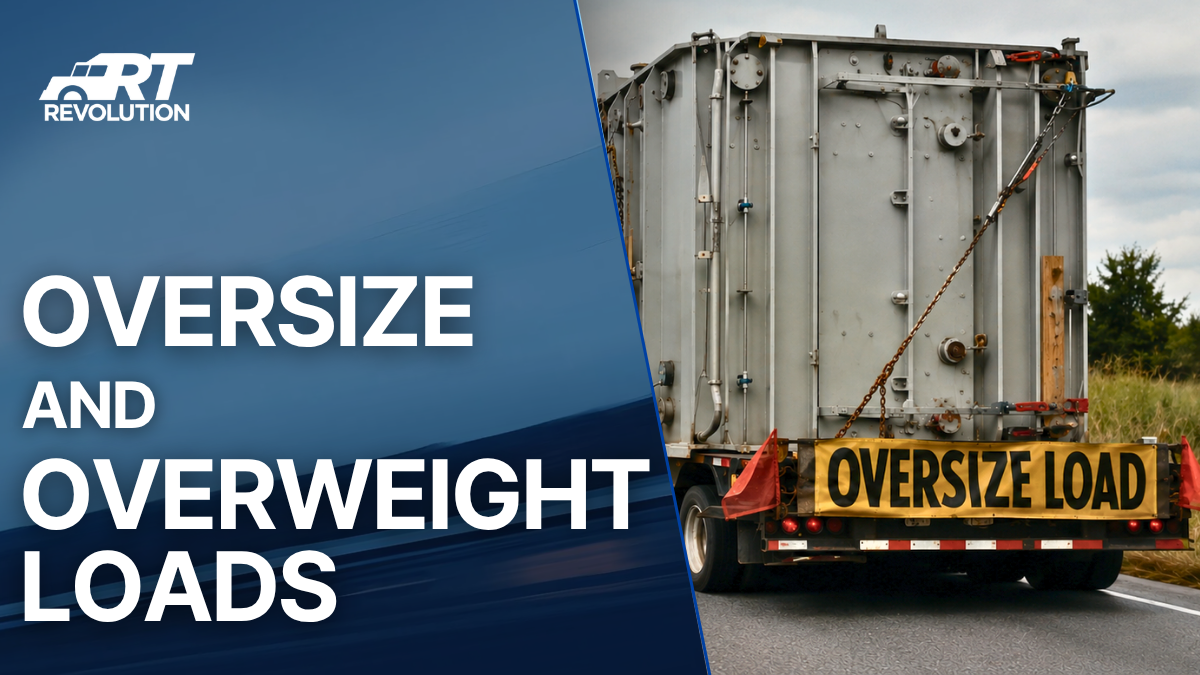
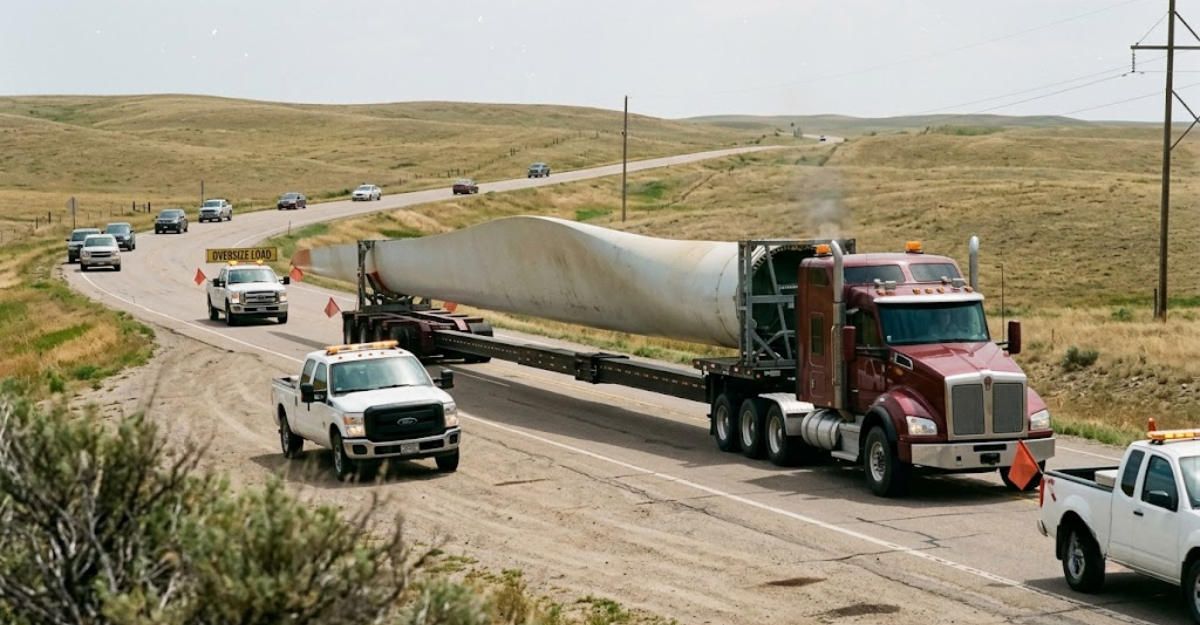
Any freight that exceeds standard legal dimensions or weight limits for highway travel requires permits, and the permitting process is neither simple nor standardized. There is no single federal oversize or overweight permit. Each state issues its own permits, each with different fees, dimensional thresholds, routing restrictions, and escort requirements. A shipment that crosses five states may require five separate permits, each with different conditions, and the route approved in one state may not connect to the route approved in the next.
For shippers moving heavy equipment, wind turbine blades, electrical transformers, or any freight that exceeds standard limits, the permit and planning process is the difference between a load that moves on schedule and a load that sits for weeks while paperwork catches up.
This guide covers federal size and weight limits, the types of permits and what they cost, routing and escort requirements, and how to plan moves that do not stall at state lines.
Federal Size and Weight Limits
Before a load needs a permit, it needs to exceed at least one of the federal limits that define "legal" dimensions and weight for highway travel:
Width: 8 feet 6 inches (102 inches). Any load wider than 102 inches is oversize. This is the most commonly exceeded dimension because industrial equipment and construction machinery frequently exceed 8.5 feet in width.
Height: 13 feet 6 inches is the standard legal height on most highways, though some states allow up to 14 feet on designated routes. Overhead clearances (bridges, overpasses, utility lines) are the primary constraint. Height violations are among the most dangerous because a load that strikes a bridge can shut down the highway and cause fatalities.
Length: 53 feet for semitrailers on the National Network (Interstate highways and designated routes). Length limits vary more by state than width or height. Some states allow longer combinations (doubles, triples) on specific routes; others restrict overall vehicle length more tightly.
Weight: 80,000 pounds gross vehicle weight, with axle-specific limits of 20,000 pounds per single axle and 34,000 pounds per tandem axle. The Federal Bridge Formula also limits weight based on axle spacing to protect bridge structures.
Freight that fits within all of these limits moves on standard equipment without permits. Freight that exceeds any one of them enters the permitting system.
Types of Oversize and Overweight Permits
Single-Trip Permits
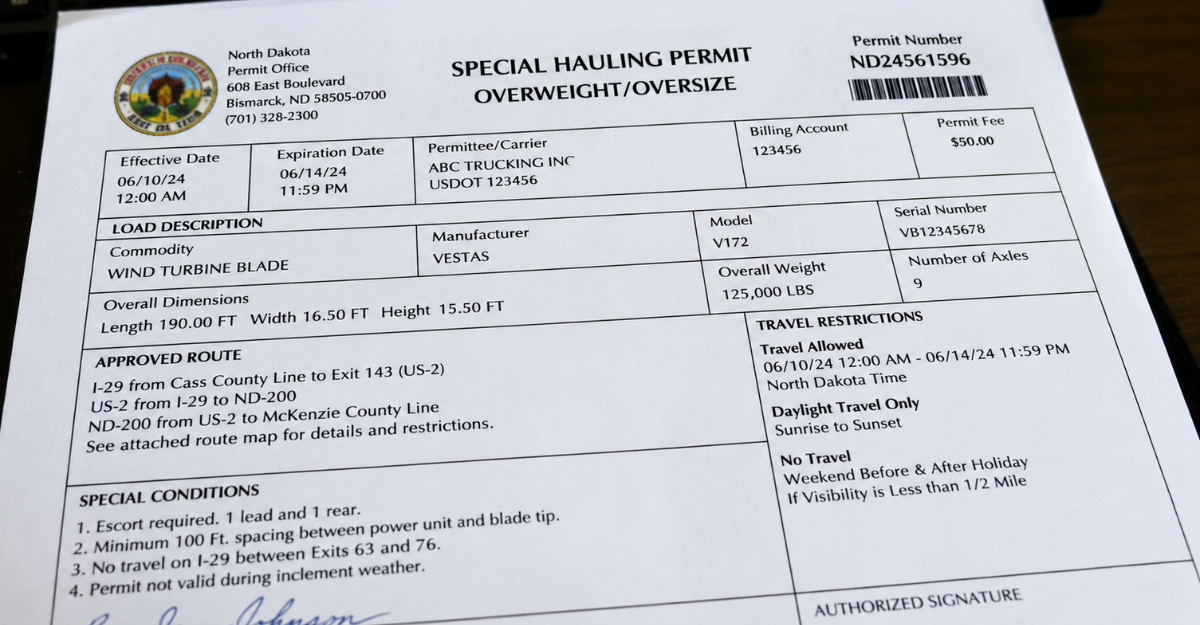
A single-trip permit authorizes one move of one load on a specified route between a defined origin and destination. The permit specifies the exact dimensions and weight of the load, the approved route down to specific highways and turns, the dates during which travel is authorized, and any conditions such as escort requirements or speed limits.
Single-trip permits are the most common permit type for shippers because most over-dimensional freight moves on a project basis: a transformer delivered to a substation, a piece of equipment shipped from a manufacturer to a plant site, or construction components moved to a jobsite. Each load gets its own permit because the dimensions and route are specific to that shipment.
Cost: $15 to $500+ per state, depending on the state and the load's dimensions and weight. Some states use flat fees, while others calculate fees based on distance, weight, or width. Florida charges $35 plus $0.15 per mile for overweight loads. Texas charges $60 plus $0.12 per mile. New Mexico charges $85 plus $20 per foot of width beyond 10 feet. These fees are per state. A five-state move can accumulate $500 to $2,000+ in permit fees alone.
Processing time: 5 to 15 business days in most states for routine oversize permits. Overweight permits that require bridge analysis can take longer. Expedited processing is available in some states for an additional fee. Superload permits (discussed below) can take weeks or months.
Annual or Blanket Permits
Annual permits authorize multiple oversize or overweight moves within a state over a 12-month period. They are available in most states for loads that are moderately oversize, typically up to 12 feet wide, 14 feet high, 95 feet long, and 120,000 pounds gross, though thresholds vary by state.
Annual permits are cost-effective for carriers that regularly haul oversize freight within a state. A flatbed carrier that makes 50 overwidth moves per year within Texas pays far less with an annual permit than with 50 individual trip permits.
Cost: $50 to $1,200 per year per state, depending on the state and the dimensional range covered. Some states offer tiered annual permits (one price for up to 10 feet wide, a higher price for 10 to 12 feet wide).
Limitation: Annual permits do not cover superloads and do not specify routes. The carrier must still verify that the chosen route can accommodate the load. Most annual permits also restrict travel to daylight hours and exclude holidays.
Superload Permits
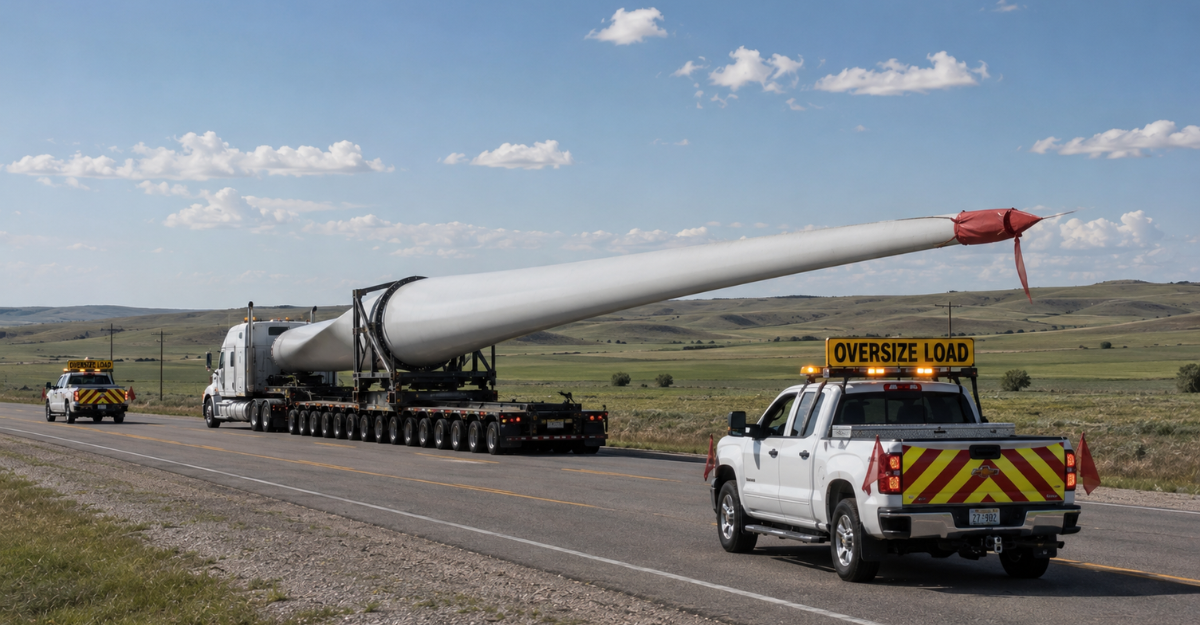
A superload is a shipment that exceeds the dimensional or weight thresholds covered by standard oversize permits, typically loads wider than 16 feet, taller than 16 feet, longer than 120 to 150 feet, or heavier than 200,000 pounds. Superloads include wind turbine components, large electrical transformers, reactor vessels, bridge sections, and mining equipment.
Superload permits require engineering review. The permitting authority must verify that every bridge, overpass, and roadway segment on the proposed route can structurally support the load. This often requires bridge analysis — structural calculations performed by engineers who evaluate whether a specific bridge can handle the concentrated weight of the load given its axle configuration. Bridge analysis costs approximately $250 per bridge evaluated, and a multi-state route may cross dozens of bridges.
Processing time: Weeks to months. Superload permits are not routine paperwork; they are engineering projects. Shippers who know they will need a superload permit should begin the permitting process 60 to 90 days before the planned move date, and earlier for loads that cross multiple states.
Routing Constraints
Route Surveys
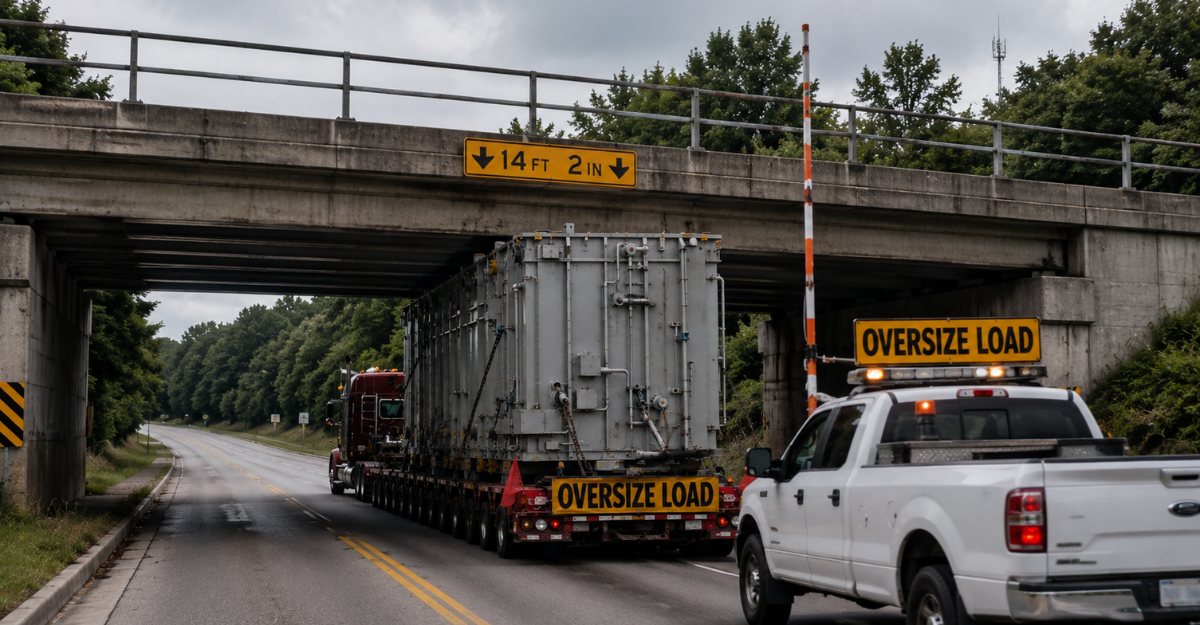
For loads that are overheight, overwidth, or both, a route survey verifies that the approved route can physically accommodate the load. This means measuring overhead clearances at every bridge, utility line, and traffic signal; checking lateral clearances against median barriers, guardrails, and construction zones; verifying turning radii at intersections and ramp curves; and confirming that every road segment on the route is structurally rated for the load's weight.
Route surveys for routine oversize loads (up to 12 feet wide, 14 feet high) are often performed using database tools that map known clearances against the load's dimensions. For larger loads, a physical survey of the route, driving the path in advance and measuring clearances at every potential obstruction, is required. Physical route surveys cost $1,000 to $5,000+ depending on distance and complexity.
Travel Time Restrictions
Most states restrict oversize load travel to daylight hours: sunrise to sunset, or 30 minutes before sunrise to 30 minutes after sunset. Night travel is generally prohibited for loads requiring pilot cars or escorts.
Additional restrictions commonly apply: no travel on major holidays (Thanksgiving, Christmas, New Year's, Fourth of July, Memorial Day, Labor Day), no travel during weekend peak periods in some states, no travel during adverse weather (high winds, ice, heavy rain, reduced visibility), and speed restrictions ranging from 45 to 55 mph depending on the state and load size.
These restrictions affect transit planning directly. A load that would take 3 days as a standard shipment may take 5 to 7 days as an oversize move because of daylight-only travel, holiday blackouts, and speed restrictions. Shippers who need the freight by a specific date must plan backward from the delivery deadline, not forward from the shipping date.
Pilot Car and Escort Requirements
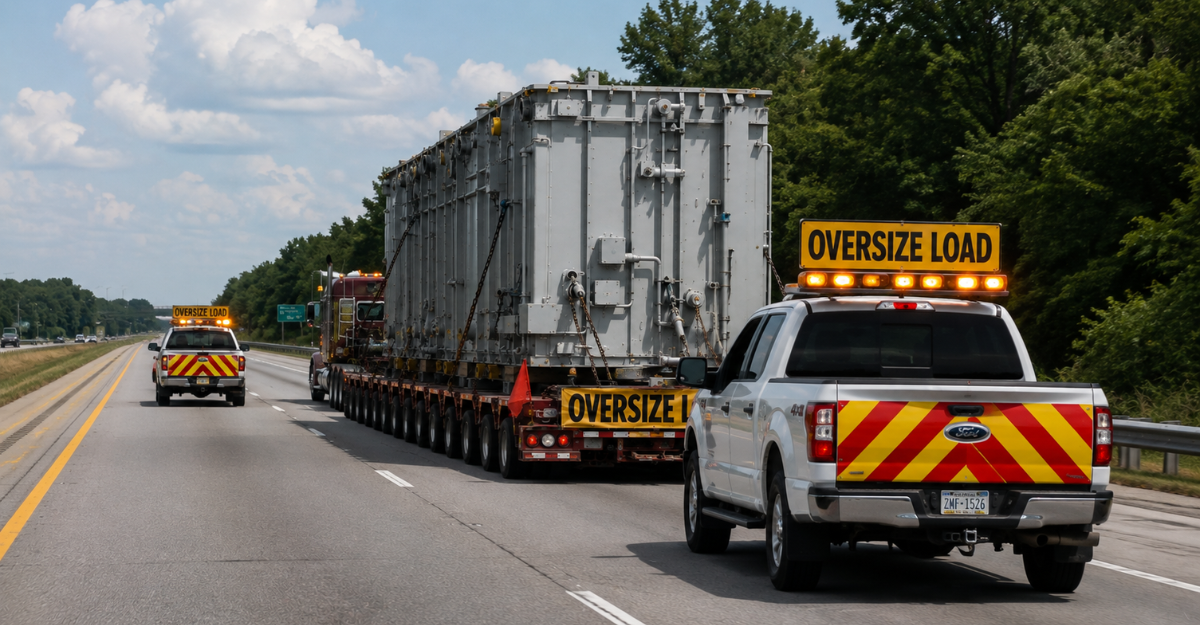
Pilot cars (also called escort vehicles) are required when a load's dimensions exceed certain thresholds, and the thresholds vary by state.
Width triggers: Most states require at least one pilot car when the load exceeds 12 feet wide. Loads exceeding 14 to 16 feet wide typically require two pilot cars, one front and one rear. Some states require a pilot car for loads over 10 feet wide on certain road types.
Height triggers: Loads exceeding 14 to 15 feet high require a pilot car equipped with a height pole — a vertical measuring device that verifies clearance at every overhead obstruction before the load passes under it.
Length triggers: Loads exceeding 90 to 100 feet overall length require rear escort in most states. Longer loads may require front and rear escorts.
Cost: Pilot car services cost $2 to $3 per mile driven, plus a daily rate of approximately $150 per day per pilot car for the driver. A 1,000-mile oversize move with one pilot car adds $2,150 to $3,150 to the transportation cost. A two-escort move doubles the escort component. On multi-state moves of 2,000+ miles with two escort vehicles, escort costs can exceed $10,000.
Certification: Most states require pilot car drivers to be certified or licensed. Some states accept other states' certifications; others require their own. The carrier or permit service coordinating the move must ensure that escort drivers hold valid certifications for every state on the route.
The HOS Exemption for Over-Dimensional Loads
FMCSA provides a limited hours of service exemption for drivers hauling oversize or overweight non-divisible loads. Under the current exemption — renewed through June 17, 2030 — drivers of over-dimensional loads are exempt from the 30-minute break requirement and may use a modified sleeper berth provision.
The exemption recognizes that oversize loads face unique constraints that standard HOS rules do not accommodate well: daylight-only travel windows that limit when driving can occur and the impracticality of pulling a 14-foot-wide permitted load off-route to find legal parking when state-mandated rest stops do not align with HOS break timing. The exemption does not eliminate driving hour limits: the 11-hour driving maximum and 14-hour on-duty window still apply. It modifies the break and rest provisions to account for the operational reality of over-dimensional transport.
Planning an Over-Dimensional Move
Start with Accurate Measurements
Every aspect of the permitting process depends on precise load dimensions: height, width, length, and weight. Errors in measurement mean the permit is wrong, and a permit that does not match the actual load is no permit at all. If an enforcement officer measures a load at 12 feet 8 inches wide but the permit says 12 feet 4 inches, the load is traveling without a valid permit. The consequences include fines and out-of-service orders — potentially impoundment of the vehicle.
Measure the freight as it will ride on the trailer, including any rigging, blocking, or securement hardware that adds to the overall dimensions. The relevant measurement is the loaded combination — not the freight in isolation and not the trailer alone.
Engage a Permit Service Early
Most carriers and shippers use professional permit services to manage the permitting process. Permit services maintain relationships with state DOT offices and know each state's application requirements and timelines. More importantly, they coordinate multi-state permit packages so that route segments actually connect at state lines, a detail that shippers managing the process internally miss more often than they expect.
The cost of a permit service — typically $50 to $200 per state per permit for routine loads — is trivial compared to the cost of a load sitting idle because a permit was filed incorrectly or a route was approved in one state but not the adjacent state.
Coordinate with the Carrier
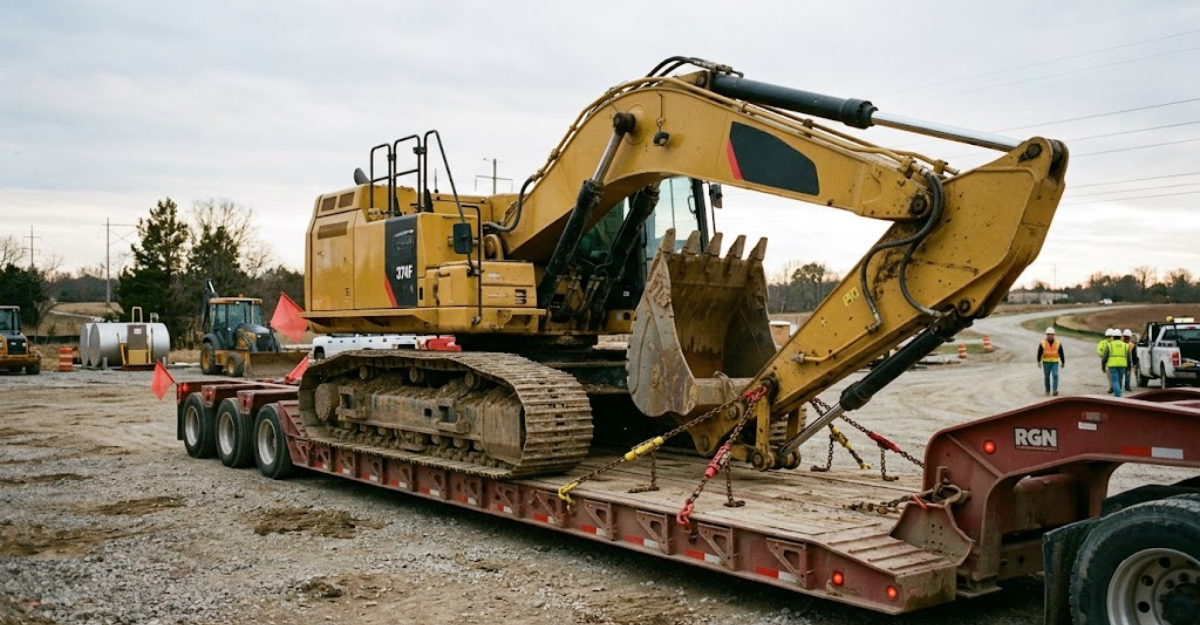
The carrier hauling the oversize load must be involved in the planning process from the beginning. The carrier determines what trailer type is required (standard flatbed, step deck, double drop, RGN, or multi-axle configuration) and verifies that the equipment meets permit conditions for axle configuration, brakes, and lighting. The carrier must also confirm that drivers hold oversize transport qualifications for every state on the route and arrange escort vehicles, which are often subcontracted to specialized firms rather than provided in-house.
Build in Buffer Time
Over-dimensional moves have more variables than standard freight: permit processing delays, weather restrictions, route changes due to construction or bridge closures, pilot car driver scheduling, and state-specific travel hour restrictions that extend transit time. A realistic timeline adds 2 to 5 days of buffer beyond the estimated transit time for a standard move on the same lane.
For superloads, the buffer should be measured in weeks. A 300,000-pound transformer moving from a manufacturing facility in the Southeast to a utility substation in the Midwest may require 3 to 6 months of planning before the load departs.
Cost Summary
The total cost of an over-dimensional move includes several components beyond the base transportation rate:
Permit fees: $15 to $500+ per state per trip. Multi-state moves accumulate quickly.
Permit service fees: $50 to $200 per state for professional permit coordination.
Route survey: $0 for database-verified routes to $1,000 to $5,000+ for physical surveys.
Bridge analysis: ~$250 per bridge for superloads requiring engineering review.
Pilot car/escort: $2 to $3 per mile plus $150/day per escort vehicle.
Equipment premium: Specialized trailers (RGN, multi-axle lowboy, dolly combinations) carry rates 30 to 100+ percent above standard flatbed rates.
Extended transit: Daylight-only travel, speed restrictions, and holiday blackouts extend driver time and per diem costs.
For a routine oversize move (12 feet wide, single state), total permit and escort costs may add $500 to $1,500 to the base transportation rate. For a multi-state superload, permit, escort, and planning costs can exceed $50,000 before the truck rolls.
Shippers budgeting for over-dimensional freight should request itemized quotes that break out each cost component rather than accepting a single all-in number. The itemization reveals where costs can be reduced: a shorter route through fewer states, for example, or a trailer configuration that stays below a permit threshold. Understanding the true cost of service is as important for over-dimensional freight as it is for standard shipments.
Frequently Asked Questions
What makes a load oversized or overweight? A load is oversized if it exceeds 8 feet 6 inches wide, 13 feet 6 inches high, or 53 feet long on the National Network. A load is overweight if it exceeds 80,000 pounds gross vehicle weight, 20,000 pounds per single axle, or 34,000 pounds per tandem axle. Exceeding any one of these limits requires permits for highway travel.
Is there a federal oversize/overweight permit? No. There is no single federal permit for oversize or overweight loads. Each state issues its own permits with its own fees, routing requirements, and conditions. A shipment crossing multiple states requires separate permits from each state, and the approved routes must connect at state lines.
How much do oversize permits cost? Single-trip permit fees range from $15 to $500+ per state depending on the state, load dimensions, and weight. Florida charges $35 plus $0.15 per mile for overweight loads, Texas charges $60 plus $0.12 per mile, and New Mexico charges $85 plus $20 per foot of width beyond 10 feet. Annual permits range from $50 to $1,200 per state.
When are pilot cars required? Requirements vary by state, but pilot cars are generally required when loads exceed 12 feet wide, 14 to 15 feet high, or 90 to 100 feet in overall length. Loads exceeding 14 to 16 feet wide typically require two escorts, one front and one rear. Pilot car costs run $2 to $3 per mile plus approximately $150 per day per vehicle.
How long does it take to get an oversize permit? Routine oversize permits take 5 to 15 business days to process. Superload permits, for loads exceeding approximately 16 feet wide, 16 feet high, 150 feet long, or 200,000 pounds, can take weeks to months because they require engineering review and bridge analysis. Expedited processing is available in some states for an additional fee.
What is a superload? A superload is a shipment that exceeds the dimensional or weight thresholds covered by standard oversize permits, typically wider than 16 feet, taller than 16 feet, longer than 120 to 150 feet, or heavier than 200,000 pounds. Superloads require engineering review, bridge analysis, and often custom routing. Examples include wind turbine components, large transformers, reactor vessels, and bridge sections.
other blog posts
).webp)
%2520(1).webp)
.webp)
.png)

%2520(1).webp)