Every carrier, broker, and logistics platform now claims to use artificial intelligence. The word appears in pitch decks, on websites, and in RFP responses with increasing frequency and decreasing specificity. For shippers evaluating logistics partners, the challenge is no longer finding providers who mention AI. It is distinguishing between providers who have deployed AI systems that produce measurable operational improvements and providers who have relabeled their existing software.
This distinction matters because the gap between genuine AI capability and marketing language is wide. A carrier that uses machine learning to predict component failures 30 days before a breakdown occurs is operating fundamentally differently from a carrier that runs a rules-based alert system and calls it "AI-powered." A freight matching platform that evaluates hundreds of variables in real time to surface optimal load assignments is doing something categorically different from a load board with a search filter.
The applications that deliver real results in freight and logistics operations are now well documented. Demand forecasting, load optimization, document processing, predictive maintenance, and exception management all have measurable track records. But the maturity curve is uneven, adoption is still concentrated among large enterprises, and several heavily promoted applications remain more aspiration than production reality.
This guide covers what is working, what is not ready, and how shippers should evaluate AI claims from their logistics partners.
Where AI Produces Measurable Results in Freight Operations
Demand Forecasting and Capacity Planning
Freight demand forecasting has historically relied on trailing averages, seasonal patterns, and the institutional memory of logistics managers who remember what happened last Q4. These methods work until they do not, and they fail most often at exactly the moments when accuracy matters most: demand spikes, market dislocations, and the transition periods between freight cycles.
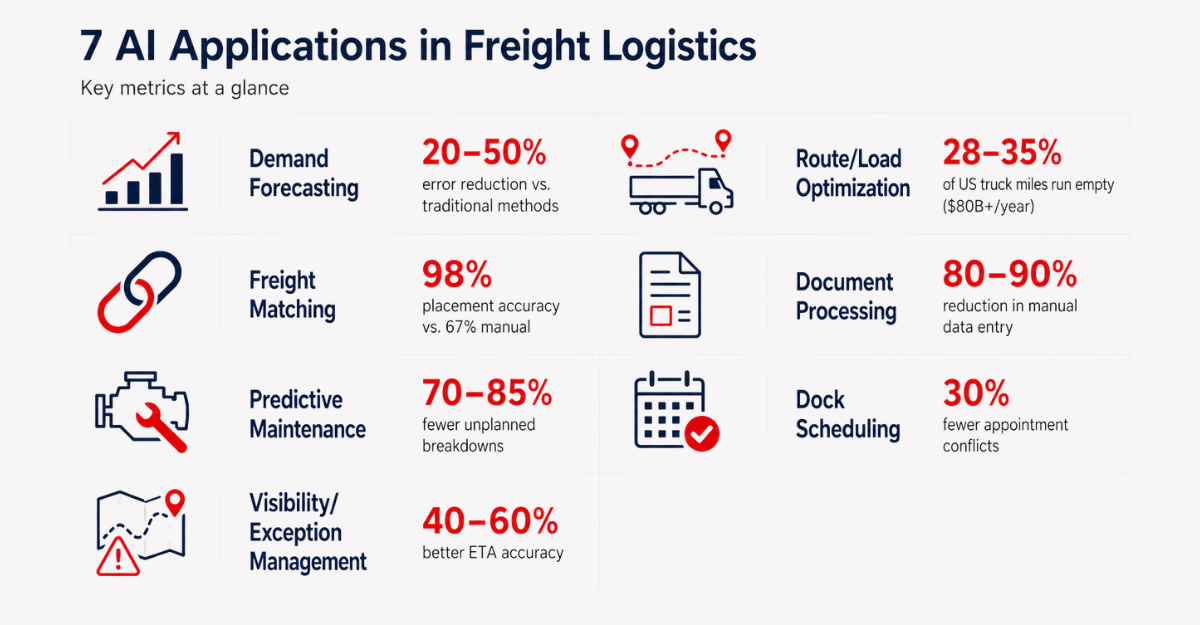
Machine learning models trained on historical shipment data, macroeconomic indicators, weather patterns, and commodity flows reduce forecasting error rates by 20 to 50 percent compared to traditional methods. The improvement is not marginal. A shipper operating a 500-lane network who improves forecast accuracy by 30 percent avoids hundreds of spot market purchases per quarter, each of which typically costs 15 to 40 percent more than contract rates.
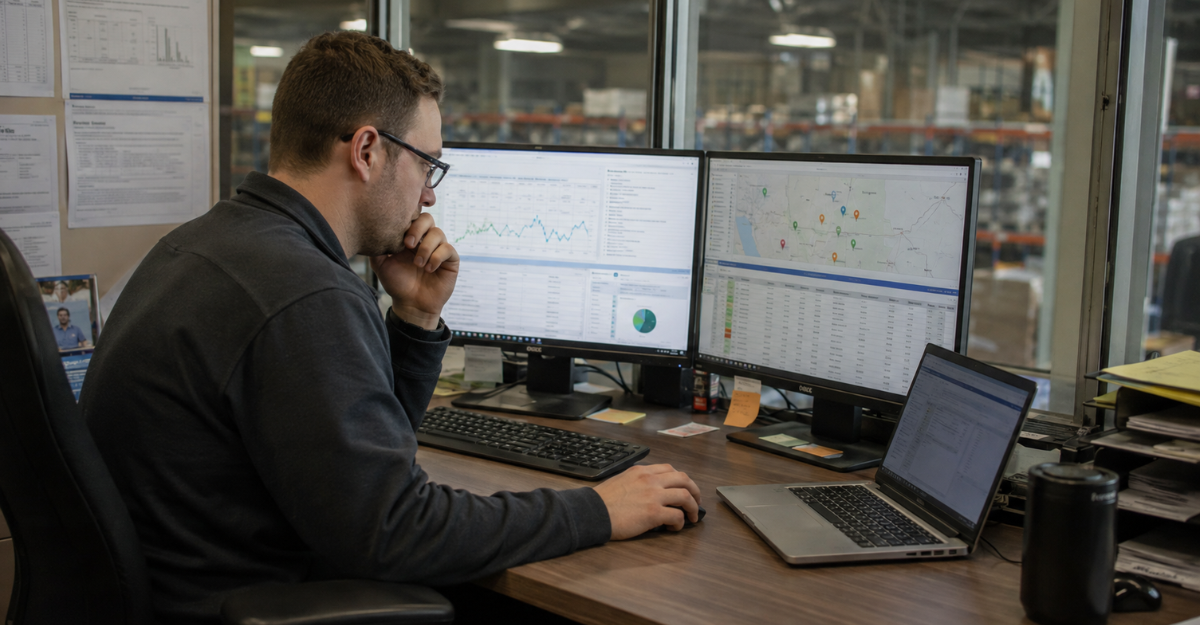
The operational benefit extends beyond cost. Better demand forecasts allow carriers to pre-position equipment, schedule drivers, and plan maintenance windows around anticipated volume. Shippers who share forecast data with their carrier partners, rather than treating volume projections as proprietary, create conditions where both sides operate more efficiently. This is one area where AI produces compounding returns: the more data the model sees across the network, the better it performs.
Route Optimization and Load Planning
Route optimization is one of the oldest applications of operations research in transportation, but machine learning has expanded what optimization engines can consider. Traditional routing software minimized distance or drive time against static constraints. Modern AI-driven systems incorporate real-time traffic, weather forecasts, construction alerts, historical delivery window compliance by facility, fuel price differentials by geography, and driver hours-of-service status to produce routes that optimize for total cost rather than shortest path.
The load planning side is where the financial impact is largest. Empty truck miles in the United States account for roughly 28 to 35 percent of total miles driven annually, representing over $80 billion per year in wasted fuel, labor, and equipment depreciation. AI load optimization platforms address this by matching available capacity against shipment demand across a carrier's entire network, identifying backhaul opportunities and multi-stop consolidation patterns that human dispatchers miss because the combinatorial math exceeds what a person can compute against a ticking clock.
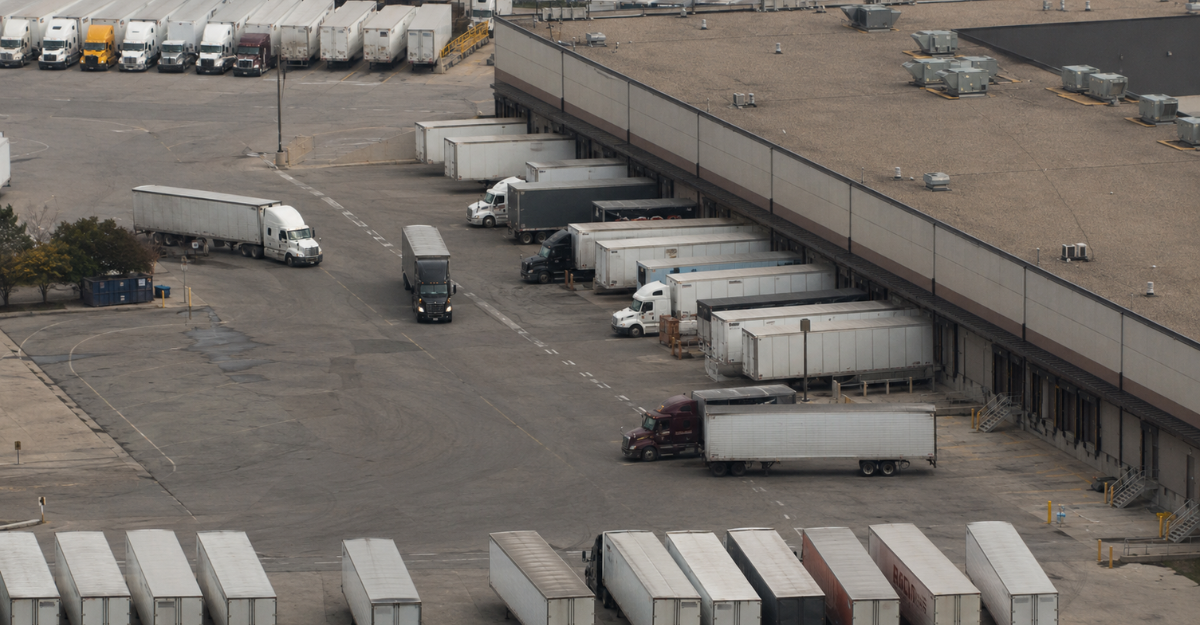
AI-powered load matching now achieves 98 percent placement accuracy in well-developed networks, compared to roughly 67 percent for manual brokerage. The digital freight matching market reached $30.56 billion in 2025 and is growing at nearly 29 percent annually, reflecting the demonstrated economic value of algorithmic capacity allocation.
Dynamic Pricing and Freight Matching
The spot freight market has always been a pricing problem: shippers need trucks, carriers have trucks, and the transaction happens under time pressure with incomplete information on both sides. AI freight matching compresses the information gap by evaluating current truck location, driver hours-of-service availability, historical lane performance, fuel costs, deadhead distance, and real-time spot rates simultaneously.
For shippers running freight procurement processes, dynamic pricing models are beginning to supplement the annual RFP cycle. Rather than locking rates for 12 months on every lane, some shippers now use AI-generated rate benchmarks to identify lanes where contract rates have drifted significantly from market conditions, triggering targeted renegotiations or mini-bids on specific corridors. The annual RFP still serves as the foundation, but AI enables continuous rate alignment on the lanes where drift costs the most.
The carrier side benefits equally. Machine learning systems that analyze historical rate data, current market conditions, and equipment positioning help carriers identify which loads to accept and which to decline based on network-level profitability rather than individual load margin. A load that looks unattractive in isolation may be highly profitable if it positions a truck for a strong backhaul.
Document Processing and Freight Audit
The freight industry runs on documents: bills of lading, rate confirmations, proof of delivery receipts, freight invoices, customs declarations, and inspection reports. Manual data entry from these documents introduces transcription errors at a rate of 1 to 4 percent per data field. At scale, those errors compound into billing disputes, audit failures, and accessorial charges that should have been caught before payment.
AI-powered optical character recognition (OCR) and natural language processing (NLP) systems now extract data from freight documents with accuracy rates that exceed manual entry, processing hundreds of documents per hour. Logistics teams that have deployed these systems report 80 to 90 percent reductions in manual data entry. The freed capacity allows freight audit teams to focus on exception investigation rather than data transcription, which is where human judgment actually adds value.
The downstream effect on freight audit is significant. When invoice data is extracted automatically and compared against contracted rates, accessorial schedules, and shipment records, billing discrepancies surface within hours rather than weeks. Shippers who audit freight invoices manually typically recover 1 to 3 percent of total freight spend through error correction. AI-assisted audit does not change the error rate, but it compresses the time to detection and increases the percentage of invoices that actually get reviewed.
Predictive Maintenance
Unplanned breakdowns are among the most expensive disruptions in freight operations. The average commercial fleet experiences 8.7 days of unplanned downtime per vehicle annually, with each breakdown event costing $3,000 to $9,000 in towing, emergency repairs, missed loads, and cascading service failures. For a 25-truck fleet, unplanned maintenance costs range from $150,000 to $450,000 per year.
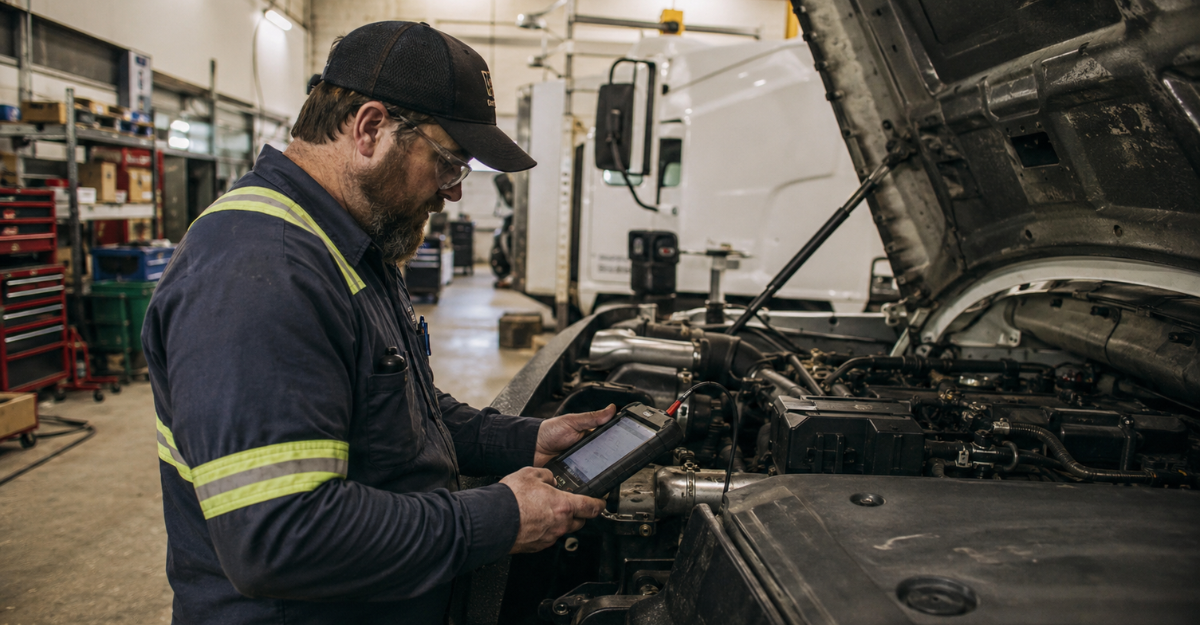
AI predictive maintenance systems analyze telematics data, engine diagnostics, historical repair records, and component-specific failure patterns to predict mechanical failures before they occur. Machine learning models now achieve 85 to 95 percent accuracy in predicting major component failures, surfacing risk 20 to 45 days before traditional diagnostic methods would raise an alarm. Fleets that have deployed these systems report 70 to 85 percent fewer unplanned breakdowns and 25 to 40 percent lower total maintenance costs.
The adoption data reveals a gap between awareness and deployment. Roughly 52 percent of fleet managers who have adopted AI predictive maintenance report measurable downtime reductions, but only 5.6 percent of fleets have deployed it broadly. The remaining 94 percent are either piloting or evaluating. Over 90 percent of 2026 commercial vehicles ship with factory-embedded telematics, which means the data infrastructure is already in place. The barrier is no longer hardware. It is the analytics layer and the organizational willingness to trust algorithmic maintenance scheduling over calendar-based or mileage-based intervals.
Dock Scheduling and Appointment Management
Detention is a symptom of scheduling failure, and scheduling failure is often a data problem. Traditional dock appointment systems operate on fixed time slots that do not account for carrier reliability patterns, commodity-specific unload times, or the cascading effects of one late arrival on every subsequent appointment.
AI-powered dock scheduling systems analyze historical arrival patterns, carrier-specific on-time rates, freight type and unload complexity, and real-time truck ETAs to dynamically allocate dock doors and appointment windows. Early deployments have reduced appointment conflicts by 30 percent and shortened average dwell times. The financial impact shows up directly in reduced detention charges and higher dock throughput per shift.
For shippers, the connection between AI dock scheduling and carrier performance management is direct. A system that learns which carriers consistently arrive within their appointment windows and which consistently arrive late provides data for carrier evaluation that goes beyond rate comparisons.
Real-Time Visibility and Exception Management
Real-time shipment tracking has become a baseline expectation rather than a differentiator, but the value of visibility data depends entirely on what happens when something deviates from plan. A GPS ping that shows a truck is behind schedule is information. An AI system that predicts the truck will miss its delivery window by 3 hours, calculates the downstream impact on the consignee's production schedule, and recommends a specific corrective action is operational intelligence.
AI-driven exception management systems now forecast ETA deviations with 40 to 60 percent greater accuracy than rule-based systems. More significantly, they can predict detention risk hours in advance and trigger dock scheduling adjustments or appointment changes before the cost clock starts running. Shippers who operationalize these alerts have reduced detention and demurrage exposure by up to 25 percent.
The operational discipline matters as much as the technology. An AI system that generates accurate exception alerts is useless if no one acts on them within the decision window. The shippers who capture the most value from AI visibility platforms are those who have defined clear escalation paths, assigned ownership for exception resolution, and built response playbooks that convert AI-generated alerts into human decisions within minutes rather than hours.
What Is Not Ready
Autonomous Trucking
Autonomous vehicle technology continues to advance, but full-scale driverless freight operations remain limited to controlled corridors and specific use cases. Regulatory frameworks vary by state, insurance models are unsettled, and the infrastructure for autonomous vehicle support (remote monitoring centers, intervention protocols, maintenance for sensor systems) is still being built. Shippers should not factor autonomous capacity into their near-term planning. The technology will affect the industry, but not on a timeline that changes 2026 or 2027 procurement decisions.
.png)
Fully Automated Brokerage
The idea of a fully automated brokerage where AI handles every aspect of freight transactions without human intervention is technically possible for simple, repetitive lanes with stable pricing. For complex freight, exception-heavy lanes, or situations requiring negotiation and relationship management, human brokers remain essential. The realistic model is augmented brokerage: AI handles the data processing, rate benchmarking, and initial carrier matching while human brokers manage exceptions, relationships, and the judgment calls that algorithms cannot make.
LLM-Powered Freight Copilots
Large language model "copilots" that can generate procurement recommendations, draft carrier communications, and explain rate anomalies in natural language are moving from pilot programs to early production deployments. The technology is promising but not yet proven at the scale and reliability level that enterprise shippers require. Shippers will likely interact with LLM-powered interfaces through their TMS platforms and carrier portals within the next 12 to 18 months, but treating them as decision-making tools rather than decision-support tools is premature.
How Shippers Should Evaluate AI Claims
When a carrier or logistics provider claims AI capability, shippers should ask specific questions that distinguish deployed systems from slide decks.
What decisions does the AI system make or recommend, and what is the measured improvement over the previous method? A provider who can cite a specific metric (15 percent reduction in empty miles, 30 percent faster exception resolution, 40 percent fewer billing errors) has deployed something real. A provider who describes capability in generalities ("our AI optimizes everything") has not.
How long has the system been in production, and how many transactions has it processed? AI systems improve with data volume and time. A model that has processed 500,000 load transactions over 18 months produces fundamentally different output than a model launched three months ago on a pilot dataset.
What data does the system require from the shipper, and how is that data protected? AI systems that produce shipper-specific insights require shipper-specific data. Understanding what data is collected, how it is stored, who has access, and whether it is used to benefit competing shippers is a legitimate procurement question. Providers with mature AI programs have clear data governance policies. Providers who cannot answer this question clearly are not ready for enterprise deployment.
Can the provider demonstrate the system's output on your actual lanes or freight profile? A proof-of-concept using the shipper's own data is worth more than any case study. Providers confident in their AI capabilities will offer this. Providers who deflect to generic demos may not have the capability they claim.
What happens when the AI is wrong? Every model produces errors. The question is whether the provider has built human oversight, confidence scoring, and fallback procedures into their operations. A provider who acknowledges model limitations and has designed around them is more trustworthy than a provider who presents their AI as infallible.
Frequently Asked Questions
How is AI being used in freight logistics operations today? AI is used in freight logistics for demand forecasting, route optimization, load matching, dynamic pricing, document processing, freight audit, predictive maintenance, dock scheduling, and real-time exception management. The most mature applications are demand forecasting and load optimization, where AI reduces forecasting errors by 20 to 50 percent and achieves 98 percent load placement accuracy compared to 67 percent for manual brokerage.
How much can AI reduce logistics costs? AI early adopters report 15 percent lower overall logistics costs. Specific applications produce targeted savings: predictive maintenance reduces total maintenance costs by 25 to 40 percent, AI freight audit recovers 1 to 3 percent of freight spend faster, and AI dock scheduling reduces detention charges by cutting appointment conflicts by 30 percent. Total cost impact depends on where AI is deployed across the shipper's operation.
Is AI replacing freight brokers? AI is augmenting freight brokerage, not replacing it. Algorithmic systems handle data processing, rate benchmarking, and initial carrier matching, while human brokers manage exceptions, carrier relationships, and complex negotiations. Fully automated brokerage works for simple, repetitive lanes but is not viable for the majority of freight that involves variability, exceptions, and judgment calls.
What should shippers ask carriers about their AI capabilities? Shippers should ask for specific metrics (measured improvements over prior methods), production deployment timelines (how long the system has been live), data volumes processed, data governance policies, and a willingness to demonstrate the system on the shipper's own freight profile. Providers who cannot answer these questions specifically may be relabeling traditional software as AI.
How does AI predictive maintenance work for trucking fleets? AI predictive maintenance analyzes telematics data, engine diagnostics, and historical repair records to predict component failures before they occur. Current models achieve 85 to 95 percent accuracy in predicting major failures, providing 20 to 45 days of advance warning. Fleets that deploy these systems report 70 to 85 percent fewer unplanned breakdowns, though broad adoption remains low at approximately 5.6 percent of fleets.
Will autonomous trucks replace human drivers in the near term? Autonomous trucking technology continues to advance but remains limited to controlled corridors and specific use cases. Regulatory frameworks, insurance models, and support infrastructure are still developing. Shippers should not factor autonomous capacity into near-term procurement planning. The driver workforce remains central to freight operations through 2026 and beyond.
other blog posts



%2520(1).webp)
%2520(1).webp)
%2520(3).webp)