A freight RFP should produce two outcomes: accurate pricing from carriers who understand your freight, and enough information for you to evaluate those carriers on criteria beyond rate. Most freight RFPs fail at one or both because they are either too vague (carriers guess at volume and lane mix, producing bids that do not reflect reality) or too rigid (carriers cannot differentiate on service, so every response looks identical and the decision collapses to cheapest price).
The difference between a good freight RFP and a bad one is specificity. A good RFP gives carriers enough data to price accurately and enough context to propose service solutions, including a clear evaluation framework so they understand what matters to you beyond rate. A bad RFP asks for a per-mile number on a spreadsheet and calls it procurement.
This guide covers how to build a freight RFP that generates bids worth evaluating, how to structure the evaluation so the decision reflects total value rather than lowest price, and the mistakes that consistently produce bad outcomes.
When to Run a Freight RFP
Not every freight procurement decision requires a formal RFP. The RFP process is appropriate when you are rebidding your full truckload or LTL program on a regular cycle (annually or every 18 to 24 months), when you are adding new lanes or new freight categories that your current carrier mix does not cover, when service failures or cost escalation have made your current carrier relationships untenable, or when organizational changes (a new distribution center, a plant closure, a shift in sourcing) have materially changed your freight profile.
For spot freight, single-lane additions, or incremental capacity needs, a full RFP is overkill. A direct conversation with your existing carriers or a targeted quote request is faster and produces better results. Running an RFP when a phone call would suffice signals to carriers that you are a high-maintenance account, which affects the rates they quote and the priority they assign you.
What to Include in the RFP
Company Overview and Context
Carriers bid differently based on who the shipper is and how their freight network fits the carrier's existing operations. A carrier that already runs trucks through your origin and destination markets can price more aggressively than one that would need to reposition equipment. Provide your company name, industry, a brief description of what you ship, your facility locations (origins and destinations), and the context for the RFP: whether this is a routine rebid, a new program, or a response to a specific problem.
Lane Data
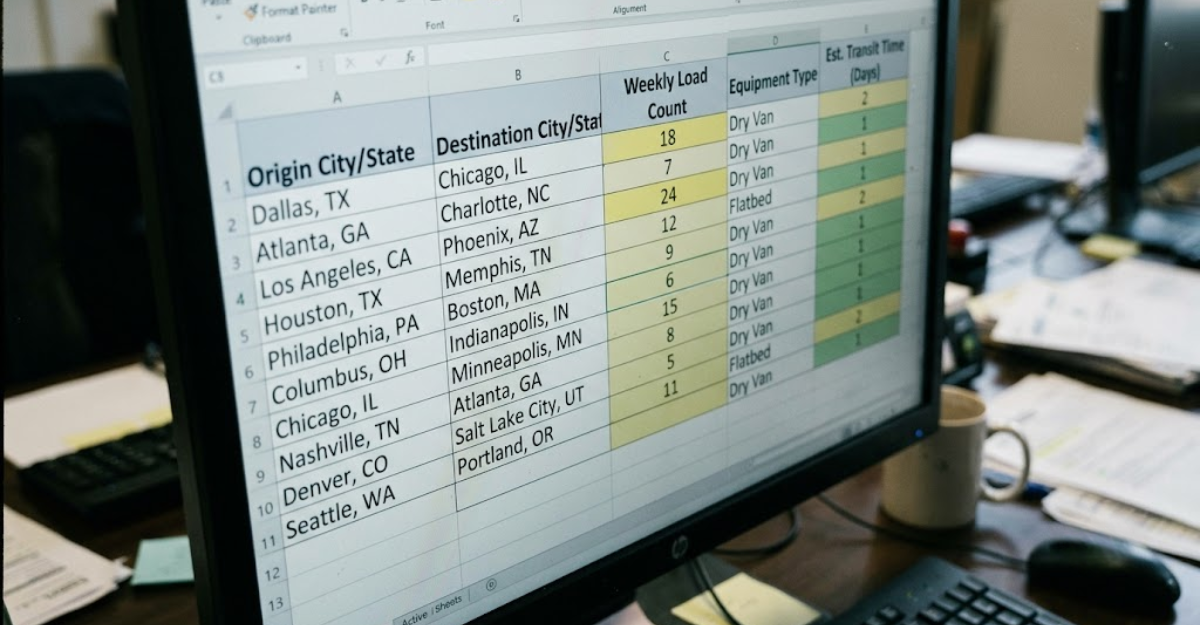
This is the core of the RFP and the section where most shippers provide too little detail. For each lane, include origin city and state (and zip code if relevant for accessorial determination), destination city and state, annual shipment volume (number of loads per week or month), average weight per shipment, required equipment type (dry van, reefer, flatbed, specialized), transit time requirement, and any special handling or accessorial requirements (liftgate, inside delivery, driver-assist unload, appointment scheduling).
If your freight is seasonal, disclose the seasonality pattern explicitly. A lane that averages 10 loads per week annually but peaks at 25 loads per week in Q4 is a fundamentally different pricing problem than a consistent 10-per-week lane. Carriers who discover the seasonality after award will either fail to cover the peak or reprice the business. Neither outcome serves you.
Service Requirements
Specify what you need beyond moving the freight from point A to point B. This includes transit time expectations (and whether they are firm or flexible), on-time delivery targets (state the percentage (95 percent, 98 percent) and how you measure it), tracking and visibility requirements (EDI 214 updates, API integration, real-time GPS, portal access), claims handling procedures and target resolution timeframes, communication expectations (who the carrier contacts for issues, escalation paths, check-call requirements), and any compliance requirements (insurance minimums, safety rating thresholds, certifications).
Pricing Structure
Tell carriers how you want them to price the business. Options include per-mile rate plus fuel surcharge (most common for truckload), flat rate per lane (origin-destination pair), percentage discount off a published tariff (common for LTL), or all-in rate inclusive of fuel.
If you use a fuel surcharge, specify the DOE reference (national or regional), the base price, and the update frequency you expect. If you want carriers to propose their own fuel surcharge schedule, say so, but require them to disclose the formula so you can compare across bids.
Specify the rate term: how long the quoted rates will be held. A 12-month commitment is standard for contract freight. Some shippers request quarterly rate reviews with adjustment mechanisms. Whatever the structure, define it in the RFP so all carriers bid against the same assumption.
Technology and Integration Requirements
In 2026, visibility and data exchange are baseline expectations, not differentiators. The RFP should specify exactly what you require: EDI transaction sets (214 for shipment status, 210 for freight invoice, 856 for advance ship notice, and 990 for load tender response are the minimum for truckload), API integration capabilities (REST APIs and webhook delivery updates if your TMS supports them), portal or platform access for manual tracking when EDI is not available, and data formatting requirements for your internal systems.
If you are evaluating carriers on technology capability (and you should be), the RFP needs to be specific enough that carriers can respond with what they actually have rather than what they think you want to hear. Ask for screenshots or demo access, and request reference contacts who actually use the carrier's technology platform daily. A carrier that claims "full visibility" but means "you can call our dispatcher and ask" is not offering the same capability as a carrier providing real-time GPS with geofence-triggered status updates.
Evaluation Criteria
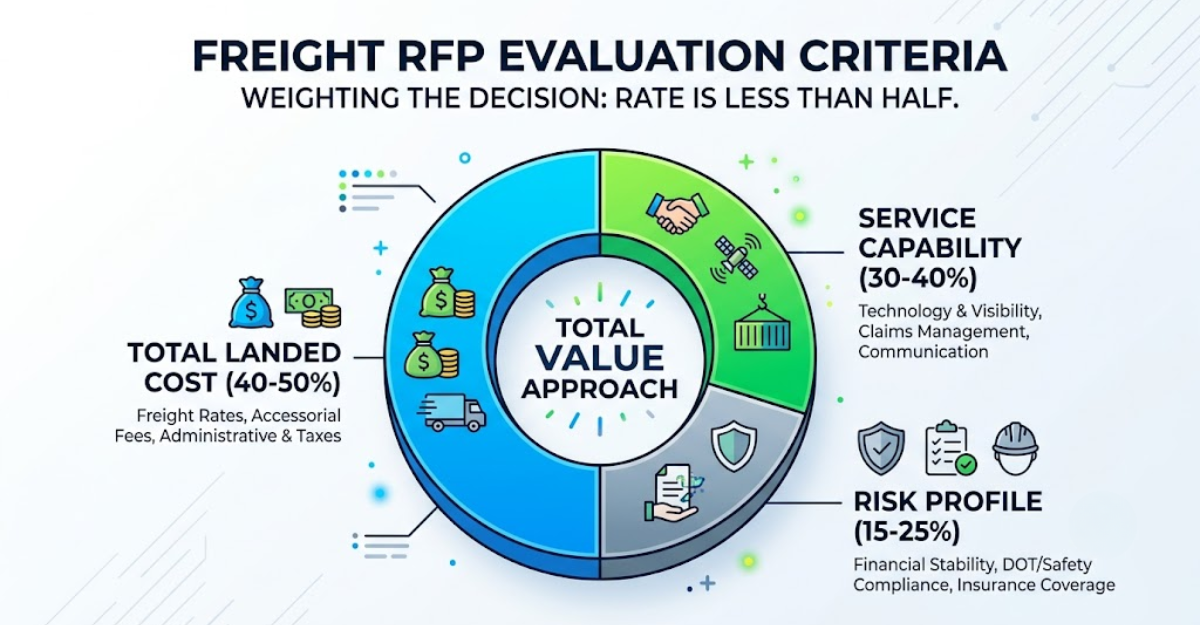
This is the section most freight RFPs omit entirely, and it costs them. If you do not tell carriers how you will evaluate their bids, they optimize for the only metric they can assume matters: price. If service capability, technology integration, or safety performance are important to you, say so and assign weights.

A defensible weighting structure for most freight RFPs:
Total landed cost: 40 to 50 percent. This is the linehaul rate plus fuel surcharge plus estimated accessorial costs plus any expected detention or delay costs based on the carrier's historical performance. Rate matters, but total landed cost — not linehaul rate — is the number that hits your P&L.
Service capability: 30 to 40 percent. Technology platform, visibility tools, claims experience, freight exception handling, communication responsiveness, and the carrier's demonstrated ability to handle your freight category.
Risk profile: 15 to 25 percent. Carrier financial stability, insurance coverage, safety scores, equipment ownership versus brokered capacity, driver retention metrics, and the carrier's ability to guarantee capacity during peak periods.
Publishing these weights in the RFP does two things: it tells carriers what you value (so they can differentiate on service rather than racing to the bottom on rate), and it forces your own procurement team to make evaluation decisions based on defined criteria rather than gut feel.
Timeline and Process
Specify the RFP timeline: when responses are due, when you will conduct carrier presentations or site visits (if applicable), when you expect to award, and when the new rates take effect. A reasonable timeline for a mid-size freight RFP is 3 to 4 weeks for bid preparation, 1 to 2 weeks for evaluation and follow-up questions, and 1 to 2 weeks for award and implementation.
Compressing this timeline, giving carriers 5 business days to respond to a complex RFP, produces rushed bids with padding built in for uncertainty. The carriers who respond fastest to an unreasonable deadline are not necessarily the carriers you want hauling your freight.
What to Avoid
Annualizing Seasonal Freight
If your freight peaks in Q4 and is minimal in Q1, do not present the annual total divided by 12 as your "average monthly volume." A carrier who bids based on 10 loads per week cannot cover 25 loads per week without spot market surcharges. Disclose the seasonal pattern so carriers can plan equipment allocation and price accordingly.
Bidding Too Many Carriers
Inviting 30 carriers to bid on your freight does not produce better outcomes than inviting 8 to 10. Most of those 30 carriers will not have network density in your lanes and will either decline to bid or submit inflated rates. The carriers who know your lanes well, because they already run trucks in those markets, will produce the most competitive and realistic bids. Pre-qualify a targeted carrier list before issuing the RFP.
Ignoring Incumbent Performance
If your current carriers are performing well, the RFP should acknowledge that. Carriers who have invested in learning your dock operations and optimizing their routes to serve your freight are not interchangeable with a new carrier offering a rate $0.05 per mile lower. The switching cost — service disruption during transition and the learning curve that comes with a new carrier relationship — is real and should be factored into the evaluation.
Making Rate the Only Decision Criterion
The cheapest carrier is the cheapest carrier for a reason. If a carrier's bid is materially below every other response, the question is not "how do we award this" but "why is this bid so low." Possible explanations include a misunderstanding of scope or a plan to broker the freight rather than haul it with owned assets. The most common explanation is that the carrier is buying the business at a loss and will seek rate increases within 6 months. A rate that is too good to be true in freight is too good to be true.
Omitting Accessorial Definitions
If your docks have a history of detention, do not bury that fact. If your deliveries require liftgate, inside delivery, or driver-assist unload, specify those requirements with expected frequency. Carriers who discover accessorial requirements after award will charge for them — often at rates higher than they would have quoted in the bid if the requirements had been disclosed.
Scoring and Comparing Bids
Build a Total Cost Model
Create a spreadsheet that calculates total annual cost per carrier per lane, incorporating linehaul rate, fuel surcharge (calculated at a consistent DOE reference price for apples-to-apples comparison), estimated accessorial costs based on your historical accessorial frequency, and estimated detention costs based on each carrier's proposed free time and detention rate.
This total cost model reveals the true cost differences between carriers. A carrier quoting $2.40 per mile linehaul with a $1.25 fuel surcharge base price and 2-hour free time before detention may be cheaper than a carrier quoting $2.30 per mile with a $1.10 base price and 1-hour free time. The fuel surcharge and detention math change the total cost ranking.
Score Service Capability Independently
Have your operations team — not your procurement team — evaluate the service capability section of each bid. The people who will interact with the carrier daily are better positioned to assess whether the carrier's technology platform and exception-handling processes will actually work in practice.
Check References on Specific Metrics
When checking carrier references, ask specific questions: what is the carrier's on-time delivery rate on comparable lanes, and has the reference shipper experienced capacity shortfalls during peak periods. "They're great to work with" tells you nothing. A specific on-time percentage on a comparable lane tells you everything.

After the Award
The RFP process does not end at award. The transition period (typically 30 to 60 days) is where the carrier relationship is established or damaged. Define a clear implementation plan that includes lane-by-lane start dates, system integration timelines (EDI setup, TMS connectivity, portal access), introductions between the carrier's operations team and your dock/logistics team, and a 90-day review checkpoint to assess early performance against the bid commitments.
The carriers who perform best over the life of a contract are the ones who were given complete information during the RFP and onboarded with the same discipline that characterized the procurement process. The cost of getting carrier selection wrong — in service failures and downstream operational disruption — exceeds the cost of running a thorough RFP by orders of magnitude.
Frequently Asked Questions
What is a freight RFP? A freight RFP (Request for Proposal) is a formal document that shippers send to carriers soliciting bids on their freight business. It specifies lane data, volumes, service requirements, equipment needs, and evaluation criteria. The RFP process allows shippers to compare carriers on a standardized basis and award business based on total value rather than rate alone.
How often should shippers run a freight RFP? Most shippers run freight RFPs annually or every 18 to 24 months for their core truckload and LTL programs. More frequent bidding can erode carrier relationships, while less frequent bidding may allow rates to drift above market. Significant operational changes (new facilities, major volume shifts, or persistent service failures) may warrant an off-cycle RFP.
What lane data should be included in a freight RFP? Each lane should include origin and destination (city, state, zip), annual or monthly shipment volume, average weight per shipment, required equipment type, transit time requirements, and any special handling or accessorial needs. Seasonal volume patterns should be disclosed separately rather than averaged into a monthly number.
How should freight RFP responses be evaluated? A balanced evaluation weights total landed cost at 40 to 50 percent, service capability (technology, visibility, claims handling, communication) at 30 to 40 percent, and risk profile (financial stability, safety scores, capacity guarantees, driver retention) at 15 to 25 percent. Publishing these weights in the RFP helps carriers differentiate on service rather than racing to the bottom on price.
How many carriers should be invited to bid? Eight to ten pre-qualified carriers is typically optimal. Inviting too many carriers produces low-quality bids from carriers without network density in your lanes. Pre-qualify by verifying that each invited carrier operates equipment in your lane markets, meets your insurance and safety requirements, and has the capacity to handle your volume.
What is the typical timeline for a freight RFP? A standard freight RFP timeline is 3 to 4 weeks for carrier bid preparation, 1 to 2 weeks for evaluation and follow-up questions, and 1 to 2 weeks for award notification and implementation planning, roughly 6 to 8 weeks total. Compressing the bid preparation window below 2 weeks typically produces rushed, padded bids.
other blog posts
%2520(5).webp)

.webp)

.webp)