
The logistics service provider market has fragmented and consolidated at the same time. There are more specialized providers than ever (niche carriers, digital freight platforms, single-mode brokerages), and there are fewer providers capable of serving as a true operational partner to an enterprise shipper. The distinction matters because what enterprise shippers need from a logistics partner has changed. Rate per mile is table stakes. The providers who earn and keep enterprise business in 2026 are the ones who combine capacity, technology, operational discipline, and accountability into a model that functions as an extension of the shipper's own supply chain team.
This is not a theoretical shift. The global third-party logistics market reached $1.3 trillion in 2026, and the transportation management system market hit $5.2 billion in the U.S. alone. Enterprise shippers are spending more on logistics services than ever, and they are becoming more sophisticated about what they expect in return. The days of selecting a provider based on a rate comparison spreadsheet are ending. Shippers who treat provider selection as a procurement exercise get procurement-quality outcomes. Shippers who treat it as a strategic partnership decision get something categorically different.
This guide covers the operating model of a modern enterprise logistics service provider, the capabilities that separate real partners from rate shops, how to evaluate providers against your specific freight profile, the KPIs that measure whether the partnership is working, and the structural decisions that determine whether the relationship scales.
What "Enterprise Logistics Service Provider" Actually Means
The term covers a range of operating models, and the differences between them are not academic. They determine what a provider can and cannot do for your freight program.
Asset-Based Carriers
An asset-based carrier owns the trucks, trailers, and terminal infrastructure it uses to move freight. The carrier employs the drivers, maintains the equipment, and controls the service execution directly. When a shipper tenders a load to an asset-based carrier, the carrier's own truck shows up.
The advantage is control. Asset-based carriers set their own service standards, manage driver performance directly, and do not depend on subcontracted capacity for their core lanes. Pricing tends to be more predictable because the carrier's cost structure is known rather than variable. When something goes wrong, there is one organization responsible for resolution, not a chain of intermediaries.

The limitation is geographic and modal scope. No single asset-based carrier covers every lane, every mode, and every service type. A carrier with 500 trucks and a southeastern U.S. network cannot serve a shipper who also needs West Coast coverage, LTL consolidation, and cross-border capability. The carrier can serve a portion of the network exceptionally well and needs to be complemented by other providers for the rest.
Freight Brokers and Asset-Light Providers
A freight broker does not own trucks. The broker arranges transportation by matching shipper loads with carrier capacity, earning a margin on the spread between the shipper's rate and the carrier's rate. Asset-light 3PLs operate similarly but may offer additional services like freight audit, TMS access, or managed transportation oversight.
The advantage is network breadth and scalability. A broker with relationships across 50,000 carriers can cover virtually any lane and scale capacity up or down without capital constraints. In volatile spot markets, brokers provide access to capacity that asset-based carriers cannot always supply from their own fleets.
The risk is accountability. When a broker subcontracts a load to a carrier the shipper has never vetted, the shipper is trusting the broker's carrier qualification process. Double brokering adds another layer of risk: the broker re-tenders the load to another broker, who tenders it to a carrier neither the shipper nor the original broker has vetted. The shipper's freight is now on a truck operated by an unknown entity, with unclear insurance and liability coverage.
Managed Transportation Providers
Managed transportation sits between transactional brokerage and full logistics outsourcing. A managed transportation provider takes ongoing operational responsibility for some or all of the shipper's freight program: carrier procurement, load planning, tendering, tracking, exception management, freight audit, and performance reporting.
The model works because most enterprise shippers do not need to own every logistics function internally. A shipper with $5 million in annual freight spend and two logistics staff members typically spends $300,000 to $600,000 per year in fully loaded internal management costs (staffing, software, broker margins, invoice leakage) before accounting for the cost of suboptimal carrier selection and missed savings opportunities. A managed transportation provider amortizes that expertise across multiple clients and invests in technology and carrier relationships at a scale that individual shippers cannot match.
Enterprise shippers adopting managed transportation report freight cost reductions of 15 to 25 percent through consolidated carrier negotiation, automated rate shopping, and invoice audit recovery. The savings come not from a single dramatic improvement but from systematic elimination of the small inefficiencies that compound across thousands of shipments.
The Hybrid Model
The most capable enterprise logistics providers operate a hybrid model: they own assets for the lanes and services where asset control matters most, maintain brokerage and carrier networks for geographic and modal coverage beyond their fleet, and provide managed transportation services that tie both capacity sources together under a single operational framework. At Revolution, we operate exactly this model. We are an asset-based logistics service provider with our own fleet, but we also maintain a vetted network of over 5,000 carriers, giving us the control of an asset-based operation with the reach and flexibility of a managed network across truckload, LTL, air, ocean, and rail.
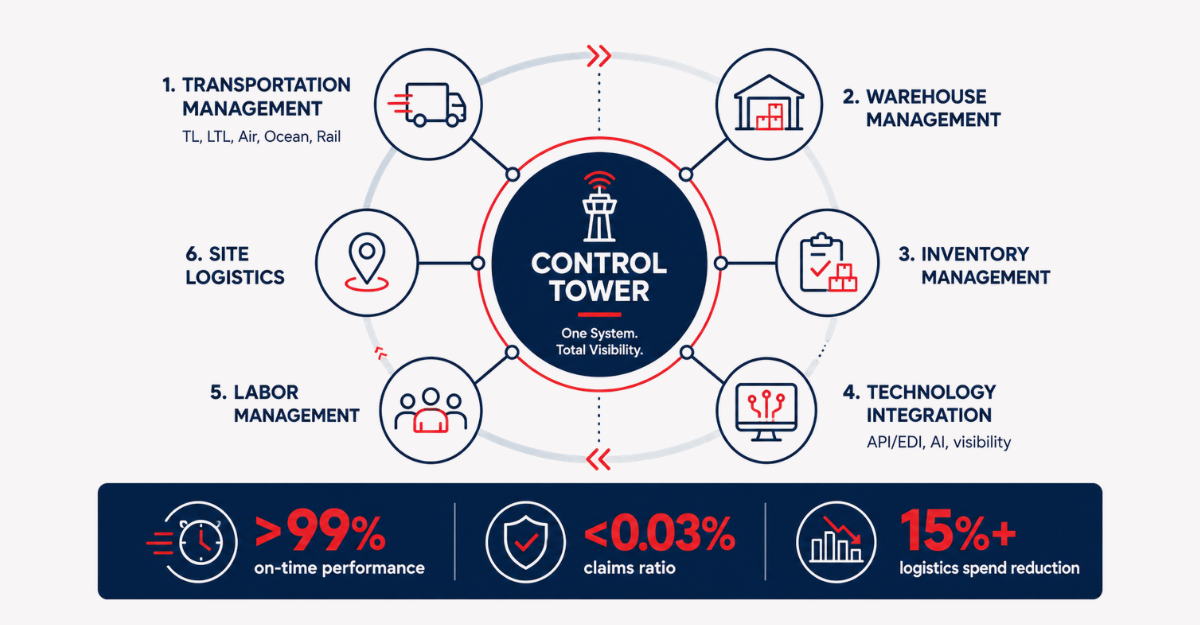
The hybrid model matters because the enterprise freight program does not fit neatly into one provider category. It requires an integrated operational partner that deploys the right capacity type for each shipment within a unified management structure. The provider's own trucks handle the lanes where control and consistency are paramount. The managed carrier network extends coverage to every origin-destination pair the shipper needs. And the technology platform, control tower, and account management layer tie everything together so the shipper experiences one operating model, not a patchwork of subcontractors.
The Capabilities That Matter
Technology Platform and Visibility
A logistics provider's technology platform is the operating system of the partnership. At minimum, enterprise shippers should expect real-time shipment tracking across all modes, automated status updates and exception alerts, a shipper-facing portal for load tendering, document access, and reporting, electronic bill of lading and proof of delivery management, and integration with the shipper's ERP, WMS, or procurement systems.
The concept that has gained the most traction is the "single pane of glass": a cloud-based, device-agnostic platform where every stakeholder sees the same data in real time. The best implementations go beyond visibility. They include API and EDI integration to the shipper's existing systems (ERP, WMS, procurement), AI-enabled pricing and routing, SOC 2 compliant data infrastructure, centralized document repositories, and standard dashboards alongside ad hoc reporting capabilities. Our own platform operates on this model, connecting 15 service lines and over 5,000 carriers through a single sign-on interface with real-time tracking and shipment data accessible to every stakeholder.
The supply chain control tower market reached $8.75 billion in 2026 because shippers have recognized that visibility without action is just data. The providers who deliver value are those whose technology does not just show where freight is but predicts when something is about to go wrong and triggers a response before the cost accrues. AI-driven logistics operations are accelerating this shift, with predictive ETA accuracy improving 40 to 60 percent over rule-based systems and detention exposure declining by up to 25 percent for shippers who operationalize exception alerts.
Carrier Network Depth and Quality
The size of a provider's carrier network is less important than its quality. A provider with 10,000 carriers in a database and no systematic performance management is less valuable than a provider with 2,000 vetted carriers who are monitored on on-time delivery, claims ratio, safety compliance, and communication responsiveness.
Enterprise shippers should ask how the provider qualifies carriers (insurance verification, DOT safety ratings, FMCSA authority status, cargo theft screening), how frequently qualifications are re-verified, and what happens when a carrier underperforms. A provider who can answer these questions with specific processes and metrics has built a managed network. A provider who cites carrier count has built a list.
Operational Responsiveness
Freight does not break between 9 a.m. and 5 p.m. on weekdays. Equipment failures, weather disruptions, dock delays, and after-hours emergencies require a provider who maintains operational coverage that matches the shipper's shipping schedule. For enterprise shippers with multi-shift operations, 24/7 coverage is not a premium feature. It is a baseline requirement.
The operational structure behind that coverage matters as much as the hours. The best enterprise providers operate a control tower model: a centralized team that manages customer service, carrier coordination, and freight execution under a single operating framework. The control tower processes orders, schedules appointments, dispatches trucks, manages carrier performance, resolves issues, and handles freight bill audit. At Revolution, our control tower operates 24/7/365 with dedicated account teams, dedicated phone and email lines, and integrated reporting and analytics. Every client has a named account manager and a team that knows their freight, their facilities, and their tolerances.

The test of operational responsiveness is not what happens during normal operations. Normal operations are easy. The test is what happens during the first 15 minutes of a freight exception: how fast the provider identifies the problem, who contacts the shipper, what alternatives are presented, and how quickly the corrective action executes. A provider's exception management process reveals more about their operational quality than any capabilities presentation.
Mode and Service Flexibility
Enterprise freight programs rarely consist of a single mode or service type. A shipper who moves truckload freight also moves LTL, intermodal, flatbed, expedited, white glove, temperature-controlled, and drayage. Managing each mode through a separate provider creates coordination gaps, data silos, and accountability fragmentation.
A provider who can manage multiple modes under a single operational umbrella eliminates the coordination tax. One point of contact for routing decisions, one platform for visibility, one invoice stream for freight audit, and one performance scorecard that covers the entire freight program. The operational simplification alone often justifies consolidating providers, even before accounting for the volume-based rate improvements that consolidation enables.
The most complete enterprise providers extend beyond transportation into warehouse management, inventory management, and labor coordination. These functions are not separate service lines bolted onto a trucking operation. They are integrated into the same operating system. When warehouse staging, inventory tracking, and transportation scheduling share a single data layer, the provider can coordinate material flow from supplier to final destination without the handoff gaps that create delays. Revolution operates this way: transportation, warehousing, inventory, and site logistics all run through one end-to-end management platform, so a shipment's status is visible from purchase order through final delivery without switching between systems or providers.
Industry and Freight Expertise
General logistics competence is necessary but not sufficient. A provider who handles consumer goods, electronics, manufacturing components, high-tech and data center equipment, and mission-critical freight understands that each category has different handling requirements, regulatory constraints, and failure costs.
Enterprise shippers should evaluate whether a provider has direct experience with their specific commodity type, understands the compliance and documentation requirements for their industry, and can demonstrate past performance on freight profiles similar to theirs. A provider who handles everything handles nothing particularly well. A provider who has depth in your freight category brings institutional knowledge that prevents the mistakes a generalist would make.

Construction logistics illustrates the difference between general capability and vertical expertise. Jobsite deliveries involve limited laydown space, crane scheduling dependencies, multiple trades competing for delivery windows, and a project timeline where a single missed delivery can idle crews and cascade delays across the schedule at $10,000 to $50,000 per day in lost productivity. A general-purpose carrier treats a jobsite like any other delivery point. A provider with construction depth understands that the delivery is part of a sequenced build plan and coordinates accordingly. Revolution's construction vertical accounts for over 40 percent of our business, with multi-phase delivery programs for data centers, manufacturing plants, stadiums, and infrastructure projects across North America. That concentration produces institutional knowledge that a diversified generalist cannot replicate.
How to Evaluate Providers
Start with Your Freight Profile, Not the Provider's Capabilities Deck
The evaluation process should begin with a thorough understanding of your own freight program: annual spend by mode, lane density map, shipment frequency and volume patterns, seasonal peaks, service requirements (transit time, appointment delivery, specialized equipment), and pain points with current providers.
A provider evaluation that starts with "tell me what you can do" produces a generic capabilities pitch. An evaluation that starts with "here is my freight profile, show me specifically how you would handle it" produces answers that reveal whether the provider's operating model fits your needs.
Run a Structured RFP
A formal freight RFP with specific lane data, volume projections, service requirements, and evaluation criteria weighted toward total cost and service quality produces comparable responses across providers. The RFP process also tests provider responsiveness and attention to detail before the contract starts. A provider who submits a sloppy RFP response will deliver sloppy operational execution.
Evaluate Total Cost, Not Rate Per Mile
The true cost of service includes the base transportation rate, fuel surcharges, accessorial charges, detention and demurrage fees, claims costs from damage or loss, administrative overhead for managing the provider relationship, and the cost of service failures (missed deliveries, production line shutdowns, customer penalties).
A provider who quotes $2.10 per mile but generates $50,000 per year in detention charges, claims, and service recovery costs is more expensive than a provider who quotes $2.25 per mile and generates none of those ancillary costs. Enterprise shippers who evaluate providers on base rate alone routinely select the provider who costs more on a total basis.
Ask About Implementation Complexity
One of the most overlooked evaluation criteria is what it takes to get started. Some providers require months of onboarding: system integration projects, data migration, parallel operations, and dedicated IT resources from the shipper's side. Others have built their infrastructure and carrier networks in advance so implementation is measured in hours rather than months.
The right question is: what does the shipper need to invest before seeing results? A provider who requires no upfront capital, no recurring platform fees, and no disruption to existing operations has made those investments on their own. The infrastructure and network are already in place. The shipper's implementation cost is effectively time spent on knowledge transfer about their freight profile, facilities, and service requirements. Typical results from a well-structured onboarding include 15 percent or greater reduction in logistics spend, 10 percent or greater improvement in service performance, and an 80 percent reduction in the email volume and administrative overhead associated with freight management.
Check References on Freight That Looks Like Yours
Provider references are most valuable when the reference shipper's freight profile resembles yours. A provider who delivers excellent service on high-volume, predictable consumer goods lanes may perform differently on low-volume, high-value, time-definite shipments. Ask for references from shippers in your industry, with similar volume, on similar lanes.

KPIs That Measure Partnership Performance
Once the partnership is operational, ongoing performance measurement ensures that the value proposition holds. The metrics that matter for enterprise logistics partnerships go beyond on-time delivery.
On-time pickup and delivery. The baseline metric. Industry benchmark is 95 percent or higher. Measure against the agreed service standard (appointment window, transit day), not the provider's internal target. The best providers exceed this threshold significantly. Revolution maintains an on-time performance rate above 99 percent across all modes because our control tower catches and corrects deviations before they become service failures.
Claims ratio. Freight damage and loss claims as a percentage of total shipments. Industry acceptable range is 1 to 3 percent. A provider consistently above 2 percent has a cargo handling or carrier qualification problem. The target should be well below 1 percent. Our claims ratio runs below 0.03 percent, a figure that reflects both the quality of our carrier network and the rigor of our cargo handling and securement standards.
Tender acceptance rate. The percentage of tendered loads the provider accepts. A provider with a 98 percent tender acceptance rate during contract periods but a 70 percent rate during peak seasons has a capacity problem that will push the shipper into expensive spot market alternatives.
Invoice accuracy. The percentage of freight invoices that match the contracted or quoted rate without requiring dispute or adjustment. Low invoice accuracy creates administrative cost and erodes trust. Target 98 percent or higher.
Exception response time. How quickly the provider identifies, communicates, and resolves freight exceptions. Measure in minutes from exception detection to shipper notification and from notification to corrective action execution. The first 15 minutes determine the outcome.
Cost per shipment trend. Track total cost per shipment (including accessorials, detention, and claims) over time. A good provider partnership should produce a declining cost trend as the provider learns the shipper's network, optimizes carrier assignments, and eliminates recurring failure points.
Structuring the Partnership to Scale
Single Provider vs. Multi-Provider Strategy
The debate between consolidating freight with a single provider versus diversifying across multiple providers is a risk management decision, not a procurement preference.
A single-provider strategy offers operational simplicity, volume-based pricing power, and deeper institutional knowledge of the shipper's freight program. But it creates concentration risk. If the provider fails during a peak period, has a technology outage, or exits a service area, the shipper has no fallback.
A multi-provider strategy distributes risk across providers and creates competitive tension that keeps pricing honest. But it adds coordination complexity, fragments data and visibility, and prevents any single provider from developing the deep network knowledge that produces compounding efficiency gains.
McKinsey estimates that companies lose 42 percent of one year's EBITDA to supply chain disruptions over a decade. The practical answer for most enterprise shippers is a core-provider model: one primary provider who handles 60 to 70 percent of volume and has deep integration with the shipper's operations, supplemented by one or two secondary providers who cover specific lanes, modes, or contingency capacity. This structure captures the benefits of consolidation while maintaining supply chain resilience.
Contract Structure
Enterprise logistics contracts should balance commitment with flexibility. Fixed-rate commitments on high-volume lanes provide pricing certainty and ensure carrier capacity allocation. Variable or index-based pricing on volatile lanes prevents both parties from being locked into rates that diverge from market conditions. Clear accessorial schedules, fuel surcharge formulas, and service-level agreements with measurable penalties and incentives create accountability.
Contract length matters. A 12-month contract with a 90-day termination clause gives both parties enough time to invest in the relationship without trapping either side in a partnership that is not working. Multi-year contracts can be appropriate when they include annual rate reviews and performance-based renewal terms.
Integration and Communication Cadence
The operational integration between shipper and provider determines the ceiling on what the partnership can achieve. At minimum, this includes a shared technology platform for load tendering, tracking, and document management, weekly or biweekly operational calls to review exceptions and performance trends, monthly or quarterly business reviews with leadership participation from both sides, and an annual strategic planning session that aligns the freight program with the shipper's business growth trajectory.

The shippers who capture the most value from their logistics partnerships are those who treat the provider as part of their operations team, sharing demand forecasts, facility changes, product launch schedules, and market condition intelligence that helps the provider plan capacity and anticipate service requirements.
Frequently Asked Questions
What is an enterprise logistics service provider? An enterprise logistics service provider is a company that manages freight transportation, warehousing, or supply chain operations for large-volume shippers. The term covers asset-based carriers, freight brokers, third-party logistics companies (3PLs), and managed transportation providers. The most capable enterprise providers combine owned assets, brokered capacity, and technology platforms under a single operational framework to manage multi-mode freight programs.
What is the difference between a 3PL and a 4PL? A 3PL handles physical logistics execution (moving, storing, and distributing freight). A 4PL manages the shipper's entire logistics function, including selecting and managing 3PLs, operating the technology platform, and providing strategic supply chain oversight. A 3PL moves freight. A 4PL manages the freight program. Many enterprise logistics providers now operate along this spectrum rather than fitting neatly into one category.
How much does managed transportation save? Enterprise shippers adopting managed transportation report freight cost reductions of 15 to 25 percent. Savings come from consolidated carrier negotiation, automated rate shopping, freight audit and invoice recovery (typically 1 to 3 percent of spend), and elimination of internal staffing and technology costs that can reach $300,000 to $600,000 annually for mid-size freight programs. Actual savings depend on the shipper's baseline efficiency and freight profile.
Should I use one logistics provider or multiple providers? Most enterprise shippers benefit from a core-provider model: one primary provider handling 60 to 70 percent of freight volume with deep operational integration, supplemented by one or two secondary providers for specific lanes, modes, or contingency capacity. This structure balances the efficiency gains of consolidation against the risk of single-provider dependency. Companies lose an estimated 42 percent of one year's EBITDA to supply chain disruptions over a decade, making provider diversification a risk management priority.
What KPIs should I track for my logistics provider? The essential metrics are on-time pickup and delivery (benchmark: 95 percent or higher), claims ratio (target: below 2 percent), tender acceptance rate (reveals capacity reliability during peak periods), invoice accuracy (target: 98 percent or higher), exception response time (measured in minutes from detection to resolution), and cost per shipment trend over time. Track these monthly with a formal quarterly business review.
How do I evaluate whether my logistics provider is an asset-based carrier or a broker? Ask directly: does the provider own the trucks that will haul your freight, or does the provider arrange capacity through third-party carriers? Asset-based carriers provide direct control and pricing predictability but have geographic and capacity limitations. Brokers provide network breadth and scalability but introduce subcontracting risk. Many modern providers operate hybrid models with both owned assets and brokered capacity. The key question is what percentage of your freight moves on the provider's own equipment versus subcontracted trucks, and how the provider vets and monitors its carrier network.
other blog posts


%2520(3).webp)
%2520(1).webp)